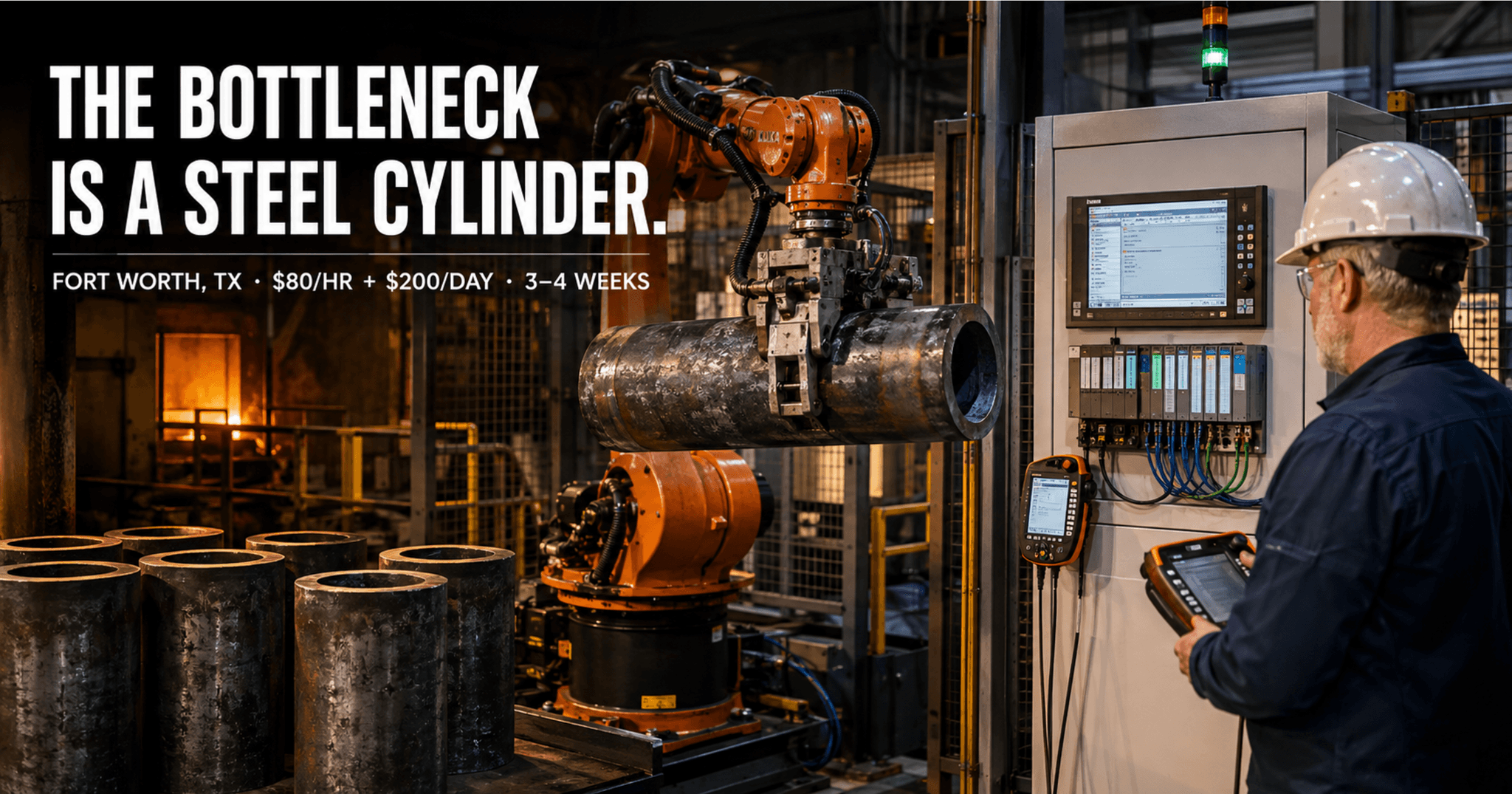

An hourly contract is open in Fort Worth, Texas for a senior robot programmer with KUKA KRC4–KRC5 experience, handling cylindrical steel forged parts on a defense-industry assembly application. The robot must be interfaced with a Siemens PLC, and it sits on an RTU that is already configured. It runs three to four weeks, starts August 10, 2026 or sooner, and pays $80.00 per hour plus a $200.00 daily per diem. There is one opening, and it requires US citizenship or a Green Card. You can apply for it here.
That is the whole assignment. What follows is why this particular kind of work — unglamorous material handling of plain steel cylinders — has quietly become one of the more consequential jobs in American manufacturing.
The bottleneck nobody expected
For three years the United States has been trying to increase artillery ammunition production. The target was widely reported: 100,000 155mm rounds per month. The money arrived. The contracts were signed. The political will was there.
The rounds were not.
As of March 2026, actual output was running around 36,000 rounds a month — roughly a third of the goal. And the reason is not what most people assume. It is not the explosive fill. It is not the fuzes. It is not a shortage of engineers or a lack of appropriation.
It is the steel.
Reporting on the shortfall has identified projectile metal parts production as the limiting factor for the entire program. With only three facilities producing those parts, projections put achievable output well short of the stated goal. The Army has been working to expand and accelerate that capacity for some time.
A 155mm projectile body is, in engineering terms, a hollow forged steel cylinder held to tight dimensional and metallurgical tolerances. It is not exotic. It is not new. And it turns out to be the hardest thing in the entire chain to make quickly, at volume, consistently.
Which means the constraint on American artillery output is, at this moment, a materials-handling and forging problem. That is a sentence worth sitting with, because it reframes what a robot programmer working on cylindrical forged parts is actually contributing to.
Why forged parts are hard to automate
Anyone who has automated a plastic injection line and then walked into a forge understands the difference immediately.
Forged steel parts are heavy. They arrive with scale on them. Their surfaces vary from piece to piece in ways that injection-molded or stamped parts do not. They are frequently still hot. They deform machinery over time. Grippers wear. Fixtures drift. A vision reference that worked perfectly on Monday may struggle on Thursday because the parts came off a different die.
Handling them reliably at production rate is not a matter of teaching points and walking away. It requires a programmer who understands what the part is going to do across thousands of cycles — and who can build tolerance for that variation into the program rather than assuming it away.
That skill set is precisely what a contract like this one is buying.
The other half: KUKA on one side, Siemens on the other
The scope for this contract carries a detail that experienced controls people will notice immediately. The KUKA robot has to be interfaced with a Siemens PLC, and it sits on an RTU that is already configured.
Read that carefully, because it defines the work.
The foundation is set. Nobody is asking the contractor to design a cell from a blank sheet or to stand up the remote terminal unit. The task is integration in the strict sense: making a KUKA controller and a Siemens PLC exchange signals correctly, reliably, and in a way that survives a production environment.
That sounds narrower than a full build. In practice it is often harder, because the seams between two vendors' ecosystems are where the ambiguity lives. KUKA has its own way of thinking about I/O, safety, and program structure. Siemens has another. Most engineers are genuinely strong on one side and merely conversant on the other — and the industry has a habit of solving that by putting two people on the problem and letting them negotiate.
One person who holds both sides at once is a much shorter list. It is also why the rate on a three-to-four-week contract reads the way it does.
The trade behind the clearance
Defense manufacturing carries a requirement that commercial work usually does not: this contract requires US citizenship or a Green Card. That is standard for the sector and it is stated plainly here so nobody spends time on an application that cannot proceed.
What that requirement also signals is a structural feature of defense work worth understanding. The pool of professionals who are simultaneously senior on a specific robot platform, genuinely capable across a second vendor's controls, and eligible to work on defense programs is small. It does not expand quickly, because none of those three things can be acquired in a hurry.
We wrote more about that dynamic in Defense and Military Manufacturing Automation: Careers Behind the Security Clearance, and the short version holds here: eligibility is not a formality in this sector, it is part of the scarcity.
Fort Worth is a reasonable place for this work to land. North Texas carries a deep aerospace and defense manufacturing base, a skilled machining and forging workforce, and the supplier density that comes with decades of the industry being there.
The contract
- Role: Senior Robot Programmer
- Location: Fort Worth, Texas
- Platform: KUKA KRC4–KRC5, interfaced to a Siemens PLC
- Application: Material handling — assembly for the defense industry
- Scope of work: Material handling of cylindrical steel forged parts; the RTU is already configured
- Start date: August 10, 2026 — or sooner
- Duration: 3–4 weeks
- Shift: Days
- Schedule: 8 hours per day, 5 days per week
- Rate: $80.00 per hour, plus $200.00 per day per diem
- Openings: 1
- Eligibility: US citizen or Green Card required
Apply for the Fort Worth KUKA robot programmer contract.
Where the skills come from
If you are building toward this kind of work rather than already doing it, the two vendor training paths are the obvious starting points. KUKA runs structured robot programming training through KUKA College, and Siemens runs SITRAIN for its automation and PLC platforms. The integration skill — the part that actually commands the rate — tends to be built on the floor rather than in a classroom, but the platform fundamentals are not optional and the certifications travel well.
For the broader control-systems credential, the International Society of Automation's certification programs are the recognised standard. On the safety side, OSHA's control-of-hazardous-energy material is the baseline every plant expects you to already know. For the wider industry picture week to week, Automation World covers the manufacturing-technology side of exactly this shift.
A note for the companies reading this
If you run a plant and you have a four-week specialist gap, the conventional route — open a requisition, engage a recruiter, absorb a placement fee, wait — frequently costs more calendar than the work itself takes.
Automate America is a global marketplace for skilled professionals — industrial, commercial and residential work, anywhere in the world, from emergency call-outs and short contracts through to year-long engagements. Onsite, remote and hybrid.
There are two ways customers staff work here, and both are free. You can post a contract, a direct job or an RFQ and see profiles of experienced professionals with completed contracts and customer reviews. Or you can skip the waiting entirely and search the marketplace and request a specific professional directly. It is free to post, free to apply and free to hire, and you post at the rate you want to pay.
If you would rather browse first, every open hourly contract is listed here, and you can also find and follow customers posting work in your region.
The part worth remembering
The public conversation about defense manufacturing is dominated by things that photograph well — fighters, submarines, hypersonics. The actual constraint, right now, is a hollow steel cylinder that has to be forged, handled, and assembled to tolerance, hundreds of thousands of times.
Somebody has to make the machine that moves it work properly. For three or four weeks in Fort Worth, Texas, starting August 10, that somebody gets paid $80 an hour plus $200 a day to do it.
At some point, choosing which problems you put your hands on stops being a job search and starts being a record of what you were willing to work on.
Frequently asked questions
What does the Fort Worth KUKA robot programmer contract pay?
The contract pays $80.00 per hour plus a $200.00 daily per diem. It runs 8 hours per day, 5 days per week on a days shift, for a duration of 3 to 4 weeks.
What experience is required for this KUKA robot programmer contract?
Senior-level KUKA robot programming on KRC4 through KRC5 controllers, applied to material handling of cylindrical steel forged parts. The role also requires interfacing the robot with a Siemens PLC. The RTU is already configured. US citizenship or a Green Card is required because the work is defense-industry assembly.
When does the contract start and how long does it run?
It starts August 10, 2026, or sooner if the professional is available, and runs 3 to 4 weeks. There is one opening.
Does it cost anything to apply or to post a contract on Automate America?
No. Applying is free for professionals, and posting a contract, direct job or RFQ is free for companies. There is no placement fee — Automate America is a marketplace.
Related occupations: PLC Programmer · Controls Engineer · Automation Engineer
Next steps on Automate America
- Post your work free — Set the rate you want to pay. Posting and receiving applicants cost nothing.
- Create your free profile — Your completed work, platforms and reviews in one record that customers search.
- Search open contracts — Every open contract and what it pays, updated as they post.
- Find professionals — Search thousands of professionals by skill, platform and location.
- Training and certification — Build the skills the contracts above are actually asking for.
Explore more
- Browse every open contract
- Find skilled professionals
- See the companies hiring
- Work by occupation
- Training programs
- More from the Automate America blog


Email the editor · Text Automate America today: 586-770-8083
Tony Wallace
Co-Founder, Automate America