Twenty-six contracts, eighty-two openings, and one number nobody writes down
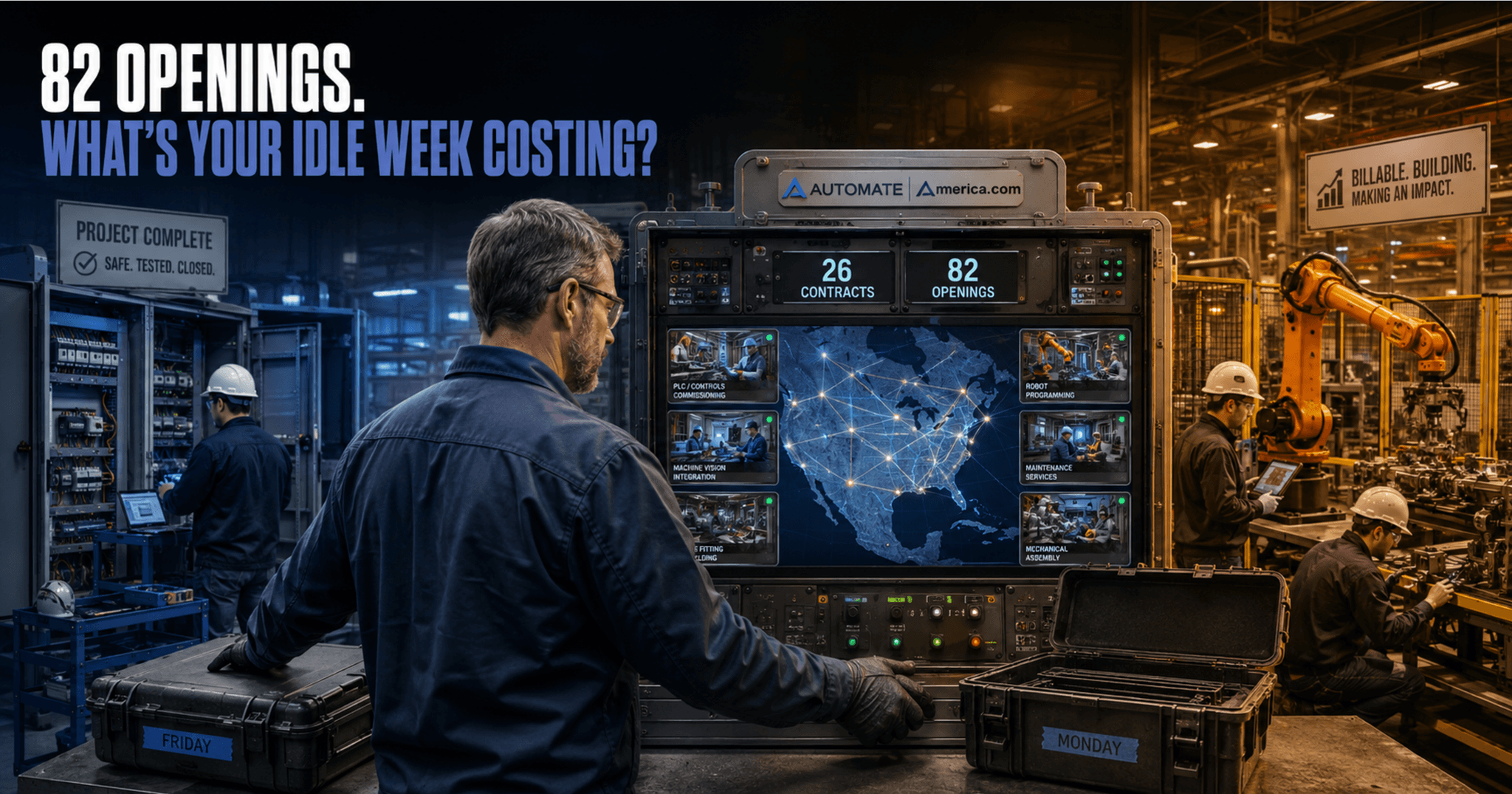
As of this morning there are 26 contracts open on Automate America, carrying 82 openings between them. They sit in 10 US states and 2 countries. Each one shows the rate the company posted before anyone applies, and eight of the twenty-six carry paid expenses as well as the rate — four of those include a per diem for each day on site, and seven pay travel time.
The trades open today are a fair snapshot of what industry is short of this week, and the board already reaches past one country: nine PLC programmer postings, six robot programmers, four controls engineers, two vision systems engineers, a senior automation engineer, maintenance technicians, pipe fitters, and a mechanical builder.
That is the board. Now the part that matters more than the board.
The most expensive week of your year has no line on the invoice
Ask anyone who runs a service company or an engineering firm what their real number is, and it will not be their bill rate. It is the week an excellent engineer rolls off a project and there is nothing to bill against. Payroll runs anyway. The person is not idle because they are not good — they are idle because the calendar did not line up.
That week never appears in a report. It is simply absorbed, quarter after quarter, and it is usually the difference between a good year and a flat one.
Eighty-two openings are sitting on the board right now, and they are community projects. A service partner can apply their available professionals directly to them. The engineer who came free on Friday is on somebody else's contract on Monday, at a rate the firm agreed to, with timesheets, invoicing and payment handled. Fewer layoffs in the slow months, and the people you spent years training are still on your payroll when the work comes back.
It runs just as usefully in the other direction. When the work outruns the payroll, a firm can take a contract larger than its own headcount and bring the extra hands in from the same marketplace — bidding jobs it would otherwise decline, without hiring for a peak that ends. And the same lever keeps your own people off the road: bring in someone local for out-of-town service instead of putting a senior engineer on a plane for six weeks.
That pool — the available professionals inside member companies — is a labour market that exists nowhere else. It is the part of this that is structural rather than merely convenient.
A network, not a company
It is worth being plain about what this is, because it is easy to mistake it for a vendor selling access to people.
A barn raising works because everybody who turns up knows two things: what needs lifting, and who is free to lift it. Nobody is in charge of that and nobody is selling anything. The only requirement is that both facts are in the open where the neighbours can see them.
That is the whole mechanic here. Members post the work they have. Members post the availability they have. Everyone sees the same board. Some of us post work, some of us take it, and most of us do both depending on the month. A network of professionals and firms sharing opportunities and availability is a more accurate description of Automate America than anything with the word “platform” in it.
Why the work and the people used to miss each other
None of this was ever a failure of effort. It was a failure of plumbing.
Specialist labour has been hard to find because the market is fragmented on both sides. On one side, the middlemen keep their networks private, because that privacy is precisely what they bill for. On the other, a large manufacturer may only use approved suppliers — accounts payable cannot onboard and pay thousands of vendors, most small firms would never clear the vendor requirements, and an independent contractor has no practical way to invoice an international manufacturer. So a qualified professional and an open contract can sit ten miles apart and never learn the other exists.
An open marketplace fixes that by holding all the work and all the people in one place, reached through a single approved supplier. A customer clears one vendor and reaches thousands of professionals. A small firm or an independent reaches work that used to be structurally out of range. That is the design, and it is why the board can carry 82 openings in ten states on an ordinary Friday.
What it costs, and who sets the number
It is free to post, free to apply and free to hire. The customer posts at the rate they want to pay — no negotiating, nobody bid down, and no margin buried in the number that nobody shows you. Trusted professionals, with ratings, reviews and endorsements, apply directly and often within minutes, and boots can be on the ground in as little as a day. You can also skip posting entirely and search the marketplace and request a specific professional.
And we carry the marketing and the sales effort. The work you post gets written, designed, published and pushed across our channels — this article being a working example of it.
One vendor, thousands of professionals
Everything above only works because of a piece of plumbing almost nobody advertises, so it is worth saying plainly: both sides do business with Automate America.
If you are the customer, you are billed by an established global company that already knows how onboarding, accounts payable and accounts receivable actually work at hundreds of large international manufacturers. One approved supplier to clear. One bill. One set of paperwork — instead of standing up ten different 1099 independents and service companies as vendors and paying each of them separately.
If you are the professional or the service partner, the same fact reads from the other side: you never have to become an approved supplier at any of those corporations. No vendor registration packet at each one, no working out how a particular multinational wants to be invoiced, no thirty-day chase. We handle that. You are paid by Automate America, on time, and you never send us an invoice at all — it generates itself from your approved timesheets and expense reports.
The work and the people were always out there. What kept them apart was paperwork neither side could reasonably carry. Take that away and contracting becomes easy, which is what makes a professional gig economy possible in industrial work at all.
You are not hiring a resume
A resume is a claim a person wrote about themselves, usually some time ago, usually with nobody checking. It has been the default for so long that we stopped noticing how little it carries.
A profile on Automate America is a different kind of object. It holds ratings, reviews, endorsements and completed contracts — work this person actually finished, for customers who said afterwards how it went. Their availability is on it, and it is current. That is evidence rather than assertion, and it is the difference between hoping you picked the right person and having reason to believe it.
It matters most to the person who has earned it. A professional's record travels with them, contract after contract, and it belongs to them rather than to whoever placed them last.
What to do with this today
If you run a service company: look at who comes free in the next three weeks, then look at the 26 open contracts and apply them. Idle Friday, billable Monday.
If you are a professional: join with your name, email and phone number, keep your availability current, and the work comes looking. Your ratings, reviews and endorsements travel with you. If you want to sharpen the platform side first, Rockwell's training catalogue and ISA's certification programmes are the two most useful places to start, and Automation World is worth reading weekly.
If you have work of your own: put it on the board. Somebody in this network has the person for it, and quite often they are free next week.
More from us: why the real constraint on industrial AI is the plant data layer, and the controls engineer and PLC programmer occupation pages.
Next steps on Automate America
- Post your work free — Set the rate you want to pay. Posting and receiving applicants cost nothing.
- Create your free profile — Your completed work, platforms and reviews in one record that customers search.
- Search open contracts — Every open contract and what it pays, updated as they post.
- Find professionals — Search thousands of professionals by skill, platform and location.
- Training and certification — Build the skills the contracts above are actually asking for.
Explore more
- Browse every open contract
- Find skilled professionals
- See the companies hiring
- Work by occupation
- Training programs
- More from the Automate America blog


✉ Email the editor · 💬 Text Automate America today: 586-770-8083
Tony Wallace, Co-Founder · Automate America · 586-770-8083 · info@automateamerica.com