Manufacturing Where the Stakes Are National Security
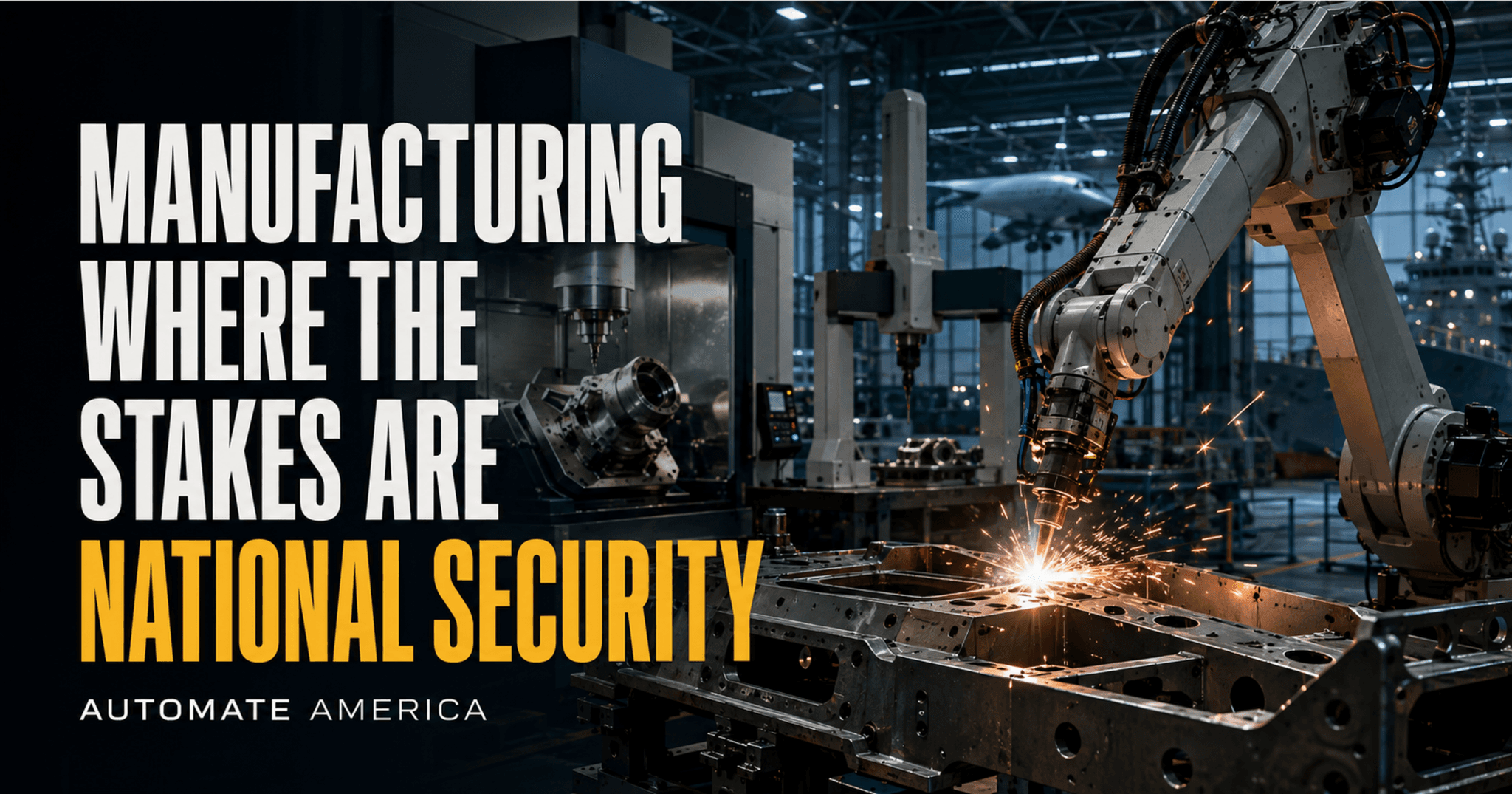
The United States defense industrial base is investing heavily in manufacturing automation and modernization, driven by sustained production demands for munitions, missile systems, armored vehicles, naval vessels, and military aircraft. Every Javelin missile, every F-35 Lightning II, every Virginia-class submarine relies on automated manufacturing processes controlled by programmable logic controllers, CNC machining centers, robotic welding cells, and sophisticated quality inspection systems. Defense work asks automation professionals for a combination of technical expertise, security clearance and regulatory compliance that commercial manufacturing does not.
Defense manufacturing differs from commercial production in ways that affect every aspect of automation engineering. International Traffic in Arms Regulations (ITAR) and the Defense Federal Acquisition Regulation Supplement (DFARS) impose strict controls on who can access technical data, what systems can connect to networks, and how manufacturing processes are documented and verified. Every weld on a submarine hull, every machined surface on a jet engine turbine blade, every circuit board in a guidance system must be traceable to specific raw material lots, machine settings, operator qualifications, and inspection results. This traceability requirement means that the automation systems in defense facilities generate and manage far more data than their commercial counterparts, and the professionals who design and maintain these systems must understand both the automation technology and the regulatory framework that governs its use.
What Defense Automation Professionals Actually Do
CNC automation engineers in defense manufacturing program and optimize multi-axis machining centers that cut exotic alloys -- titanium, Inconel, tungsten, depleted uranium -- into components with tolerances measured in ten-thousandths of an inch. A turbine blade for a Pratt and Whitney F135 engine might require 40 hours of machining across five different CNC operations, with in-process inspection at each stage using coordinate measuring machines (CMMs) integrated directly into the manufacturing cell. These engineers work with machine tool builder like DMG MORI, Mazak, and Haas, programming in G-code and conversational formats while configuring Fanuc, Siemens SINUMERIK, and Heidenhain CNC controllers. The critical difference from commercial CNC work is the documentation burden -- every program revision, every tool change, every offset adjustment must be recorded in the manufacturing execution system (MES) and linked to the specific part serial number for lifetime traceability.
Robotic welding automation is essential in defense manufacturing. General Dynamics Land Systems uses dozens of FANUC and ABB robotic welding cells to fabricate Abrams tank hulls and Stryker vehicle bodies from high-hardness armor steel that requires precise heat input control to maintain ballistic protection properties. Huntington Ingalls Industries employs hundreds of welding robots in submarine and aircraft carrier construction. The automation engineers who program and maintain these systems must understand both robotics (path planning, torch angle optimization, seam tracking with laser vision systems) and metallurgy (heat affected zones, pre-heat requirements, interpass temperature monitoring). Welding procedure specifications (WPS) qualified under AWS D1.1 or MIL-STD-1595 must be followed exactly, and the robotic systems must be configured to document compliance with every parameter on every joint.
Test and inspection automation engineers build the systems that verify defense products meet specifications. Automated optical inspection (AOI) systems examine printed circuit boards for defense electronics. Ultrasonic testing (UT) and radiographic testing (RT) systems inspect castings and forgings for internal defects. Leak testing systems verify sealed enclosures. Functional test systems exercise completed assemblies through their full operational envelope. These engineers work with National Instruments (NI) LabVIEW and TestStand platforms, Keysight instruments, and custom test fixtures, integrating sensors and instruments through GPIB, PXI, and Ethernet interfaces. The test systems must not only pass or fail parts -- they must generate the documentation packages that customers like the US Army, Navy, and Air Force require as deliverables alongside the hardware.
Controls engineers in munitions and energetics manufacturing face unique challenges. Automated systems that handle explosives, propellants, and pyrotechnics must incorporate intrinsic safety barriers, explosion-proof enclosures, and safety interlocked sequences that prevent any possibility of unintended initiation. Allen-Bradley GuardLogix and Siemens S7-1500F safety PLCs control these processes with redundant safety circuits rated to SIL 3. Remote operation is standard -- operators control mixing, pressing, and assembly operations from hardened control rooms through CCTV and HMI systems, with the automation handling material movement through the hazardous areas. Facilities like the Holston Army Ammunition Plant in Tennessee and the Lake City Army Ammunition Plant in Missouri employ hundreds of controls professionals to maintain these safety-critical systems.
Security Clearances: The Career Multiplier
Most defense automation positions require at minimum a Secret security clearance, and many require Top Secret or Top Secret/SCI. The clearance process takes 4 to 12 months for Secret and 6 to 18 months for Top Secret, involving background investigations, financial record reviews, and interviews with references and associates. US citizenship is mandatory -- no exceptions. Once granted, a clearance matters because the cleared labor pool is smaller than demand. Maintaining a clearance requires ongoing compliance with security protocols, reporting foreign contacts, and periodic reinvestigation. The investment pays off: cleared automation engineers have access to programs that operate for decades, providing exceptional job stability compared to commercial manufacturing where contracts can shift year to year.
Certifications and Training for Defense Manufacturing
Beyond standard automation certifications (ISA CAP, CCST, vendor-specific PLC certifications), defense manufacturing values Certified Welding Inspector (CWI) credentials for welding automation roles, ASNT NDT Level II or III for inspection automation, and Six Sigma Green or Black Belt for process optimization. IPC-A-610 (Acceptability of Electronic Assemblies) and J-STD-001 (Requirements for Soldered Electrical and Electronic Assemblies) certifications are required for electronics manufacturing automation. AS9100 quality management system knowledge is expected for anyone working in aerospace defense. NIST SP 800-171 and Cybersecurity Maturity Model Certification (CMMC) Level 2 or higher compliance knowledge is increasingly required as the Department of Defense tightens cybersecurity requirements across the defense supply chain.
Training pathways include military service (many defense automation professionals are veterans who learned electronics, hydraulics, and mechanical systems in the armed forces), community college programs in manufacturing technology and mechatronics, and four-year engineering degrees. Universities with strong defense manufacturing connections include Purdue University (energetics and advanced manufacturing), Georgia Tech (defense research through GTRI), MIT (Lincoln Laboratory), and Virginia Tech (proximity to the Pentagon and defense contractors in Northern Virginia). Vendor training from FANUC, ABB, Rockwell Automation, and Siemens is essential for the specific platforms used at each facility.
Pay and Major Employers
Pay for CNC automation programmers in defense and robotic welding engineers depends on experience, the employer and the region. Controls engineer with safety PLC expertise are paid according to experience, the employer and the region. Pay for test automation engineers, manufacturing execution system (MES) engineers and senior automation managers overseeing entire production lines depends on experience, the employer and the region. On Automate America each professional sets their own rate on their profile, and a contract shows the rate the company posted.
Major defense employers include Lockheed Martin (F-35, missiles, space systems), RTX Corporation (Raytheon missiles, Pratt and Whitney engines), Northrop Grumman (B-21 bomber, autonomous systems), General Dynamics (Abrams tanks, Gulfstream aircraft, submarines), Boeing Defense (military aircraft, satellites), L3Harris Technologies (electronic warfare, communications), BAE Systems (electronic systems, combat vehicles), and Huntington Ingalls Industries (aircraft carriers, submarines). The defense industrial base also includes thousands of Tier 2 and Tier 3 suppliers -- machine shops, electronics manufacturers, and specialty material producers -- that need automation professionals but often struggle to compete with prime contractor compensation.
Geographic clusters include the greater Washington DC area (Northern Virginia, Maryland), the Connecticut-Rhode Island submarine corridor, the Dallas-Fort Worth Metroplex (Lockheed Martin, L3Harris, Bell), Huntsville Alabama (Redstone Arsenal, missile defense), Southern California (aerospace), and scattered government-owned ammunition plants across the country.
Next steps on Automate America
- Post your work free — Set the rate you want to pay. Posting and receiving applicants cost nothing.
- Create your free profile — Your completed work, platforms and reviews in one record that customers search.
- Search open contracts — Every open contract and what it pays, updated as they post.
- Find professionals — Search thousands of professionals by skill, platform and location.
- Training and certification — Build the skills the contracts above are actually asking for.
Explore more
FOLLOW AUTOMATE AMERICA


✉ Email the editor·💬 Text Automate America: 586-770-8083
Tony Wallace, Co-Founder · Automate America
Text first: 586-770-8083 or call·info@automateamerica.com