A public contract just wrote down what most plants are only whispering about
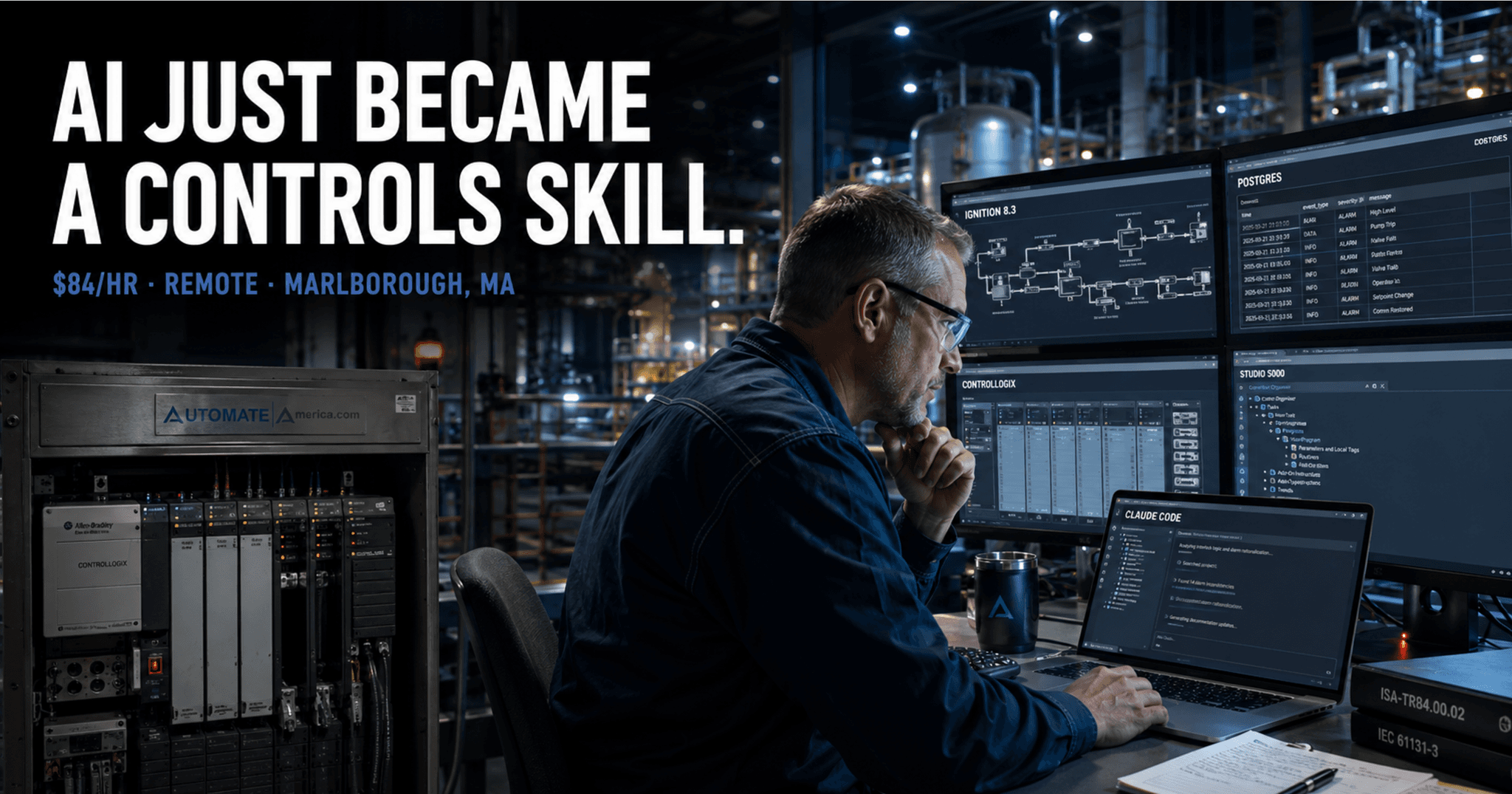
There is an hourly contract open right now in Marlborough, Massachusetts for one senior automation engineer. It pays $84.00 an hour, flat. It is primarily remote, with occasional customer and site travel in the Northeast — being within about four hours of New England by road is a plus rather than a requirement. It starts immediately, and it is ongoing and open. The stack is Ignition 8.3 and Postgres, ControlLogix and Studio 5000, across batch processing, chemical processing, continuous process, MES and part tracking, in specialty manufacturing, life sciences and industrial manufacturing.
All of that is ordinary. This is the line that is not:
“Engineers are expected to be proficient with, and bring, their own Claude Code.”
A few lines further down, the posting asks that the engineer be comfortable working alongside a team of AI engineering agents, describing AI as “the enablement of increased engineering velocity while freeing engineers to focus on higher-level technical and design decisions.”
We have published a great many controls contracts. This is the first one where the AI requirement was not a nice-to-have buried in the last bullet. It is in the scope, in the skills panel, and in the culture statement. Somebody sat down and decided that an engineer who works this way is a different hire from one who does not, and then said so in public.
The constraint on industrial AI was never the model
There is a story the general press has been telling for two years: the models get better, therefore industry gets automated. Anyone who has actually tried to point a modern AI system at a plant knows that is not where the difficulty lives.
The industry research now says the same thing plainly. Reporting on agentic AI in manufacturing describes adoption moving decisively out of pilots and into production — and identifies the limiting factor as fragmented, machine-unfriendly data rather than model capability. Companies are not stalling because the reasoning is too weak. They are stalling because the plant cannot hand the system a clean, structured, trustworthy account of what is actually happening on the floor.
Sit with that for a moment, because it relocates the whole problem.
If the constraint on industrial AI is the data layer, then the people who decide whether industrial AI works are not the data scientists. They are the people who own the tag structure, the historian, the alarm model, the batch records and the MES integration. They are controls engineers, automation engineers and system integrators. The bottleneck has a job title, and it has had one for thirty years.
Which is why a contract like this pays what it pays
An engineer who is fluent in both directions — who can hold the process, the PLC and the SCADA layer in their head and drive AI tooling hard enough to multiply their own output — is not a marginally faster version of the old role. They are a different unit of capacity.
The judgment does not move. Reviewing incomplete customer requirements and spotting what is missing is judgment. Deciding a system architecture that will still make sense in six years is judgment. Standing in front of a factory acceptance test that is not going well is judgment. None of that is delegated, and the posting is explicit that ownership runs from requirements through architecture, detailed engineering, factory and site acceptance testing, and into commissioning.
What changes is how much of it one person can carry, and how much of the day is spent on the parts that never needed a human in the first place. That is the trade the market has started pricing.
What Ignition 8.3 changed underneath all of this
The timing is not a coincidence. Inductive Automation released Ignition 8.3 in September 2025, and the feature list reads like a set of answers to exactly the problem above. A new Industrial Historian Solution Suite, including a historian API for custom implementations. An Event Streams module that pipes event-driven data from sources such as tag changes or Kafka topics into handlers such as scripts and database tables. A built-in REST API. Git-based version control and collaboration. Simplified containerisation, a new gateway deployment mode, and a redesigned gateway configuration interface. Automation.com's coverage walks the same ground.
Read those as a set and a pattern appears: structured event data, programmable interfaces, and source control. Those are the three things that turn a plant from something an AI system can only guess at into something it can actually be pointed at. The platform layer arrived first. The contracts are arriving now.
What this looks like on an ordinary Tuesday
Strip out the futurism and it is unglamorous, which is how you know it is real.
An engineer inherits a project with requirements that are two-thirds written. In the old shape of the day, the first week goes to reading, cross-referencing and rebuilding context somebody else already had. In the new shape, that week compresses, and the engineer spends their attention on the question that actually decides the project: is this the right architecture, and what did the customer fail to tell us?
The contract's own culture language points at the same thing — “Autonomy of action. Alignment of architecture. Transparency of work,” and a stated preference for engineers who review, critique, agree a plan, and then execute rather than stalling on edge cases. That is not a description of somebody typing faster. It is a description of somebody deciding better, more often, with less friction between the decision and the deliverable.
Why work like this reaches a marketplace before it reaches a job board
Here is the part worth your time if you run a plant, an engineering group or a service company.
A requirement this specific is close to unfillable through the usual channels. It is one professional, the start is immediate, the engagement is primarily remote, and the skill combination did not exist as a category two years ago. A requisition takes weeks to open. An agency will bring you people screened against a keyword list that has no entry for what you actually need. By the time either process produces a name, the project has moved.
A marketplace removes the calendar from that problem. The customer wrote what they needed, chose the rate they were willing to pay, and published it. Professionals who genuinely do this work read the real words and come directly.
On Automate America it is free to post, free to apply, and free to hire. You post at the rate you want to pay — there is no negotiating and nobody is bid down. Trusted professionals with ratings, reviews and endorsements apply directly. You can also skip posting altogether and search the marketplace and request a specific professional instead of waiting to be found.
Then we do the part almost nobody expects: we carry the marketing and the sales effort. Your contract gets written, designed, published and pushed across our channels — this article being a working example of it. That is what a free, fair and open marketplace is: all the work and all the people in one place, on terms everyone can see.
And if you run a service company, this reads the other way round
Most coverage of a contract like this assumes one reader: an individual deciding whether to apply. That misses half the market, and it misses the half with the most to gain.
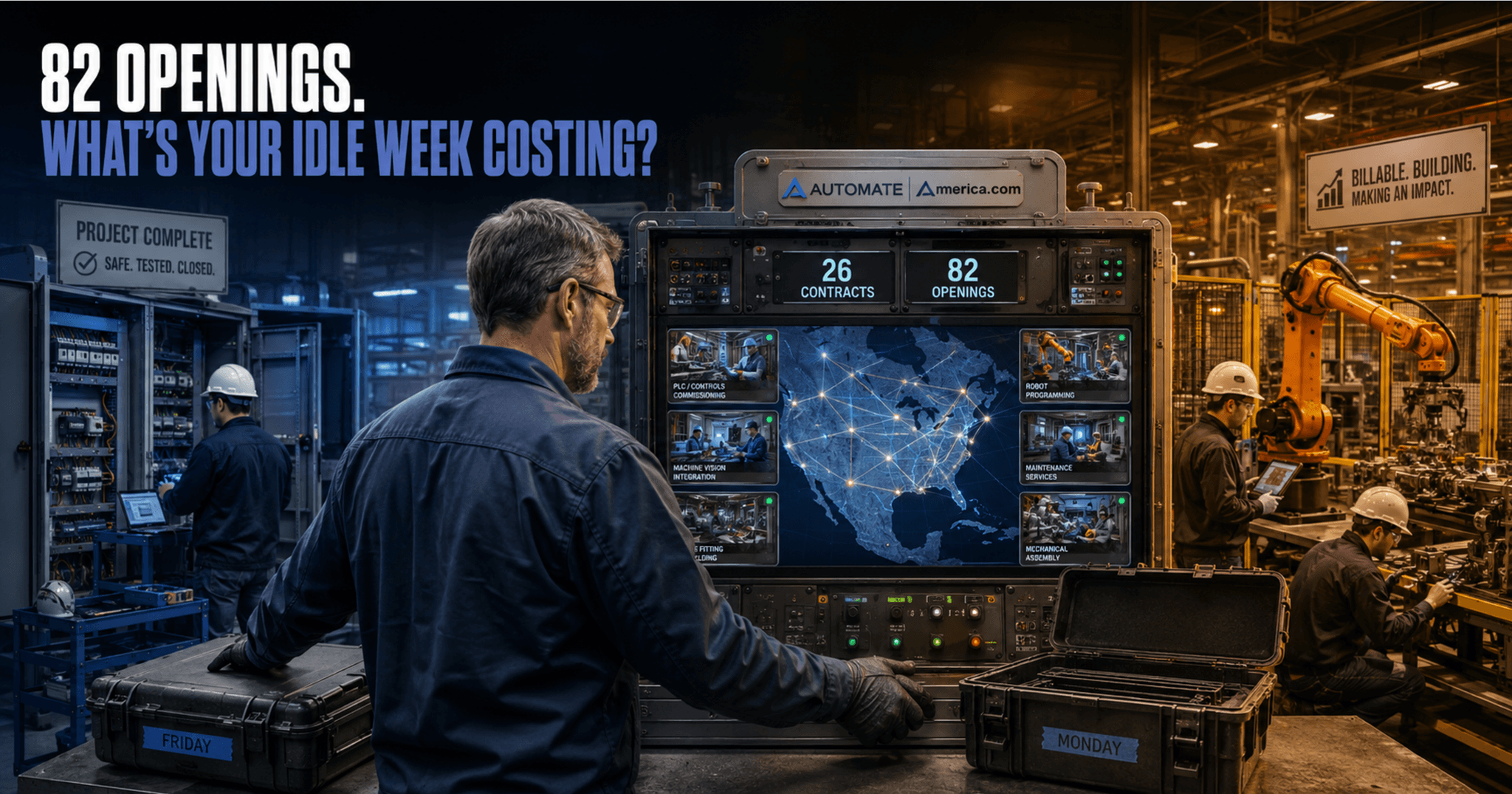
Ask anyone running an automation service company what their real problem is and you will not hear “finding work.” You will hear about the non-billable week — an excellent engineer rolls off a project, payroll runs regardless, and there is nothing to bill against. It is the number that never makes it into a report, and it is the number that decides whether the year was good.
A contract posted here is not only a job for one person. It is billable work for a firm's available bench. Service companies apply their own employees to open contracts on Automate America: the engineer who came free on Friday is on somebody else's contract on Monday, at a rate the firm agreed to, with the paperwork handled. Fewer layoffs in the slow months, and the people you spent years training are still there when the work comes back.
It runs in the other direction just as usefully. When the work outruns the payroll, a service company can take a contract bigger than its own headcount and pull the extra hands from the marketplace — bidding jobs it would otherwise decline, without hiring for a peak that ends. The same lever keeps your own staff off the road: source someone local for out-of-town service instead of putting a senior engineer on a plane for six weeks.
That pool — the available professionals sitting inside member companies — is a labor market you reach here. It is the part of this that is structural rather than merely convenient.
Why the work and the people keep missing each other
None of this is a failure of effort. It is a failure of plumbing, and it is worth naming plainly.
Specialist labor is hard to find because the market is fragmented on both sides. On the supply side, the people who do the work are spread across thousands of small firms and independents. On the buy side, a large manufacturer may only use approved suppliers: accounts payable cannot onboard and pay thousands of vendors, most small firms would never clear the vendor requirements, and an independent contractor has no practical way to invoice an international manufacturer. So a qualified professional and an open contract can sit ten miles apart and never learn the other exists.
The fix is not a better job board. It is one open marketplace holding all the work and all the people, reached through a single approved supplier — so a customer clears one vendor and gets access to thousands of professionals, and a professional or a small service firm gets access to work that used to be structurally out of reach. We take less out of the bill rate than an agency does, and the professional keeps more of it. That is the whole design.
If you are the engineer this was written for
You already know whether you are. You have been working this way for a year or more, probably without a tidy name for it, and you have watched the gap widen between what you can now deliver in a week and what the job description in front of you assumes is possible.
The contract is open here at $84/hr flat. One position, immediate start, ongoing and open. If the platform side is where you want to get stronger first, Rockwell Automation's training catalogue covers the ControlLogix and Studio 5000 half, and ISA's certification programmes cover the process and batch control ground this contract sits on. Locally, Quinsigamond Community College in Worcester runs the engineering and advanced-manufacturing pathways closest to Marlborough. Automation World is worth reading weekly if you want to watch this shift keep moving.
More context from us: the first write-up of this contract, our look at AI in predictive maintenance, and the controls engineer and PLC programmer occupation pages. You can also browse every open hourly contract or register with just your name, email and phone number.
The questions customers actually ask us
Is it really free to post? Yes. Posting a contract, a job or a request for quote costs nothing.
Will I get flooded with unqualified applicants? No — you see profiles of experienced industry professionals, and you decide who to talk to.
How fast does specialised work fill? It depends on the rate, the location and the dates — you see applications as they arrive.
What if I need a hand? Reach out any time — we are a message away.
The models will keep improving whether or not any of us pay attention. The part that decides whether that matters inside a real plant is the engineer standing between a messy process and a system that needs clean structure to be useful at all. That job just became one of the most valuable in industry, and the contracts have started to say so out loud.
Next steps on Automate America
- Post your work free — Set the rate you want to pay. Posting and receiving applicants cost nothing.
- Create your free profile — Your completed work, platforms and reviews in one record that customers search.
- Search open contracts — Every open contract and what it pays, updated as they post.
- Find professionals — Search thousands of professionals by skill, platform and location.
- Training and certification — Build the skills the contracts above are actually asking for.
Explore more
- Browse every open contract
- Find skilled professionals
- See the companies hiring
- Work by occupation
- Training programs
- More from the Automate America blog


✉ Email the editor · 💬 Text Automate America today: 586-770-8083
Tony Wallace, Co-Founder · Automate America · 586-770-8083 · info@automateamerica.com