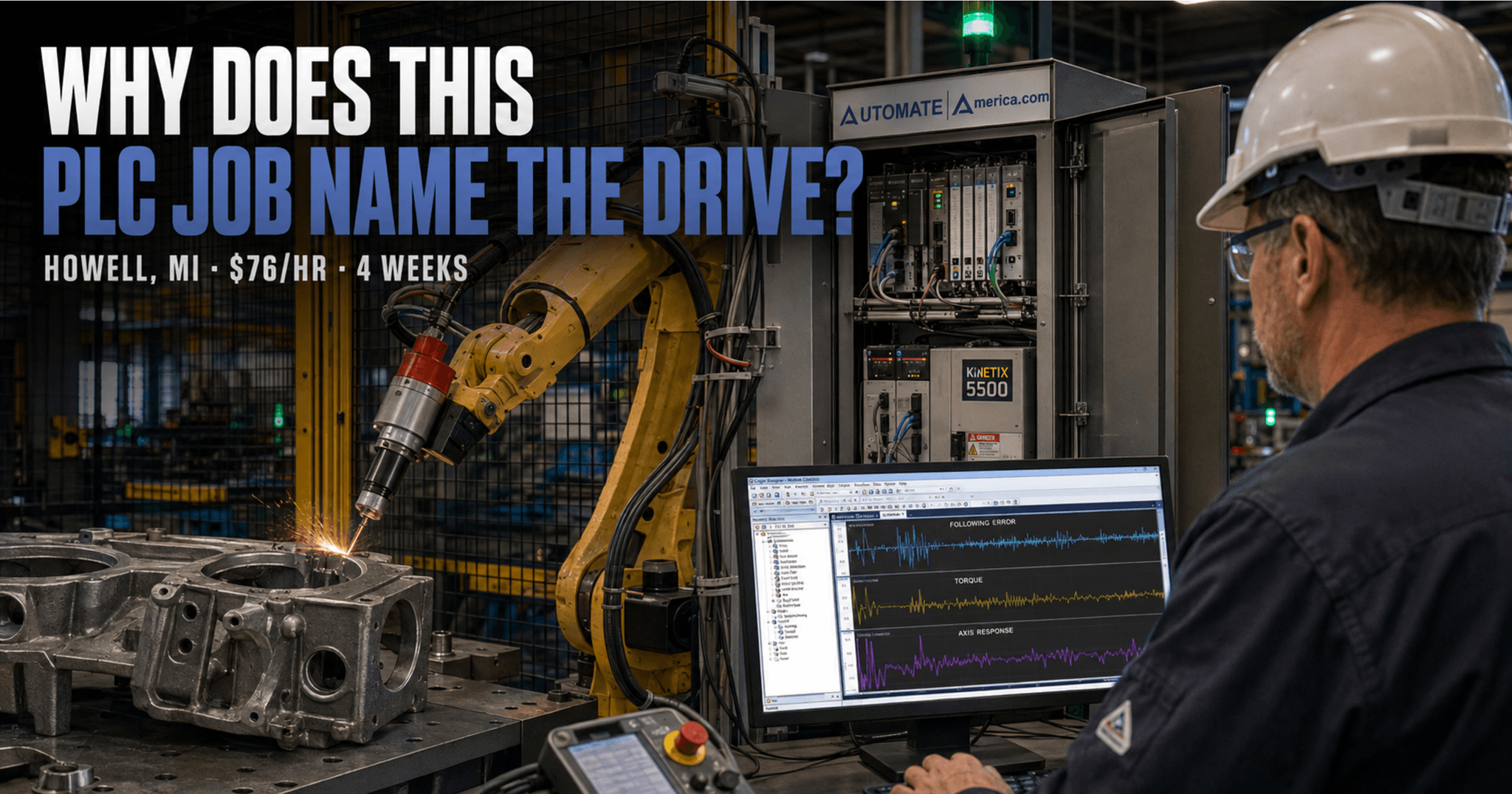

An hourly contract is open in Howell, Michigan for a PLC programmer with Allen-Bradley PLC and HMI experience and hands-on time with Kinetix 5500 servo drives. The work is the final programming, commissioning, debug and acceptance of a robotic deburring cell. It pays $80 an hour, it starts immediately, it runs about four weeks, days, eight hours a day, five days a week, and there is one opening. AAM standards experience is a plus. You can apply here.
That is the whole offer, up front. The rest of this is about why the posting names a drive — and why, on this particular kind of cell, that is the part that decides whether the job goes well.
Most controls postings name the PLC. This one names the drive.
Read enough hourly contracts and you notice the pattern. The controller gets named, the software gets named, and the motion hardware gets waved at — “servo experience preferred.”
This posting does the opposite. It puts Kinetix 5500 in the mandatory column, right next to Studio 5000. That is a deliberate signal from a machine builder who knows exactly which part of the commissioning is going to eat the calendar.
Here is the reason. Deburring is a force- and path-sensitive process. A robot carries an abrasive tool along the edge of a casting, and the load on that tool changes continuously as it enters the cut, crosses a thick section, rides over a gap and exits. The commanded path is easy. Holding the commanded path while the load fights you is the entire problem.
That is drive work. Following error, tuning, the feedback loop, how the axis behaves when the tool bites — those are the things that separate a cell that produces a consistent chamfer from one that produces a chamfer that wanders. A programmer who can write the sequence but cannot tune the axes will get the cell moving and then stall for a week on edge quality. On a four-week contract, that week is a quarter of the job.
What the Kinetix 5500 actually brings to a cell like this
The Kinetix 5500 is Rockwell’s mid-range EtherNet/IP servo drive, and its defining practical characteristic is the single-cable motor connection — one hybrid cable carries both motor power and Hiperface DSL feedback from the drive to a Kinetix VP motor. Standard motor cables run to 50 metres; continuous-flex cables run to 30. Older MP-Series motors with Hiperface feedback can still be used through the 2198-H2DCK converter kit.
That sounds like a wiring convenience, and on installation day it is. But on a commissioning contract it is something more useful: fewer connections is fewer places for the fault to be. When an axis faults intermittently at three in the afternoon on week three, every cable you did not have to run is a branch of the fault tree you do not have to walk.
The second thing that matters here is that the drive lives inside Studio 5000 with the controller. The axis is not a separate world reached through a separate tool with a separate cable and a separate set of habits. Motion configuration, tuning and diagnostics sit in the same project as the logic. For a four-week commissioning window with one person on site, that consolidation is worth real days.
The other drives — and why the market has four good answers, not one
It is worth doing this part honestly. Rockwell is not alone, and a programmer who has only ever seen one drive platform tends to mistake that platform’s habits for the laws of physics.
Rockwell Automation — Kinetix 5500. EtherNet/IP, single hybrid cable to Kinetix VP motors, configured and tuned inside Studio 5000 alongside the Logix controller. Its strength is integration: if the plant is already an Allen-Bradley plant, the drive is not a separate decision. That is exactly the situation on this contract. (Rockwell literature)
Siemens — SINAMICS S210. Siemens’ mid-range servo system, rated up to 7 kW, built to pair with SIMOTICS S-1FK2 servomotors, with integrated safety functions and a deliberately streamlined commissioning workflow. In a Siemens house it carries the same “it is already part of the system” advantage the Kinetix has in a Rockwell house. (Siemens)
Kollmorgen — AKD2G. The specialist’s answer. Dual-axis in one unit, expandable I/O without growing the footprint, dual-channel STO, removable memory, single hybrid cable to AKM2G motors, and a graphic display on the drive itself. Where Rockwell and Siemens sell integration, Kollmorgen sells motion performance and density — which is why it turns up so often in machine builder’ own equipment rather than in plant-standard cabinets. (Kollmorgen)
SEW-EURODRIVE — MOVIDRIVE / MOVI-C. A modular multi-axis architecture with single-axis and double-axis modules, functional safety as standard, and integrated positioning and sequence control. SEW’s tradition is drive technology as a system — gearmotor, drive and control considered together — which is why you meet it most on conveying and material-handling systems. (SEW-EURODRIVE)
None of these is the “best drive.” They are four different answers to the question what else is this axis connected to? — and the reason this contract names Kinetix specifically is that the answer here is an Allen-Bradley PLC and HMI. The plant standard chose the drive before anyone wrote the posting.
Michigan builds the machines that build everything else
Howell sits in Livingston County, on the stretch between Lansing and Detroit. It is not where cars get assembled. It is where the equipment that makes the parts gets designed, built, wired, programmed and proven out before it ever ships.
That distinction gets lost in most coverage of Michigan manufacturing, and it matters to anyone deciding whether to take this contract. A deburring cell being commissioned in Howell is machine-builder work: a defined piece of equipment, a defined scope, a final acceptance at the end of it. You are not joining a plant. You are finishing a machine.
Michigan has more of that work per square mile than almost anywhere in the country, and it is the reason a four-week specialist contract here is normal rather than exotic. The tier suppliers and machine builders in this corridor run on exactly this pattern — bring in the specialist for the commissioning window, prove the cell, sign it off.
What “final programming, commissioning, debug and acceptance” means in practice
The posting is specific about the scope, and the specificity is good news. This is not a build-from-nothing contract.
- Final programming — the structure exists. You are completing it, not architecting it.
- Commissioning — bringing the axes and the sequence up on real hardware with real parts.
- Debug — the honest middle of the job, where the drive experience earns the rate.
- Final acceptance — there is a defined end, and somebody signs it.
Four weeks with an acceptance at the end is a clean shape for a contract. You know what “done” looks like on the day you start, which is not true of most work.
The practical terms, in one place: $80 an hour. Days, eight hours, five days a week. Standard PPE and lock out / tag out. Starts immediately, runs about four weeks. One opening.
And to say the part that Automate America exists to make true: the rate is the rate. There is no rate negotiated behind your back and no invitation to bid yourself downward against whoever else applied. The number is published because published numbers are how a market stays honest.
Frequently asked questions
Do I need Kinetix 5500 experience specifically, or will other servo drive experience do?
The posting lists Allen-Bradley / Rockwell as mandatory, with Kinetix 5500 and Studio 5000 named. If your servo background is SEW, Siemens or Kollmorgen and your Allen-Bradley PLC and HMI work is solid, apply and say exactly that — the honest read of your own experience is worth more than a guess about how the customer will weigh it.
What does “AAM standards experience a plus” mean for my application?
Exactly what it says: a plus, not a requirement. If you have worked to those standards, put it near the top of your application. If you have not, it does not disqualify you.
Is this a plant job or machine builder work?
Machine builder work. The scope is the final programming, commissioning, debug and final acceptance of a robotic deburring cell — a defined piece of equipment with a defined sign-off, not an ongoing production role.
How quickly does a contract like this fill?
The start date is immediate and there is one opening, so it moves fast. Applications go straight to the customer on Automate America.
Why this contract is on Automate America and not on a job board
It is worth saying plainly what this platform is, because it explains why a four-week specialist contract in Howell can be published at a real number.
Automate America is a marketplace. A customer posts the work at the rate they want. Professionals apply directly. There is no bidding and no negotiating. The rate you see is the rate.
For the builder who needed this programmer, the alternative is familiar and expensive: a requisition, an agency, and a shortlist that lands after the ship date has already moved. The money is rarely the problem. The calendar is. A marketplace removes the calendar.
It is free to post, free to apply and free to hire. No barriers to entry, less commitment, less risk. The work runs from emergency call-outs and short contracts through to year-long engagements, onsite, remote or hybrid, anywhere in the world, across every profession — not automation alone. Trusted professionals carry real ratings, reviews and endorsements with them and apply directly.
And the marketing effort is ours, not the customer’s. A posted contract gets written up, designed, published and pushed across our channels — this article being the obvious example. The customer posts the work; we go and find the people.
As this is published there are 25 contracts open across 9 states and 2 countries.
Ready to look at it properly?
Apply for this contract in Howell, Michigan · See every open hourly contract · Browse professionals
And if you are on the other side of this — a machine builder with a cell to finish and nobody free to finish it — post your own work. It takes a few minutes, it costs nothing, and it puts the job on the board, open to every professional who does that work. Contractors and contracts, exactly when you need them.
Next steps on Automate America
- Post your work free — Set the rate you want to pay. Posting and receiving applicants cost nothing.
- Create your free profile — Your completed work, platforms and reviews in one record that customers search.
- Search open contracts — Every open contract and what it pays, updated as they post.
- Find professionals — Search thousands of professionals by skill, platform and location.
- Training and certification — Build the skills the contracts above are actually asking for.
Explore more
FOLLOW AUTOMATE AMERICA


✉ Email the editor·💬 Text Automate America: 586-770-8083
Tony Wallace, Co-Founder · Automate America
Text first: 586-770-8083 or call·info@automateamerica.com