Nobody has been writing this requirement down
Read enough automation postings and they blur together. A vendor, a city, a rate, a list of acronyms. Then one arrives that asks for something no other posting on the board asks for, and it is worth stopping on.
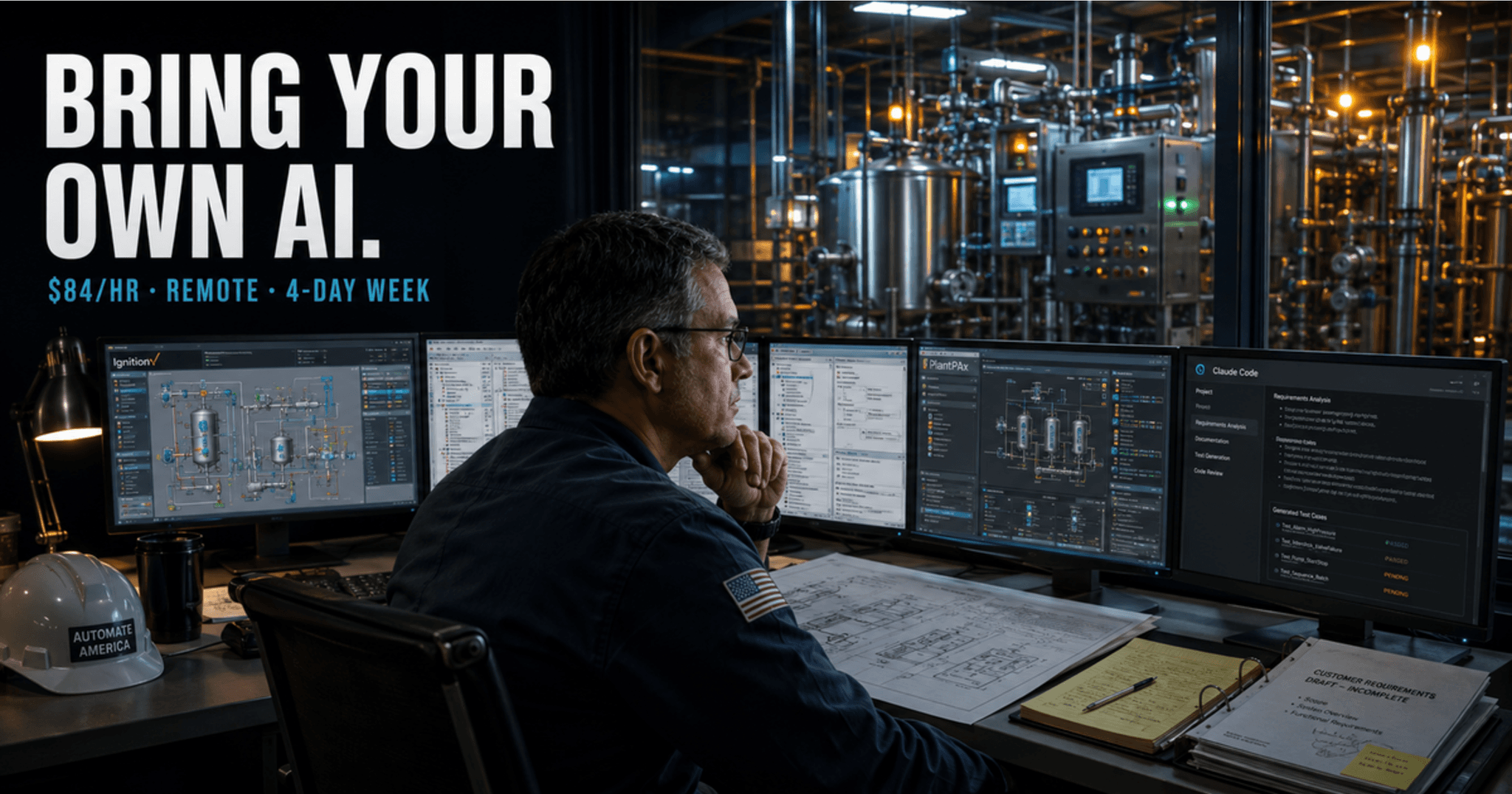
An hourly contract is open in Marlborough, Massachusetts for one Senior Automation Engineer. Inductive Automation Ignition 8.3 is mandatory. Allen-Bradley ControlLogix and Studio 5000 sit beside it, with FactoryTalk View SE, PlantPAx and Postgres across the wider stack. It pays $84.00 an hour, eight hours a day, four days a week, remote with occasional site travel in the Northeast. It starts immediately, runs about a month, and can extend. One opening.
And it expects you to bring your own AI.
“This is not primarily a PLC programming position”
That sentence is in the posting, in those words. It is the most useful line in it, because it disqualifies quickly and honestly.
A great many excellent engineers make their living inside a ladder editor. This is not that work. What is being bought here is ownership: taking a project from requirements, through system architecture, into detailed engineering, then factory and site acceptance testing, and finally commissioning. The posting is explicit that proven architectures, blueprints and engineering patterns already exist as a foundation, and that the engineer is expected to exercise judgment on top of them rather than wait to be handed a specification.
It goes further. The successful candidate must be comfortable reviewing incomplete customer requirements, identifying what is missing, making sound engineering decisions, and then influencing and directing other automation engineers and their work. That is a different job from programming, and it is priced like one.
Deep in one platform. Fluent across the rest.
The stack list is long — Ignition 8.3, ControlLogix and Studio 5000, FactoryTalk View SE, Siemens TIA V21, ABB Robotics, Keyence, CodeSys, PlantPAx, Tatsoft, Postgres — but the requirement is not “all of it.” It asks for subject-matter expertise in one or more of those platforms, plus general fluency across the manufacturing technology stack at L1, L2, L3 and L4.
That distinction matters, and it is where a lot of good candidates rule themselves out unnecessarily. L1 is the device and sensor layer. L2 is control. L3 is where manufacturing execution lives — scheduling, dispatch, quality, tracking. L4 is the enterprise layer above it. An engineer who has genuinely deep hands on Ignition and Rockwell, and who can hold an intelligent conversation across the other three layers, is exactly the profile described. MES experience against the core four is called out as desired rather than mandatory.
The applications are process work: batch, chemical, continuous process, part tracking and troubleshooting, across life sciences, specialty manufacturing and industrial manufacturing. If you have commissioned a jacketed reactor, argued about a recipe model, or chased a phantom part through a tracking database at two in the morning, this posting was written about your afternoon.
Bring your own Claude Code
Here is the line that makes this contract genuinely unusual: engineers are expected to be proficient with, and bring, their own Claude Code. The customer runs an AI-enabled engineering environment and states that being comfortable collaborating with a team of AI engineering agents alongside people is highly desirable. The stated purpose is not headcount reduction — it is engineering velocity, freeing the engineer to spend their hours on higher-level technical and design decisions.
Whatever you make of that as a trend, notice what it means practically. The tooling expectation has moved from “knows the vendor software” to “knows the vendor software and arrives with their own leverage.” It is the first contract on this marketplace to say so in writing. It will not be the last.
The rest of the stated culture reads the same way — autonomy of action, alignment of architecture, transparency of work. Plan, agree the plan, close planning, then execute. Questions and edge cases inform the work rather than halt it. That is a real filter: some engineers thrive in it and some are miserable in it, and both should be able to tell which they are from that paragraph alone.
Four days, eight hours, and what “fractional” actually buys
The schedule is eight hours a day, four days a week. The engagement is described as ongoing and fractional, starting immediately, about a month, with potential to extend.
Fractional is often read as “small.” It is more accurate to read it as senior. Organisations do not buy a fraction of a junior engineer — they buy a fraction of someone whose judgment is worth more than their keyboard time. A four-day week at this level is not a discount; it is an admission that the valuable part of the work is the deciding, and the deciding does not require five days of presence to happen.
It is primarily remote. Occasional customer and site travel in the Northeast is part of it, and the posting notes that being within striking distance of New England — roughly four hours by ground — is a plus rather than a requirement.
If you want work like this, sharpen the two things it names
Two platforms are named as mandatory or near it, and both publish serious training paths worth putting on a profile. Inductive Automation runs free Ignition training and a credentialing path through Inductive University, and Ignition 8.3 specifically is recent enough that demonstrable hands-on time is a differentiator rather than an assumption. On the Rockwell side, Rockwell Automation Training Services covers ControlLogix, Studio 5000, FactoryTalk View SE and PlantPAx directly.
For the process-control half of the job — batch models, continuous control, the standards conversation that surrounds regulated manufacturing — ISA certification remains the credential that plant engineering leaders actually recognise. And if you want to keep a live read on where this market is moving, Control Engineering and Automation World are both worth a weekly ten minutes.
If the profile fits, the fastest route is simply to apply: apply for the Senior Automation Engineer contract. If it is close but not quite, it is worth browsing every open hourly contract — there are twenty-five open right now across ten states and two countries — and reading the controls engineer and automation engineer pages to see how the market is pricing adjacent work.
Now the part for whoever needs an engineer like this
Everything above is one contract. The reason it is worth your attention if you run a plant is what it demonstrates about the mechanism.
This posting went up, it was written and designed and published, and it is being pushed across our channels — and none of that cost the customer anything. That is the deal. Automate America is a marketplace. That is the entire product.
You post the work at the rate you want to pay. There is nothing to negotiate and nobody bidding you down, and you talk with the person who does the job. Trusted professionals — with ratings, reviews and endorsements earned on completed work — apply to you directly. It is free to post, free to apply, and free to hire. No barriers to entry, less commitment, less risk.
You are not limited to waiting, either. You can search the marketplace and request a specific professional directly, or find and follow the customers already working this way.
Emergency call-outs through year-long engagements. Onsite, remote or hybrid — you choose. Anywhere in the world, across every profession, not only automation. A one-month specialist gap should never cost a quarter of hiring calendar, and on a marketplace it does not have to.
Post your own opportunity, free. Or create an account with just your name, email and phone number and look around first.
The engineer who takes this one
A month from now this contract is running. The architecture decisions are made, the acceptance tests are written, and the engineer on it is the one who read a posting that said bring your own AI and recognised it as the beginning of something rather than a curiosity.
That engineer is reading this now. Automate America — contractors and contracts, exactly when you need them.
Next steps on Automate America
- Post your work free — Set the rate you want to pay. Posting and receiving applicants cost nothing.
- Create your free profile — Your completed work, platforms and reviews in one record that customers search.
- Search open contracts — Every open contract and what it pays, updated as they post.
- Find professionals — Search thousands of professionals by skill, platform and location.
- Training and certification — Build the skills the contracts above are actually asking for.
Explore more
- Browse every open contract
- Find skilled professionals
- See the companies hiring
- Work by occupation
- Training programs
- More from the Automate America blog


✉ Email the editor · 💬 Text Automate America today: 586-770-8083
Tony Wallace, Co-Founder · Automate America · Text/Call 586-770-8083 · info@automateamerica.com