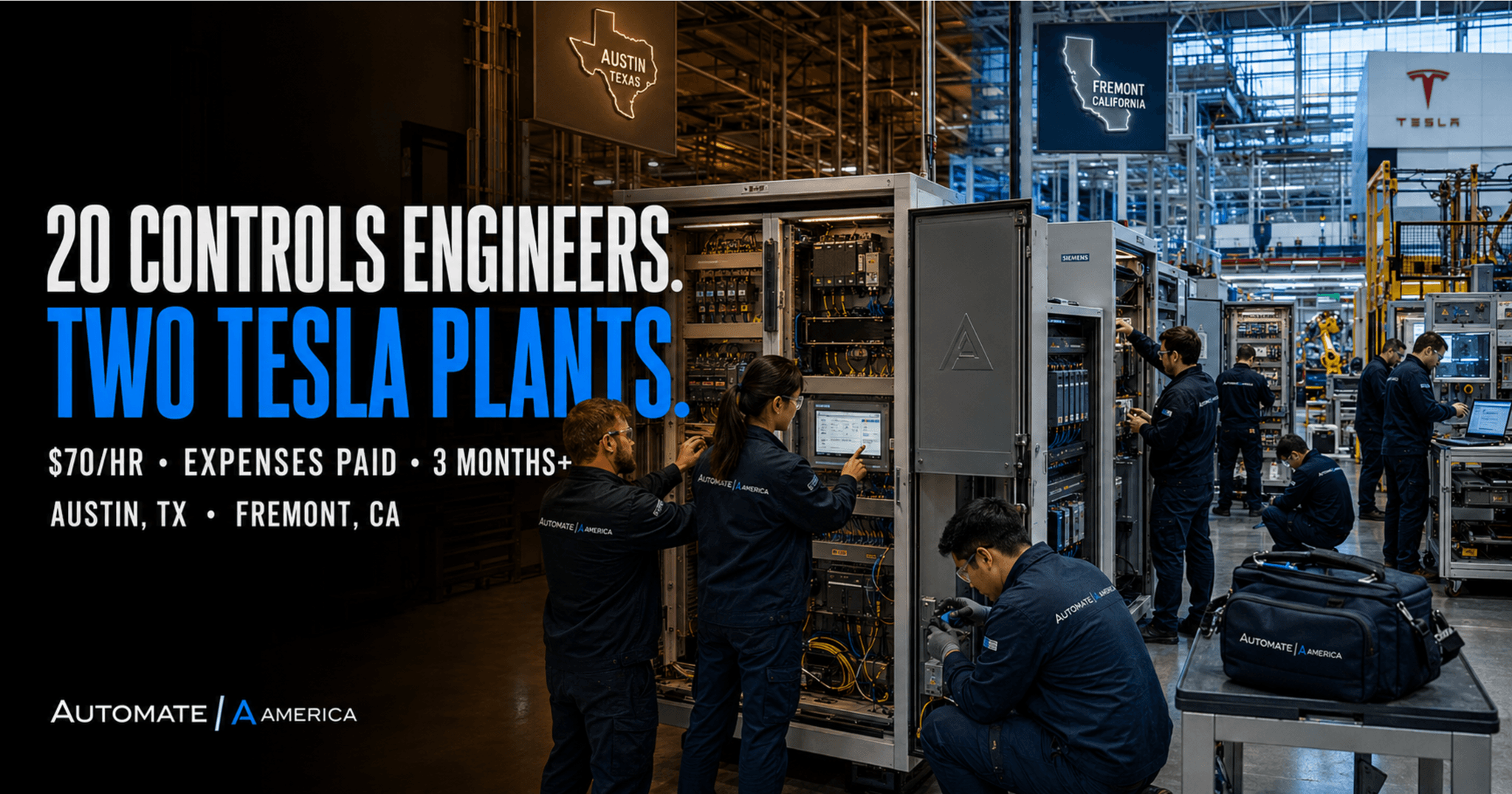
Two contracts posted on Automate America this week are looking for up to twenty controls engineers between them — up to ten in Austin, Texas and up to ten in Fremont, California. Both are Siemens jobs: PLCs, HMIs and servo drives, commissioning new automotive manufacturing equipment at Tesla. Both start in August. Both run three months plus. Both pay $70.00 an hour with expenses covered. Prior Siemens PLC and servo drive experience is required on each, and previous Tesla experience is listed as a plus. What makes these worth a second look isn't only the rate — it's the shape of them. Twenty seats on two contracts is not a company casting around for one cheap body; it's a customer who has costed out exactly how many hands a new-equipment start-up takes, and posted that number in the open where any qualified engineer in the country can read it. The location, the duration, the rate and the expense terms are all on the page before you speak to anybody. That's a meaningful change from how this work used to move, and it's the reason both contracts are worth understanding properly rather than skimming.
What the two contracts actually are
They are the same scope in two places. Each is an hourly contract for controls engineers working on Siemens automation — programmable controllers, operator interfaces and servo drives — on automotive manufacturing systems that have not run before. The scope of work is new equipment commissioning, which is its own discipline: there is no known-good baseline to fall back on, no previous program to diff against, and no one down the hall who has seen this cell work. You are the one establishing what "working" means.
- Austin, Texas — up to 10 controls engineers. View and apply to the Austin contract.
- Fremont, California — up to 10 controls engineers. View and apply to the Fremont contract.
Both start in August 2026 and run three months plus. Both are $70.00 per hour plus expenses. Both require prior Siemens PLC programming and servo drive experience; previous Tesla experience is a plus, not a requirement.
Why twenty openings is the story
Most contract postings in this trade are for one person. A posting for ten tells you something different about the job behind it. It means the schedule is real, the scope has been broken down, and somebody has worked out that a commissioning window of this size needs a crew rather than a hero. For engineers, that changes the calculation in three practical ways.
First, you are not walking in alone. On a new-equipment start-up, being one of ten means there is someone to check a drive fault against at two in the morning instead of guessing. Second, ten seats means the customer expects to be onboarding a group, which usually means the site access, the safety induction and the documentation are organised rather than improvised. Third — and this matters more than it sounds — it means a service company with a bench can put a team forward instead of a single name. Two contracts of ten is precisely the kind of scope that turns a good two-person outfit into a crew billing on both coasts by the autumn.
Three months plus, and what "plus expenses" is really worth
Duration and expense terms are the two details people skim, and they are the two that decide whether a contract is actually worth taking. Three months plus means you unpack once. You learn one site, one crew and one set of machines, and you are there long enough to see the work finished rather than handing a half-commissioned cell to whoever comes next. For anyone who has spent a year stringing together two- and three-week jobs, that continuity is the difference between a run of gigs and a season of real work.
"Plus expenses" is the other half. On a three-month out-of-town contract without expense cover, a good hourly rate quietly turns into a worse one — the hotel and the travel come out of the number you were quoted. When expenses are covered, the rate stays the rate. Both of these contracts carry it, which is why the $70.00 an hour on the page is a more honest figure than it would be on a contract that leaves accommodation to you.
This is what the future of work looks like
Think about how twenty openings like these would have reached you a decade ago. They mostly wouldn't have. Work of this size moved through a short list of phone calls; if you weren't in somebody's contact book, you never heard about it, and the rate you were eventually offered had already had a piece taken out of it by people you never met.
What's happening on the open contract board is a different arrangement. The customer describes what they need and what they will pay. Professionals read the same page, decide for themselves, and apply directly. Nobody is deciding on anyone's behalf what they are worth. Companies get to see the actual depth of talent available for a start-up window, and engineers get to choose the work instead of waiting to be selected for it. That is a healthier market for both sides, and it is why the same shift is showing up across PLC programming, robot programming and the skilled trades generally — not just in automotive controls.
How to put yourself forward
If you already have a profile, open whichever contract fits and apply. If you don't, creating one is free and takes a few minutes; your completed contracts and reviews are what customers search on, so it's worth filling in properly. Customers looking for this skill set browse the professionals directory directly, and a complete public profile is what gets you found and requested for work you never applied to.
Running a service company? Put your own people forward on both contracts — twenty seats across two states is a genuine growth opportunity for an outfit with a bench. And if you're on the other side of this and have work of your own to fill, you can post it free.
Either way, it's worth checking the open board regularly. Most contracts never make it into a post like this one — what reaches your feed is a fraction of what's actually open.
Staying current in Siemens controls
If you're building toward work like this, the professional bodies and trade press are worth your time: the International Society of Automation for standards and certification, PMMI for packaging and processing machinery training, and Automation World for what's actually shipping on plant floors right now.
Frequently asked questions
How many controls engineers are being hired, and where?
Up to twenty across two separate contracts — up to ten in Austin, Texas and up to ten in Fremont, California. Each contract is posted individually on Automate America and you apply to whichever location suits you. Both are open at the same time.
What does the Siemens controls engineer contract pay?
Both contracts pay $70.00 per hour plus expenses. Expenses are covered on top of the hourly rate, so the quoted rate is what you keep rather than a figure that absorbs your travel and accommodation.
How long do the contracts run, and when do they start?
Both start in August 2026 and run three months plus. That's long enough to settle at one site and see a new-equipment commissioning through to completion rather than handing it over partway.
What experience is required?
Prior Siemens PLC programming and servo drive experience is required on both contracts, working with PLCs, HMIs and drives on automotive manufacturing systems. Previous Tesla experience is listed as a plus, not a requirement. The scope of work is new equipment commissioning.


Tony Wallace
Founder, Automate America