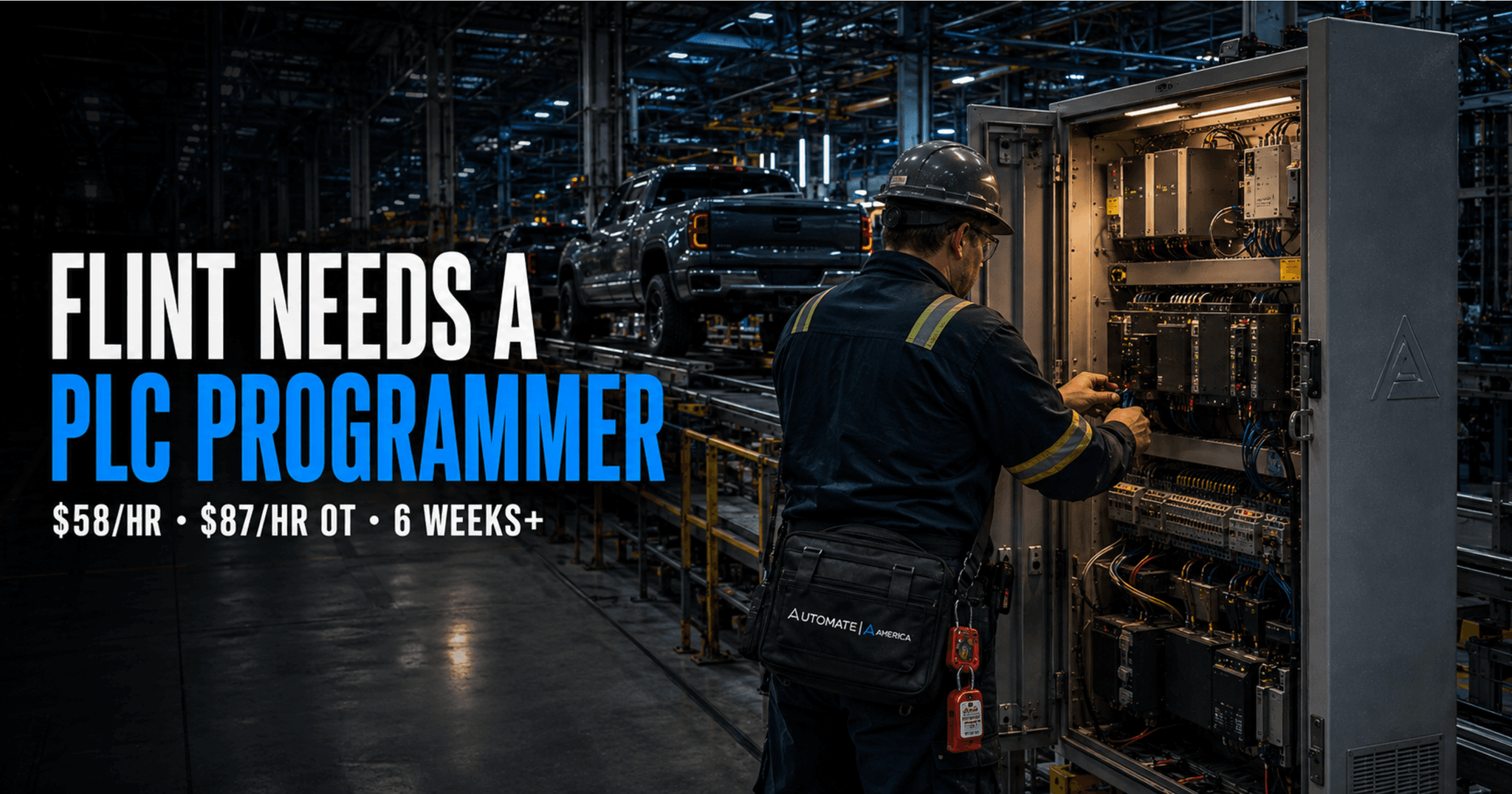
An hourly contract is open in Flint, Michigan for a PLC programmer with Allen-Bradley and GM standards experience. The scope is conveyor commissioning and debug on automotive manufacturing systems and material handling. It starts August 10, 2026 and runs six weeks plus, on days shift at ten hours a day, six days a week. It pays $58 per hour straight time and $87 per hour overtime, and there is one opening. You can apply for it here.
That is the whole contract in a paragraph. The reason it exists is more interesting, and it starts with a number that has nothing to do with electric vehicles.
What changed in Flint
GM's Flint Assembly plant has been building trucks since 1947. Today it produces the Chevrolet Silverado HD and the GMC Sierra HD — more than 1,100 pickups a day across three shifts. For years that ran on a five-day schedule.
In June 2026 it stopped being a five-day plant. Demand for heavy-duty gas pickups got strong enough that GM added a sixth production day every week. That came on top of a more than $1 billion investment the company put into Flint Assembly and the neighbouring Flint Metal Center to keep next-generation heavy-duty truck production in Michigan.
Adding a day reads like a scheduling decision on a press release. On the floor it is a material handling decision. Every conveyor, every transfer, every accumulation zone in that building now carries twenty percent more running time than it was scheduled for. Equipment that used to get a two-day window for attention now gets one.
That is the context this contract sits in.
The contract
- Role: PLC Programmer
- Location: Flint, Michigan
- Platform: Allen-Bradley / Rockwell, Studio 5000, with GM standards experience
- Application: Automotive manufacturing systems, conveyors, material handling
- Scope of work: Commissioning and debug
- Start date: August 10, 2026
- Duration: Six weeks plus
- Shift: Days
- Schedule: 10 hours per day, 6 days per week
- Rate: $58 per hour straight time, $87 per hour overtime
- Openings: 1
Apply for the Flint PLC programmer contract.
Why "GM standards" is the entire shortlist
Most contract postings list a platform and leave it there. This one names a platform and a standard, and the second half is what actually narrows the field.
Automotive OEMs do not run generic controls code. They run to internal specifications that govern tag naming, program structure, fault handling, message formats, HMI conventions, safety architecture and how a machine is expected to behave when something goes wrong. A programmer who knows Studio 5000 inside out but has never worked to a GM specification will write code that functions and still fails review — and on a plant running six days a week, nobody has a spare afternoon to walk them through it.
So the shortlist is not "Allen-Bradley programmers." It is "Allen-Bradley programmers who have already worked inside these plants." That is a much smaller group, and it is why a six-week contract like this carries the rate it does.
Commissioning and debug is its own discipline
There is a real difference between writing conveyor logic and commissioning it. Writing it happens at a desk with a simulator. Commissioning happens on the floor, with mechanical people still setting stops, electricians still landing wires, and a schedule that assumed everything would work the first time.
Debug on a conveyor system is a specific kind of problem-solving: photo-eyes that see a part a fraction too early, accumulation that backs up under real load in a way it never did in simulation, handshakes between zones that are correct in logic and wrong in timing, and drives that behave differently full than they did empty. None of it is exotic. All of it takes someone who has done it before and does not panic when the line does something the print did not predict.
Material handling is the quiet half of automotive automation — the robots get the attention, but the conveyors decide whether the plant hits its number. Industry bodies like MHI and the Conveyor Equipment Manufacturers Association publish the design and safety standards this equipment is built to, and it is worth knowing them well if this is the work you want.
Skills worth sharpening
If Allen-Bradley is your platform, Rockwell's own training and certification catalogue is the direct route — Studio 5000 Logix Designer, ControlLogix and CompactLogix hardware, and the drive and motion courses that matter on conveyor work. For the broader control-systems credential, the International Society of Automation's certification programs are the recognised standard, and they carry across employers rather than tying you to one vendor.
On the safety side, lockout/tagout is not paperwork on a job like this — it is the thing standing between you and a moving conveyor. OSHA's control-of-hazardous-energy material is the baseline every plant expects you to already know. This contract asks you to bring standard PPE, a lockout/tagout kit, and basic hand and electrical tools.
For what is happening across the wider industry week to week, Automation World is a reliable read.
What six weeks looks like
The planned schedule is ten hours a day, six days a week. At the posted rates, that is forty hours at $58 and twenty hours at $87 — roughly $4,000 in a full planned week, and something in the region of $24,000 across the six-week run, before any extension. Those are the published rates applied to the published schedule, not a promise about how any particular week will land.
The honest read is that this is a dense contract, not a comfortable one. Six-day weeks are six-day weeks. That is exactly why the overtime line is the number to look at rather than the straight-time headline, and it is why the people who take work like this tend to be the ones who would rather compress a lot of earning into a short defined window than stretch it thin over a year.
How this works if you are the one hiring
Automate America is a global marketplace for skilled professionals — industrial, commercial and residential work, anywhere in the world, from emergency call-outs and short contracts through to year-long engagements. Onsite, remote and hybrid.
There are two ways customers staff work here, and both are free. You can post a contract, a direct job or an RFQ and see who applies. Or you can skip the waiting entirely and search the marketplace and request a specific professional directly — the professionals carry completed contracts, customer reviews and endorsements on their profiles, so you are choosing from evidence rather than a résumé. It is free to post, free to apply and free to hire, and you post at the rate you want to pay.
If you would rather browse first, every open hourly contract is listed here, and you can also find and follow customers posting work in your region.
The wider point
A plant adding a production day is a good problem. It means demand is real, the investment landed, and the trucks are selling. But the ripple from that decision reaches a long way down — into the conveyors, into the controls, and eventually into a six-week posting for one programmer who has done this exact thing before.
That is what specialist contract work actually is most of the time. Not a gap to be filled, but a specific capability needed for a specific window. The plants that figure out how to reach that capability quickly are the ones that hold their schedule.
Six weeks in Flint, starting August 10. One seat, on the platform you already know, in the plants you have already worked in.
Frequently asked questions
Where is this PLC programmer contract and who is the end manufacturer?
It is in Flint, Michigan, and the end manufacturer is GM. The work is conveyor commissioning and debug on automotive manufacturing systems and material handling.
What does the Flint PLC programmer contract pay?
$58 per hour straight time and $87 per hour overtime. The planned schedule is ten hours a day, six days a week on days shift, so overtime is a meaningful part of the week rather than an occasional extra.
What experience is required?
Allen-Bradley PLC programming with Studio 5000, and prior experience working to GM standards. The application areas are automotive manufacturing systems, conveyors and material handling. You bring a laptop, a lockout/tagout kit, and basic hand and electrical tools, plus standard PPE and a hi-vis vest.
When does it start and how long does it run?
It starts August 10, 2026 and runs six weeks plus. There is one opening.
Related occupations: PLC Programmer · Controls Engineer · Maintenance Technician


Tony Wallace
Co-Founder, Automate America