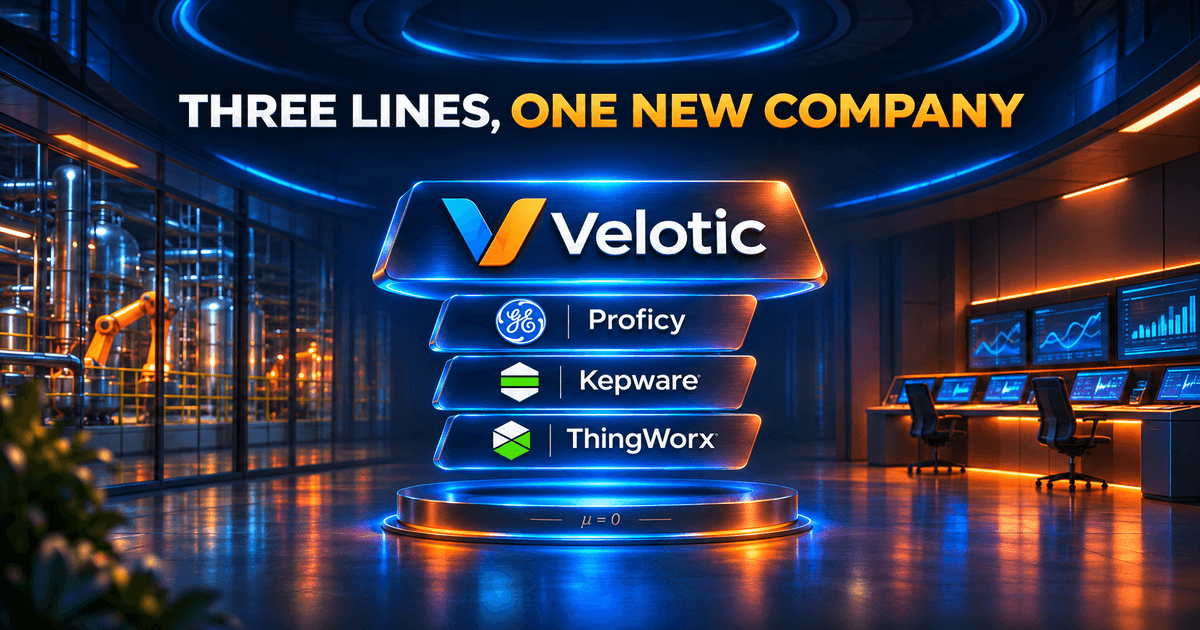
Proficy, Kepware and ThingWorx now sit under one company, Velotic, and TPG's announcement of the launch says the three stay separate product lines. Plants run that software every day, and someone has to set it up and keep it connected. Those are the SCADA and HMI developers, the Kepware and OPC integrators, and the MES and historian teams. This post gives the Velotic news with every date and page, then shows how to find those professionals and service companies on Automate America, a marketplace that is free, fair and open to skilled professionals of every trade, wherever in the world they are.
On this page
- What happened when Kepware, ThingWorx and Proficy launched together as Velotic?
- Who sets this software up and keeps it connected?
- How can a company search professionals by the brands and skills they list?
- What do a professional's reviews and endorsements show?
- How does a company find a service company for the job?
- Which contract to hire begins on Monday, November 23?
- Is it free to post a contract, a job or an RFQ?
- Which questions does this post answer?
What happened when Kepware, ThingWorx and Proficy launched together as Velotic?
The sales came first, and both are done. GE Vernova completed the sale of its Proficy software business to TPG for $600 million on March 2, 2026, as GE Vernova's own announcement reports. PTC completed the sale of its Kepware and ThingWorx businesses to TPG on March 16, 2026, receiving $523 million in cash at closing, as PTC's own announcement of the sale reports.
The next day, on March 17, 2026, Proficy, Kepware and ThingWorx launched together as Velotic. TPG's announcement describes Velotic as an independent industrial software company with more than $300 million of revenue, and the three as remaining distinct product lines. That makes three software lines under one company.
A Velotic news release dated November 5, 2026 introduces its "Industrial AI Value Cube." On November 16, 2026, Velotic announced it has joined the Rockwell Automation PartnerNetwork.
Each fact above comes from the page of the company that announced it, and each carries its own date. A change of owner and name is news for a company, but on a plant floor the software keeps running the same shifts. The useful question for a reader is who the plant calls when something has to be set up, connected or fixed.
Anyone who wants to learn more can start with Velotic's Learning Hub. For hands-on grounding in the controls this software connects to, Madison College in Madison, Wisconsin lists an in-person Industrial Automation - PLC and Controls certificate of 10 credits at its Truax campus that covers programming and troubleshooting PLCs and human-machine interfaces, and Wake Tech Community College in Raleigh, North Carolina describes an Industrial Automation certificate whose courses cover PLCs, HMI configuration, industrial networks and data communications.
Who sets this software up and keeps it connected?
Software is a tool, and a plant still depends on the people who set it up and keep it running. Whichever company's name is on the product, the same roles carry the daily load.
- SCADA and HMI developers build the screens and supervisory views that operators use every shift.
- Kepware and OPC integrators connect controllers and devices to the systems that read their data.
- MES and historian teams keep production records and process history organized so that others can use them.
Each role has its own vocabulary. A SCADA developer thinks in tags, alarms and screens. An integrator thinks in drivers, channels and the connections between devices. A historian team thinks in how data is stored, named and found again years later.
These are skilled trades with their own depth, and they are learned on real systems over years. A plant that adds a line, replaces a controller or moves to a new version of its software needs someone who has done that work before. Some of those professionals work onsite, some work remotely and some do both, and the work can be an emergency call-out or a project that lasts a full year.
Last week's daily posts covered related ground. Monday looked at AI agents for controls engineers, Tuesday at digital twins and who builds them, and Wednesday at why plants still need robot programmers.
How can a company search professionals by the brands and skills they list?
On Automate America, a company can search professionals by the brands and skills they list. The professionals page is where that search starts.
A company has two ways to find its people on Automate America. It can post the work free and read the profiles of the professionals who apply. Or it can search the professionals itself, choose one and request that professional directly. Both ways start from the same profile, so what a company reads before it decides is the same either way.
Members who would rather talk to an AI assistant of their own, such as ChatGPT, Claude, Muse, Gemini or a program they write, can have it write the posting for them.
What do a professional's reviews and endorsements show?
A profile takes the place of a resume. It shows finished contracts, ratings, reviews, badges, connections and endorsements, all on one page for a company to read before it talks to anyone.
Two parts of the profile matter most for software work. The first is reviews from customers. The second is endorsements from people they worked with, which come from people the professional is connected to. A connected pair can also tell the story of how they met and worked together, so a reader sees more than a list of skills.
For a professional, the profile is a record that keeps growing, with each finished contract counted and each new review and endorsement added. For a company, it is a way to see what a professional has done, the reviews from customers and the skills their connections endorse, before the first conversation.
Each applicant, and each professional found by search, arrives with the same kind of profile. That makes it simple to compare people fairly.
How does a company find a service company for the job?
Some jobs call for a company rather than one person, such as a firm that installs a system or keeps it maintained. Service companies list that kind of offering on the Services page of Automate America, and anyone can browse it without an account. The page has one search box: type a service or a trade, such as welding, a city or a state, or both together.
A listing shows what the company chose to enter about the service, such as what it is, whether it is done onsite, remotely or both, and how far the company will go, from one state to anywhere in the world. It also carries the company's track record on Automate America (contracts completed, jobs filled, timesheets approved and achievement badges), and a counter at zero is left off. When some of the company's professionals are available, a green pill on the listing says how many, and the listing names them by first name and occupation, each linked to a profile.
To reach the company, a customer can press Request This Service: the work form opens with the service already filled in and addressed to that company, and the customer chooses whether to send it to that company only or publish it to everyone. A visitor without an account goes straight to the filled-in form and signs in at the last step. A customer can also connect with the company and, once connected, message it directly.
Which contract to hire begins on Monday, November 23?
Monday, November 23, is the start date for contract 4336, a robot programmer opening in Lake Orion, Michigan. The posting is set up as a contract to hire, and the robots involved are made by FANUC. The role is onsite, and the rest of the posting can be read on its page.
Both sides first see how the other works on the job itself. If the company then offers the professional a full-time role, it pays no placement fee and no conversion fee.
Anyone looking beyond Lake Orion can browse more open contracts on Automate America. There is also a PLC / HMI programmer opening in Wixom, MI, and a robot programmer opening in Spartanburg, SC, on an ongoing dispensing and riveting project. Each posting's page lists its full terms.
Is it free to post a contract, a job or an RFQ?
A company can post a contract, a job or an RFQ on the post-work page, and posting it is free. Registering takes a name, an email, a phone number and a password, and a professional or a company can create a profile or sign in to begin.
A contract goes up at the rate the company chooses, with no negotiating: the rate you see is the rate you're paid. Professionals apply with their profiles, and the company reads them as they arrive. Whether it is a contract, a job or an RFQ, a company can also post it anonymously, keeping its name and logo away from public view: the public never sees who posted it.
Applying is free for professionals, and hiring is free for companies. The promotion is handled too: Automate America turns each posting into a written, designed piece and spreads it across its own channels, so the customer does not have to find the audience alone. Where Automate America manages the contract, the customer deals with a single supplier and pays a single invoice, while Automate America pays the professionals, or their service companies, from the approved timesheets and expenses.
Companies that sell or support industrial software, and service companies that install and maintain it, can list their products and services free as well. Each listing gets its own page. A service listing never expires, and search engines can find its page. Buyers can search products on the products page.
A service company with available employees can also send them to open hourly contracts and keep the team billable, with every person still on the company's own payroll; the one exception is a contract to hire.
Which questions does this post answer?
Are Kepware, ThingWorx and Proficy still separate product lines?
Yes. When Proficy, Kepware and ThingWorx launched together as Velotic on March 17, 2026, TPG's announcement described the three as remaining distinct product lines.
Can a company search professionals by the brands and skills they list?
Yes. On Automate America a company can search professionals by the brands and skills they list, and their profiles show reviews from customers and endorsements from people they worked with.
What does it take to register on Automate America?
A name, an email, a phone number and a password. Posting the work is free.
Does a contract to hire carry a placement fee?
No. A company that hires the professional full time after the contract owes no placement fee and no conversion fee.
What can you do next on Automate America?
- Post your work free — Set the rate you want to pay. Posting and receiving applicants cost nothing.
- Create your free profile — Your completed work, platforms and reviews in one record that customers search.
- Search open contracts — Every open contract and what it pays, updated as they post.
- Find professionals — Search thousands of professionals by skill, platform and location.
- Training and certification — Build the skills the contracts above are actually asking for.
Where can you find more contracts, professionals and training?
- Browse every open contract
- Find skilled professionals
- See the companies hiring
- Work by occupation
- Training programs
- More from the Automate America blog
FOLLOW AUTOMATE AMERICA
Tony Wallace, TonyW@AutomateAmerica.com
Make it a great day, we're here to help.