The Electric Arc Furnace Revolution
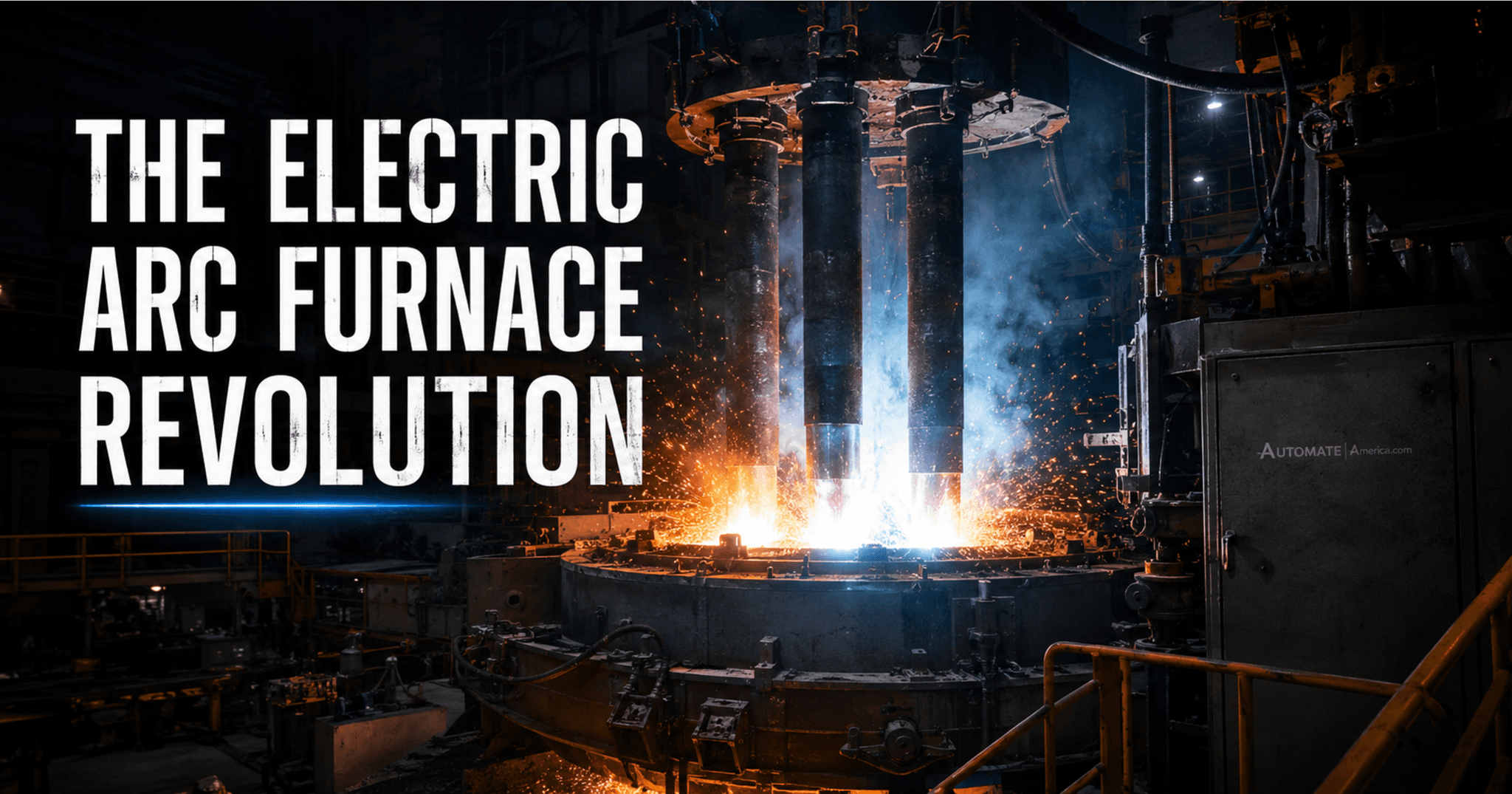
The American steel industry is undergoing its most significant transformation since the introduction of the basic oxygen furnace in the 1960s. Over 70 percent of new US steel production capacity is now electric arc furnace (EAF) based, driven by Nucor, Steel Dynamics Inc. (SDI), Commercial Metals Company (CMC), and other minimills that melt recycled scrap steel using massive electric arcs reaching temperatures of 3,000 degrees Fahrenheit. EAF steelmaking is inherently more automated, more flexible, and more environmentally sustainable than traditional blast furnace operations, and it is creating a new generation of automation careers. The industry projects 25,000 to 35,000 new positions in AI engineering, cybersecurity, and process specialization through 2027, yet companies like Nucor struggle to fill technical positions because few workers have the specific combination of metallurgical knowledge and automation skills these modern mills require.
A modern EAF minimill is a showcase of industrial automation. The scrap yard uses overhead cranes with automated positioning to load charging buckets. The EAF itself uses electrode regulation systems that maintain optimal arc length by adjusting electrode position hundreds of times per second, power profile control systems that manage the electrical energy input through the melting cycle, and automated alloy addition systems that hit target chemistry within tight tolerances. The ladle metallurgy station uses automated wire feeding, argon stirring, and temperature measurement systems. The continuous caster transforms liquid steel into solid slabs, blooms, or billets using mold level control, spray cooling optimization, and strand guidance systems that must operate with absolute reliability at throughput rates of 200 to 400 tons per hour. The rolling mill then reduces the cast product to its final dimensions using coordinated automation of stand motors, roll gap actuators, loopers, shears, and coilers running at speeds up to 70 miles per hour for hot strip mills.
What Steel Automation Professionals Actually Do
EAF automation engineers work with the most dramatic process in steelmaking. They configure and maintain the electrode regulation systems (from vendors like Danieli, Primetals Technologies, and SMS group) that control the electric arcs, optimize power profiles to minimize energy consumption while maximizing melting speed, configure the chemical sampling and alloy addition systems that hit target steel chemistry, and integrate data from dozens of sensors measuring temperature, gas composition, electrical parameters, and structural vibration. Modern EAFs increasingly use AI-driven optimization that adjusts the melting practice in real time based on scrap mix, energy prices, and target steel grade. The engineer must understand both the metallurgical process and the control system that manages it.
Continuous casting automation engineers ensure the safe and efficient transformation of liquid steel to solid product. The mold level control system is particularly critical -- maintaining the liquid steel surface within a millimeter of its setpoint inside a water-cooled copper mold while steel is simultaneously being poured in from above and withdrawn from below. Eddy current sensors measure the mold level, and electromagnetic or stopper rod actuators control the flow. The spray cooling system downstream uses hundreds of nozzles to extract heat from the strand at precisely controlled rates that determine the internal quality of the steel. Breakout detection systems use thermocouple arrays embedded in the mold to identify the early stages of a shell breach that, if undetected, would release liquid steel and potentially cause an explosion. These systems must have response times measured in milliseconds.
Rolling mill automation engineers work across Level 1 (basic automation) and Level 2 (process optimization) systems. Level 1 manages the real-time motor control, roll gap positioning, and material tracking through the mill using PLCs and specialized drive systems from vendors like ABB, Siemens, and Danieli Automation. Level 2 calculates optimal roll schedules, predicts finishing temperatures, and adapts passes in real time based on measured strip dimensions and mechanical properties. Hot strip mills are among the most complex automated systems in any industry, with 20 or more consecutive rolling stands that must be precisely coordinated while processing steel at temperatures exceeding 1,600 degrees Fahrenheit.
Pay and Career Progression
Entry-level mill operators often work overtime and earn shift differentials. EAF operators train for one to three years and earn a shift differential. Rolling mill operators and technicians need electrical, mechanical, and basic PLC skills. Automation and controls engineers program PLCs (primarily Allen-Bradley, Siemens, and Beckhoff in steel applications), configure HMI/SCADA systems, and maintain drive systems; their pay follows experience, the employer and the region. Pay for metallurgical engineers with process control responsibilities depends on experience, the employer and the region. For AI and data analytics engineers applying machine learning to process optimization, pay follows experience, the employer and the region; the work is demanding, and even small improvements in yield and energy efficiency have an enormous economic impact.
Nucor's compensation model is particularly notable. The company uses a production bonus system where team members earn base pay plus weekly bonuses tied to the quantity and quality of steel produced. Under this system, pay rises with the output of the team and the mill. Steel Dynamics, CMC, and other EAF operators use similar incentive structures. On Automate America each professional sets their own rate on their profile, and a contract shows the rate the company posted.
Essential Skills and Certifications
PLC programming and troubleshooting is the core skill -- Allen-Bradley ControlLogix and CompactLogix are dominant in many US mills, while Siemens S7-1500 and Beckhoff TwinCAT are common in mills built with European technology. AC and DC drive programming covers ABB ACS880 and DCS880 drives, Siemens SINAMICS, and specialized mill duty drives from vendors like Nidec (formerly Emerson/Control Techniques). HMI/SCADA platforms include Ignition (gaining rapid market share in steel), Wonderware, and GE iFIX. Industrial networking skills are essential because modern mills use Ethernet-based networks (EtherNet/IP, PROFINET, EtherCAT) for everything from drive communication to safety systems.
Safety certifications include OSHA 10 or 30-Hour General Industry, MSHA (Mine Safety and Health Administration) training for some operations, crane operation certification (NCCCO), and hot-work safety training. ISA CCST and CAP certifications validate automation competency across industries. Lean Six Sigma certifications are valued for process improvement roles. Vendor certifications from Rockwell Automation, Siemens, ABB, and specific steel technology providers (Danieli, Primetals, SMS) demonstrate platform expertise. The Association for Iron and Steel Technology (AIST) offers training programs including the Modern Electric Furnace Steelmaking course covering safety, electrical and mechanical fundamentals, refractories, raw materials, and energy balance.
Training and Getting Started
Nucor Technical Academy in Tuscaloosa, Alabama provides hands-on training specifically designed for new entrants to the steel industry. Many EAF operators follow a 6 to 12-month path in support roles learning the operation before beginning 12 to 24 months of on-the-job EAF training. Community colleges near steel production centers offer relevant programs -- Ivy Tech Community College in Indiana (near Nucor mills in Crawfordsville and Bluffton), Cuyahoga Community College in Cleveland (near major steel operations), and community colleges in Birmingham, Alabama (near multiple minimills). AIST provides professional development, networking, and scholarships specifically for the steel industry. Universities with strong metallurgical and materials engineering programs include Colorado School of Mines, Missouri University of Science and Technology, and Michigan Technological University. Professionals from other heavy industries -- power generation, chemical processing, mining -- will find their automation skills directly applicable to steel, though the metallurgical knowledge takes time to develop.
FOLLOW AUTOMATE AMERICA


✉ Email the editor·💬 Text Automate America: 586-770-8083
Tony Wallace, Co-Founder · Automate America
Text first: 586-770-8083 or call·info@automateamerica.com