
Four openings, and the reason there are four
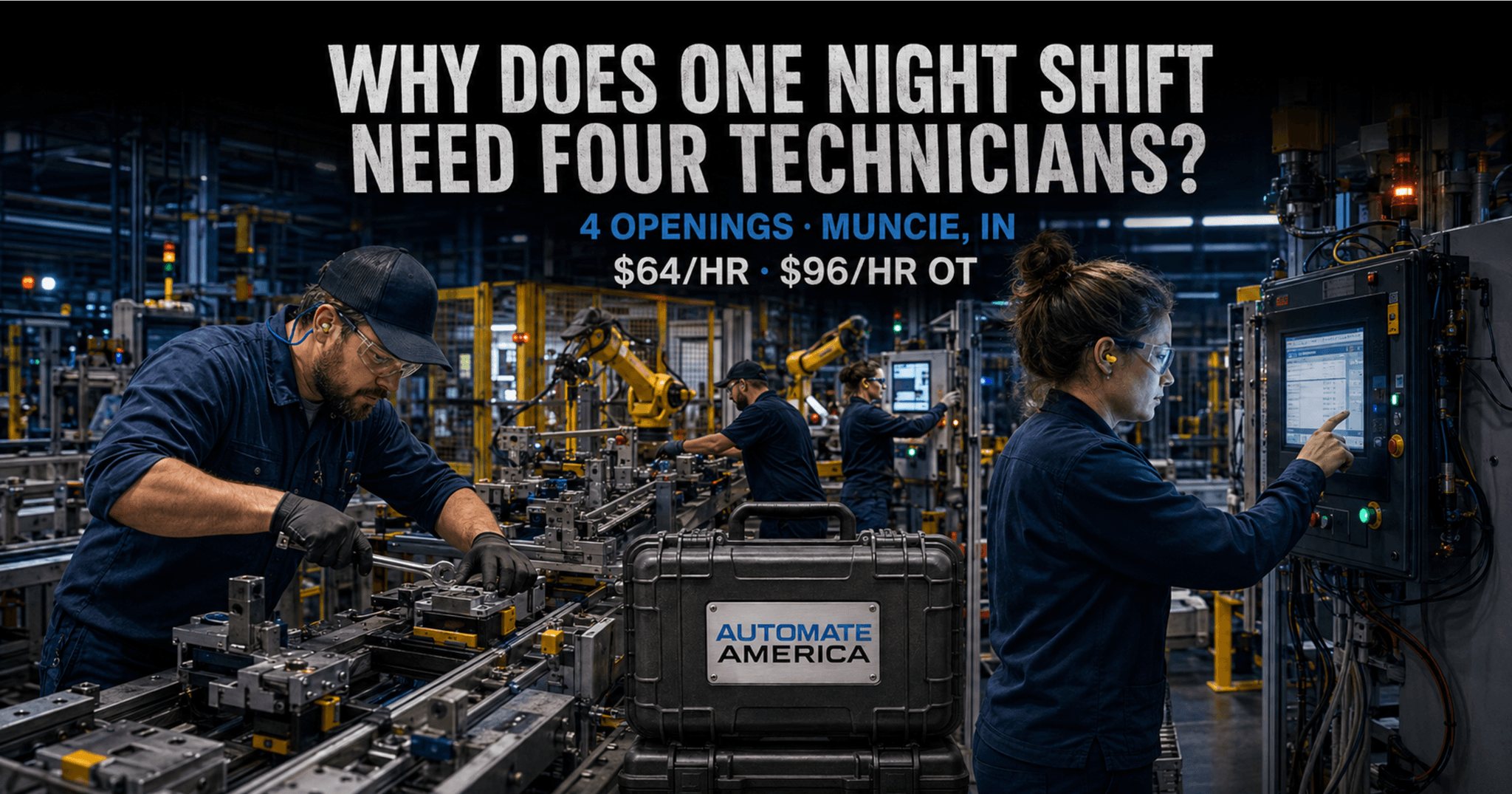
A plant in Muncie, Indiana runs an assembly line around the clock, and right now it is short four maintenance technicians. Not four of the same person — two mechanical and two controls, one of each on 2nd shift and one of each on 3rd. The work starts August 10 for two weeks and extends a week at a time. It pays $64.00 an hour base and $96.00 an hour on overtime, on 10-hour nights, seven days a week.
The pairing is the interesting part. A lot of plants post for "maintenance" and take whoever answers. This one split the request down the middle, twice, and staffed each half of the night separately. That tells you something about what actually goes wrong on an assembly line after the day shift goes home.
What "minor" really means on a live line
The scope sheet is unusually plain about the work. On the mechanical side: adjust pallet stops and switches, replace damaged tooling, troubleshoot line stoppages, support mechanical change overs. On the controls side: adjust and replace sensors, clear and release faults, handle miscellaneous robot faults, handle miscellaneous torque gun faults, review test stand alarms.
Every one of those tasks is described as minor. Anyone who has stood on a plant floor at two in the morning knows how much that word is carrying. Minor does not mean easy and it does not mean unimportant. It means nobody can tell you in advance which of those things will be wrong tonight, and that the difference between a good technician and an expensive night is whether the fix takes eight minutes or eighty.
A pallet stop that drifts out of position does not announce itself. It produces a jam three stations downstream and a fault code that points somewhere else. A torque gun that intermittently faults is not a broken tool — it is twenty minutes of somebody deciding whether the problem is the gun, the controller, the fastener or the fixture. The word "miscellaneous" in a scope sheet is an honest admission: the plant knows it cannot list what will happen, so it is hiring judgement rather than a checklist.
Why the mechanical and controls split matters
On a modern assembly line the two disciplines have grown apart. The mechanical technician lives in the physical world of stops, tooling, guarding and change overs — the parts of the line you can put a wrench on. The controls technician lives in sensors, faults, robot cells and test stands — the parts that tell the line what to do and complain when it does not.
Plenty of technicians are genuinely strong on one side. Fewer are strong on both, and a plant that needs coverage at 2 a.m. cannot gamble on which kind of failure the night will bring. Staffing one of each per shift is not redundancy; it is the plant admitting that a line stoppage can start on either side of that line and it needs someone competent standing on both.
The posting lists Allen-Bradley / Rockwell experience — RSLogix 5000 and Studio 5000 — as good to have, not as a requirement. That distinction is worth reading carefully if you are on the fence. If your servo and sensor years went into a different platform, this contract is still written for you. The gate here is troubleshooting on live equipment, not a software badge. Technicians who want to add the platform can do it through Rockwell Automation's training and certification programs, and those coming from the process and instrumentation side will find the ISA certification tracks map closely onto this kind of work.
Nights, seven days, and being honest about it
Ten-hour shifts, seven days a week, on 2nd and 3rd shift. There is no version of that sentence that sounds like a lifestyle choice, so it is worth putting the arithmetic where you can see it rather than burying it.
At $64.00 an hour base with $96.00 an hour on overtime, a seven-day week of ten-hour nights is a serious week. The contract is two weeks to start and extends weekly, which means the commitment you are making today is short and the upside if the plant keeps you is open-ended. For a technician between projects, that shape — short commitment, real rate, weekly renewal — is often a better trade than a longer contract at a softer number.
Standard PPE applies: safety shoes, glasses and hearing protection, plus lock-out / tag-out discipline. If you want the formal grounding on that, OSHA's control of hazardous energy standard is the source document, and it is the one that matters most on a line that other people will restart while you are working on it.
The part written for service companies
If you run a service company or you are an Automate America service partner, read this section twice, because the contract is aimed at you as much as at any individual technician.
Four openings. Four days' notice. Nights and weekends included. Through the usual channels, that request becomes a month of phone calls, a stack of resumes you did not ask for, and a margin nobody shows you. Meanwhile your own technicians are sitting on the bench in the second week of August, which costs you more than the payroll line suggests — it costs momentum, and it costs the conversation you have with those technicians in September.
You can apply your own people to this contract directly. Idle Friday, billable Monday, on work that renews weekly for as long as the plant needs the coverage. That is the whole mechanism, and there is nothing clever about it: the work is posted publicly, you apply, the customer picks.
Why the work is here and not somewhere else
Automate America is a marketplace. That is the entire product, so it is worth being plain about it.
A customer posts the work themselves, at the rate they want. Nobody negotiates them down and nobody bids the professionals down. It is free to post, free to apply and free to hire. Trusted professionals with ratings, reviews and endorsements apply directly, and the customer decides who to talk to.
And the customer does not have to market the work. We do that. The contract gets written, designed, published and pushed across our channels — which is exactly what you are reading right now. This article, the email that went with it and the posts that carry it are not a favour; they are the product. That is the part most people do not realise until their first posting fills.
It runs from emergency call-outs through year-long engagements, onsite, remote or hybrid, anywhere in the world, across every profession. If you have work, you can post your own opportunity free and see what the response looks like before you commit to anything.
The wider picture
Skilled maintenance is the constraint almost nobody budgets for. Industry skills bodies such as NIMS have spent the last few years expanding maintenance and industrial-technology credentials, and the growth in demand is not driven by new plants — it is driven by existing lines running harder, longer and with more automation bolted onto them than the original maintenance plan assumed. Every robot, torque gun and test stand added to a line adds something that can fault at 2 a.m.
That is why a request like this one shows up with four days' notice. It is not poor planning. It is a plant discovering that around-the-clock output needs around-the-clock coverage, and that the coverage has to exist before the stoppage does. Industry coverage of that shift is worth following at Automation World if you want the broader context.
If this one is yours
Four openings in Muncie, Indiana. Two mechanical, two controls, one of each on 2nd and 3rd shift. Ten-hour nights, seven days. $64.00 an hour base, $96.00 an hour overtime. Starts August 10 for two weeks, extending weekly.
Apply for the contract here. If you would rather look at everything open first, the full hourly contract board is public, and you can search professionals or follow the customers posting work if you are on the hiring side. New here? Create an account — it takes a minute and costs nothing.
Contracts staffed this fast do not sit for long. And if it is not your week, it is somebody's — you probably thought of them somewhere around the rate line.
Next steps on Automate America
- Post your work free — Set the rate you want to pay. Posting and receiving applicants cost nothing.
- Create your free profile — Your completed work, platforms and reviews in one record that customers search.
- Search open contracts — Every open contract and what it pays, updated as they post.
- Find professionals — Search thousands of professionals by skill, platform and location.
- Training and certification — Build the skills the contracts above are actually asking for.
Explore more
- Browse every open contract
- Find skilled professionals
- See the companies hiring
- Work by occupation
- Training programs
- More from the Automate America blog


✉ Email the editor · 💬 Text Automate America today: 586-770-8083
Tony Wallace, Co-Founder · Automate America · Text/Call 586-770-8083 · info@automateamerica.com