The half of automation nobody films
A shop in Holland, Michigan needs two machine tool builders, starting September 14 and running through October 31, with the posting saying it is likely to extend. The work is general assembly on automated manufacturing equipment: building fixtures up from prints, mounting cylinders, clamps and nests, and running plug-and-play electrical cable and pneumatic hose. Ten-hour days, five days a week, day shift, some Saturdays possible. The rate is $64.00 an hour straight time, $83.20 on overtime, and $102.40 on Sundays and holidays.
That is the contract, plainly. The rest of this is about the trade it belongs to, and about the town it is in — because both are more interesting than the job ad makes them sound.
West Michigan builds the machines that build things
There is a stretch of Michigan running roughly from Holland up through Zeeland and Grand Rapids that does something slightly unusual. It does not only make products. It makes the equipment that makes products, and then it makes the products too.
Within a short drive of that Holland shop are office-furniture manufacturing, automotive interiors and seating, mirrors and electronics, food processing at scale, and the machine builder and integrators who supply all of them. Companies like Haworth in Holland, Gentex in Zeeland and tier suppliers such as Autokiniton and Challenge Manufacturing anchor the demand side; a dense layer of tool shops, fixture builders and automation integrators supplies it.
That density is the reason a seven-week fixture build in Holland is not an isolated gig. A builder who takes this contract lands inside a radius where equipment is being designed, assembled, commissioned and rebuilt more or less continuously.
What a machine tool builder actually does
Ask most people what automation looks like and they will describe a robot arm moving. Ask anyone who has commissioned a line and they will tell you the robot is the last thing to arrive and the easiest part to make work.
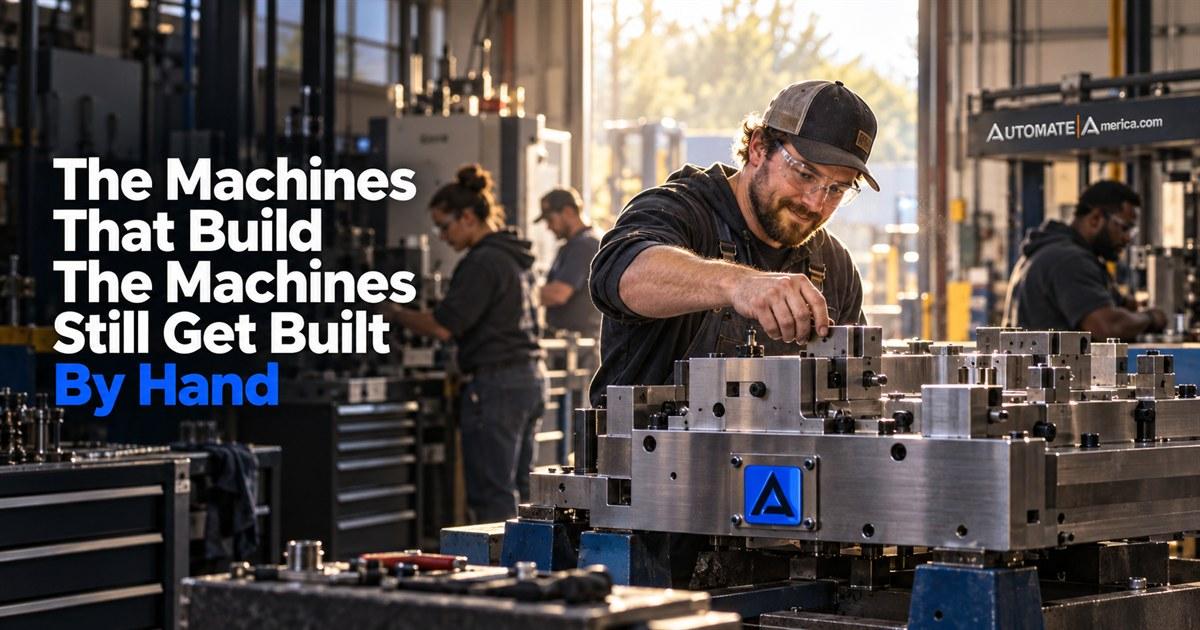
Before that, somebody takes a stack of assembly prints and turns them into steel that holds a part in exactly one position, every time, for years. That is the machine tool builder's job. It involves:
- Reading the print and building to it. Not interpreting it, not approximating it — building the thing the drawing describes, including the details that only matter later.
- Locating and mounting. Cylinders, toggle clamps, locating nests, stops and sensors, each one positioned so the part seats the same way on the ten-thousandth cycle as on the first.
- Running the services. Electrical cable and pneumatic hose, routed, clipped and terminated so the machine can be maintained by somebody who has never seen it before.
- Proving it. Levelling, squaring, checking, adjusting — the unglamorous hours that decide whether the line runs or fights.
The reason this matters commercially is simple: the tolerance a builder sets is the tolerance every part after it inherits. A fixture built half a millimetre out does not fail on the bench. It fails eight months later as an intermittent reject rate nobody can trace.
Why this kind of work is contracted rather than hired
A build like this one has a defined start, a defined end and a defined deliverable. It needs two skilled pairs of hands for about seven weeks, and then it does not need them again until the next build.
No shop can carry permanent headcount for every peak in that curve and stay profitable. Capability here is reached, not owned. That is why short, well-specified builds are the natural shape of contract work in this trade, and why a builder who is good at them rarely has an empty calendar for long.
If you are the one who needs the builders
Automate America is a free, fair and open marketplace — all the work and all the people in one place, with no gatekeeper in between.
You post at the rate you want to pay, and there is nothing to negotiate. Nobody is bid down and nobody is quoted a margin they cannot see. Trusted professionals with real ratings and reviews from completed contracts apply directly.
It is free to post, free to apply and free to hire. Registration takes a name, an email address and a verified phone number.
And once your work is on the board, getting it seen is our job rather than yours. We write it up, design it, publish it and push it across every channel we run. This article is what that looks like.
And if you run a service company
This is the part that gets missed most often, and it is half the market.
A service company's most expensive week is the one with skilled people on the payroll and nothing to bill them against. Automate America is where those people go billable on somebody else's build — without your having to win the job first. Your builders stay on your payroll, arrive with your company's backing, and come back having worked in an industry you may not currently serve.
Slow season, apply your available employees to open contracts. Busy season, take builds bigger than your headcount and pull the extra hands from the marketplace. One supplier, thousands of professionals, at no cost to you.
Learning the trade, and keeping it current
Machine building is still largely learned on a floor beside somebody who already knows it, but the credentialing side is real and worth having. NIMS maintains national metalworking and machining standards used across the industry. The Manufacturing Institute publishes workforce research and training pathways for exactly this population. The NIST Manufacturing Extension Partnership works directly with small and mid-size manufacturers — including the kind of shop this contract is in — and has a Michigan centre. For wage context across mechanical assembly and industrial machinery occupations, the Bureau of Labor Statistics OEWS series is the standard reference.
The contract, once more, in one place
Two machine tool builders. Holland, Michigan. September 14 through October 31, likely to extend. Ten-hour days, five days a week, day shift, some Saturdays possible. $64.00 straight, $83.20 overtime, $102.40 Sunday and holiday. General assembly, fixtures to print, cylinders, clamps, nests, plug-and-play cable and hose.
View the contract and apply · Post your own opportunity, free · Browse every open hourly contract · Search and request professionals directly · Find and follow customers · Join or sign in
The robots get the photographs. The fixtures decide whether the line makes its number.
Next steps on Automate America
- Post your work free — Set the rate you want to pay. Posting and receiving applicants cost nothing.
- Create your free profile — Your completed work, platforms and reviews in one record that customers search.
- Search open contracts — Every open contract and what it pays, updated as they post.
- Find professionals — Search thousands of professionals by skill, platform and location.
- Training and certification — Build the skills the contracts above are actually asking for.
Explore more
- Browse every open contract
- Find skilled professionals
- See the companies hiring
- Work by occupation
- Training programs
- More from the Automate America blog


✉ Email the editor · 💬 Text Automate America today: 586-770-8083
Tony Wallace, Co-Founder · Automate America · Text first 586-770-8083 · TonyW@AutomateAmerica.com