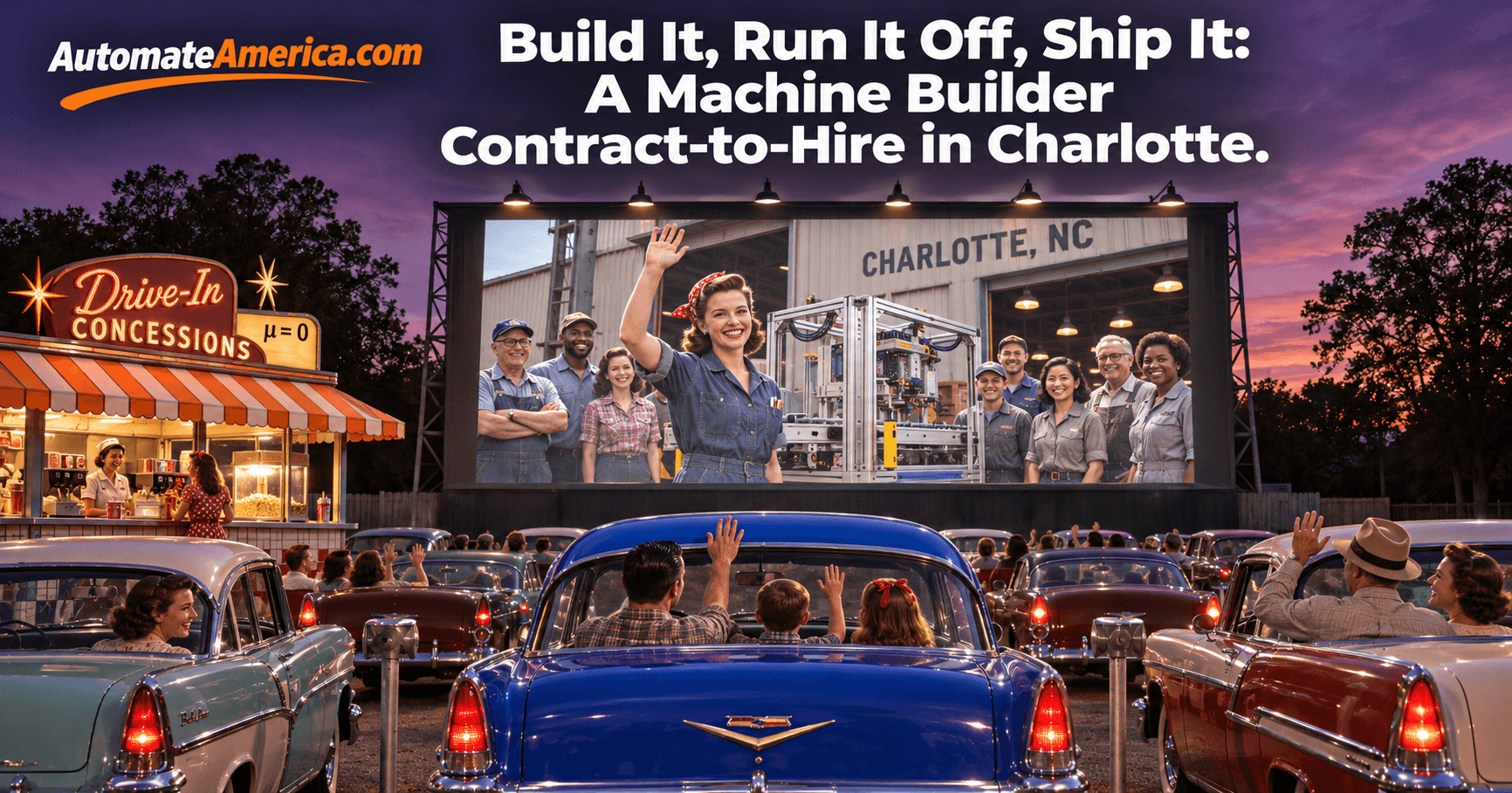
A custom machine builder in Charlotte, North Carolina needs one Machine Builder on site from Monday, November 9, 2026 through January 29, 2027: twelve weeks on the day shift, 6 a.m. to 2:30 p.m., five days a week. Pay is $44 an hour base, $54.40 an hour overtime and $80 an hour double time. The role is contract-to-hire: if you are hired on full time, health insurance after the probationary period and a full benefits package come with it. Read the full contract and apply.
What the twelve weeks are for
The posting lists the whole life of a custom machine. You fabricate, machine and assemble the equipment for each project; help debug and troubleshoot it; take part in its tryout and runoff; document every detail component you make and every change to the mechanical, pneumatic and hydraulic drawings and the bill of materials; take the machine apart and prepare it for shipment; and help install it, with service calls and service reports at the customer's location.
From the bench to the runoff
A custom machine is rarely right the first time it moves. Debugging is where a builder earns the job: a cylinder that strokes too fast, a guard that fouls a slide, a sensor bracket that sits a few millimeters off. The tryout runs the machine against real parts, and the runoff is the day it proves itself to the people who will own it. A builder who has been in the frame from the first bolt usually finds the fault faster than anyone reading the drawings cold. Guarding has to be right before anyone runs it off; the B11 machine safety standards are where most shops start.
The drawings and the bill of materials
Every change made on the floor has to reach the paper. This posting asks the builder to document the detail components and the changes to the mechanical, pneumatic and hydraulic drawings and the bill of materials, so the machine that ships is the machine on the prints. When the customer's maintenance team, the next shift or the next builder opens those prints, they find the machine as it really is, not as it was first drawn. On a build with air and oil circuits, the National Fluid Power Association keeps the fluid power basics in one place.
Installation and service calls
The machine is not finished when it leaves the shop. The posting includes disassembly for shipment, the installation at the customer's location and service calls there, with a service report each time. One eligibility question asks whether you can cover required travel costs up front and be reimbursed under the contract's terms, so expect some time at customer sites.
Where custom machines like this one go
A custom machine is built for one job on one line, which is why nobody can buy it from a catalogue. Shops that build them in the Carolinas and across the Southeast supply assembly lines, packaging lines, test stands and material handling for plants that make cars and parts, appliances, medical devices, batteries and consumer goods. The posting does not say which industry this machine is for, and it does not need to: the work of building it is the same. Frames and bases are fabricated, slides, cylinders and fixtures are fitted, air and oil circuits are plumbed, and the whole thing is made to run the part it was built for, again and again, before it ever leaves the shop.
That is what makes the builder's trade portable. A builder who has assembled, debugged and installed a machine for one customer can do it for the next, whatever that customer makes. The skills travel; only the part on the fixture changes.
The skills that carry a builder through twelve weeks
The posting's interview questions say what matters: how many years of custom machine building you have, whether you can supply your own tools, and whether the 6 a.m. to 2:30 p.m. day suits you. Under those sit the everyday skills of the trade: reading mechanical, pneumatic and hydraulic drawings; fitting and aligning by hand; working to a bill of materials; keeping records of what you changed; and the patience to chase a fault until it stops coming back.
If you want to put a name to those skills, two places are worth knowing. NIMS credentials cover machining and industrial technology skills that shops recognize, and the International Fluid Power Society certifies fluid power mechanics and technicians, the people who keep the air and oil circuits on machines like this one working. Neither is a requirement of this posting; both are ways to show a customer what you already know.
What you bring
The tools called for are basic hand tools, basic electrical tools, Allen wrenches and standard air tools. One interview question asks whether you can supply your own tools to build with, so check your own kit before you apply.
Schedule, pay and the contract-to-hire part
The day shift runs 6 a.m. to 2:30 p.m., five days and forty hours a week, from Monday, November 9, 2026 to January 29, 2027. The posted rates are $44 an hour base, $54.40 an hour overtime and $80 an hour double time, in US dollars. If you are hired on full time, health insurance after the probationary period and a full benefits package come with the role.
Why contract-to-hire suits a build like this
A build has a shape: it starts, it peaks at runoff, and it ships. Contract-to-hire fits that shape for both sides. The builder sees the shop, the team and the machines before deciding whether to stay, and is paid the posted rates the whole time. The shop sees the builder's work on a real build before offering a permanent place. For this posting the permanent side is stated plainly: if you are hired on full time, health insurance after the probationary period and a full benefits package come with it.
Who did the work, and who got the credit
Machine builders are some of the least visible people in manufacturing. The machine leaves with the shop's name plate on it, the plant runs it for years, and the person who aligned every slide and chased every leak is rarely named. That is the part Automate America was built to change. On a member profile, the contracts you finish and the reviews customers leave stay with you, so the next shop can see what you have built before it calls. Every contract you complete adds to that record, and the record travels with you to the next build.
How Automate America works for builders and the shops that hire them
Automate America is a marketplace where companies post their opportunities directly to skilled professionals. Professionals search open contracts in plain words, apply with the profile they already have, and mark themselves available each week so customers see them first. Companies post hourly contracts, direct jobs and RFQs at no cost, search for professionals the way they would describe them, and request the person they want by name. Everything about this contract, from the duties to the three posted rates, is on its own page, open to anyone.
How to apply
You apply on the contract page with your profile. Four interview questions are answered when you apply: your years of custom machine building, whether you can supply your own tools, whether the 6 a.m. to 2:30 p.m. hours work for you, and your interest in a contract-to-hire position. Two eligibility questions cover US work authorization and travel costs. Apply for the Machine Builder contract.
Posting a build of your own
The shop behind this contract had a build schedule and wrote its need up as a posting with its own rate, as a contract that can turn permanent. Plants, integrators and machine builders with a build ahead can do the same on Automate America, where companies post their opportunities directly to skilled professionals. Posting a contract costs nothing, and you can search the professionals who build machines like this one.
This article is one of the ways a posting reaches people: the same contract goes out by email, in a short video and across the social channels we run.
Thank you
Thank you to the builders who keep American plants running, and to the shops that post their work openly with the rates on the page. Every machine on a plant floor started on somebody's bench. If this one is yours to build, the link below is where it starts.
The contract, in brief
Machine Builder (Automation Machine Builder). One needed, on site in Charlotte, North Carolina. Fabrication, machining and assembly of custom equipment, debugging and troubleshooting, tryout and runoff, documentation of drawing and BOM changes, disassembly for shipment, installation and service calls. Monday, November 9, 2026 to January 29, 2027, twelve weeks, day shift 6 a.m. to 2:30 p.m. $44 an hour base, $54.40 overtime, $80 double time. Contract-to-hire. US work authorization required.
Read the full contract and apply · Browse every open contract · Search and request professionals · Post a contract
Next steps on Automate America
- Post your work free — Set the rate you want to pay. Posting and receiving applicants cost nothing.
- Create your free profile — Your completed work, platforms and reviews in one record that customers search.
- Search open contracts — Every open contract and what it pays, updated as they post.
- Find professionals — Search thousands of professionals by skill, platform and location.
- Training and certification — Build the skills the contracts above are actually asking for.
Explore more
- Browse every open contract
- Find skilled professionals
- See the companies hiring
- Work by occupation
- Training programs
- More from the Automate America blog


✉ Email the editor · 💬 Text Automate America today: 586-770-8083
Tony Wallace, Co-Founder · Automate America · Text first 586-770-8083 · TonyW@AutomateAmerica.com