Four to five FANUC robot programmer are needed to debug and commission new automated manufacturing equipment for the automotive industry, and the cells they will bring up are guided by FANUC iRVision 3D. The work starts on September 28, 2026 in Wixom, Michigan for three to four weeks, then moves to Toledo, Ohio and runs through the end of the year. It pays $64 an hour straight time and $80 an hour overtime, on a day shift of about ten hours a day, six days a week. GM GRS standards certification is required, along with hands-on 3D vision integration and troubleshooting, and automotive experience is preferred.
What commissioning a vision-guided cell really involves
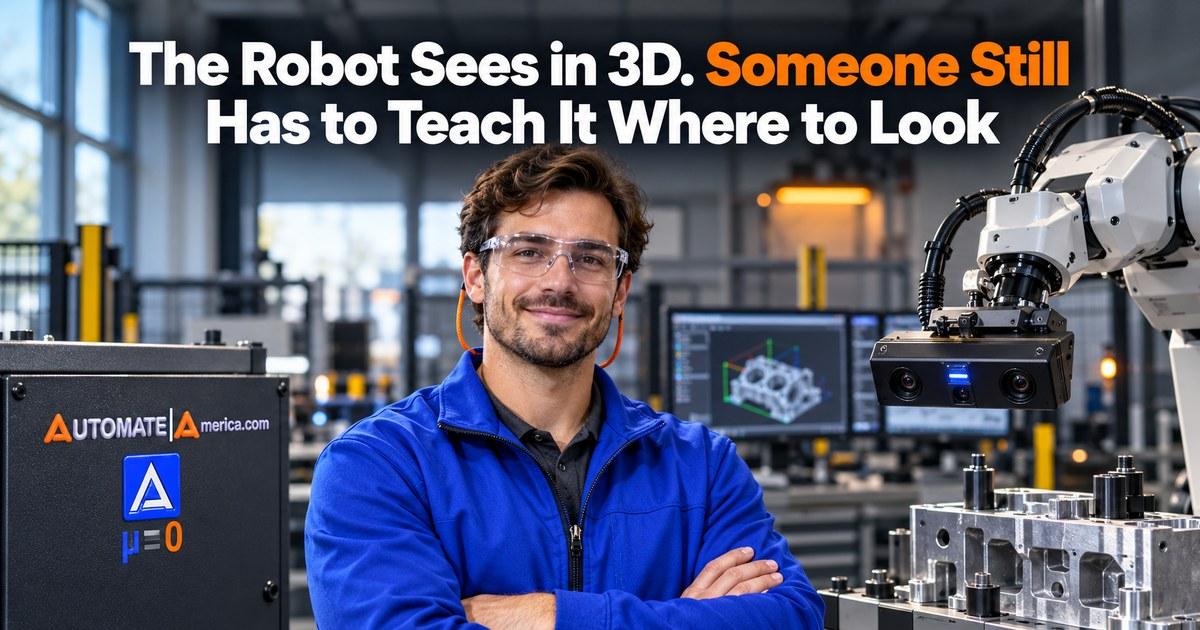
On a conventional cell, a robot goes to a position it was taught and trusts the fixture to have put the part there. A vision-guided cell turns that around. The part arrives wherever it arrives, a sensor measures where it actually is, and the robot corrects its own path to meet it. That is what makes these cells flexible enough for modern automotive lines, and it is also what makes them harder to bring up, because a new variable now sits between the robot and every part it touches.
Commissioning one is a chain of agreements. The sensor has to agree with the robot about where the sensor is. The robot has to agree with the tool about where the gripper is. Both have to agree with the fixture, the conveyor and the part about where the work is. Each of those can be slightly wrong on its own and still pass a quick check, and the error only shows when they stack: a pick that lands perfectly all morning and then misses on a part that came in a few degrees rotated, under a different angle of light from the skylights.
Debug on this kind of equipment is therefore less about writing motion and more about finding which agreement broke. The professionals who are good at it tend to have a habit in common: they measure before they teach, and they do not call a cell finished until it has run parts on its own, across real variation, without anyone standing beside it.
3DL and 3DV, and why the posting names both
FANUC's iRVision family covers two-dimensional and three-dimensional guidance, and this contract is firmly in the 3D half. The posting lists both the 3DL, the laser-based 3D sensor, and the 3DV, FANUC's 3D vision sensor. They solve related problems in different ways, and a programmer who has set up one is usually well placed to learn the other, but they are not interchangeable in practice: calibration routines, lighting sensitivity and the way each one fails are different enough to matter on a startup schedule.
Naming both is a signal worth reading. It says the equipment will need people who understand 3D guidance as a discipline rather than a single part number, and who can troubleshoot the sensor, the calibration and the robot program as one system.
Wixom first, then Toledo
The contract is built around the equipment rather than a single address. The first three to four weeks are in Wixom, in Oakland County, northwest of Detroit, which is where the equipment is debugged. After that, the work follows the equipment to Toledo, Ohio, a little over an hour south, and stays there through December.
For a programmer, that shape has a practical advantage that is easy to overlook. The people who debug a cell before it ships are the people who already know its quirks when it is set down again on a different floor, with different power, different air and different light. Keeping that knowledge on the project through installation is one of the more reliable ways to shorten the second startup, and the posting is written to do exactly that.
Southeast Michigan and northwest Ohio share one of the densest concentrations of automotive manufacturing and automation expertise in the country. Organisations such as Automation Alley exist largely because so much of that work is concentrated in the same few counties.
The schedule and the pay, plainly
The pay is $64 an hour straight time and $80 an hour overtime. The schedule is a day shift of about ten hours a day, six days a week, from September 28, 2026 to the end of the year. That is a startup schedule, and it is stated up front rather than discovered in the first week.
The posting also notes that travel-related expenses are possible for highly qualified candidates, depending on where they live. That is a conditional line and it is worth reading as one: it depends on the candidate and the location, and the details are settled on the contract rather than promised in advance.
GM GRS certification and the rest of the requirements
The requirements are specific, and that specificity is useful to anyone deciding whether to apply. Strong FANUC robot programming. FANUC iRVision 3D, required. Hands-on 3D vision integration and troubleshooting. Industrial automation experience. GM GRS standards certification, required. Automotive experience, preferred.
The certification requirement tells you something about the equipment: it is being built and commissioned to a documented automotive robotics standard, where program structure, naming, and safety and fault-handling conventions are expected to follow an established pattern rather than each programmer's personal style. Programmers who have worked to those standards before know how much faster a cell comes up, and how much easier it is to support later, when every program on the floor reads the same way.
What a strong application for this contract shows
Because the requirements are this specific, the applications that stand out tend to be specific too. A line that says "FANUC programming, 10 years" tells a hiring manager very little. A line that says which 3D sensor you commissioned, on what kind of cell, and what the hardest problem was tells them almost everything they need to know before the first conversation.
The details worth putting in front of them are the ones this posting asks about directly. Name the iRVision 3D work you have done, and whether it was the 3DL, the 3DV or both. Describe a startup you took from first power-up to running parts, and roughly how long it took. Say where you have worked to GM GRS standards and on what equipment. If you have chased a vision problem down to calibration, lighting or part presentation, say which one it turned out to be and how you proved it. And keep your profile current, because ratings, reviews and completed contracts are the first things a customer looks at when your application arrives.
Where this skill is learned, if you are building toward it
Robot programming with vision guidance sits at the top of the skills ladder for robotics technicians, and there is no shortcut to the hands-on part. In the same region as this contract, Oakland Community College and Owens Community College both train technicians for the manufacturing economy around them, and the robot manufacturers' own training programs remain the standard route to controller-specific skills. For the wider career picture, the U.S. Bureau of Labor Statistics Occupational Outlook Handbook is the most reliable public reference on the engineering technician roles this work grows out of.
How this contract came to be public at all
Automate America is a marketplace for skilled professionals, and it is free to post, free to apply and free to hire. A customer posts the work at the rate they have chosen, that rate is public before anyone applies, and nobody bids anyone down to win it. Professionals with ratings, reviews and completed contracts behind them apply directly.
For a plant or an integrator facing a startup, the mechanics are simple. Post the work with the skills and the rate, and it goes in front of thousands of professionals, including people who are not reading any job board because they already have a job. We write it up and promote it across email, social and video, and the paperwork stays simple because Automate America is the one approved supplier, whoever you bring on.
If you run a service company
The most expensive week in a service company is the one where a qualified programmer is on the payroll with nothing to bill. It never appears on an invoice, which is why it is so rarely discussed, and it happens to nearly every shop between projects.
A contract like this one is a direct answer to it. Service companies can apply their own available employees, who stay on their own payroll, spend the remaining months of the year commissioning vision-guided automotive equipment, and come back with experience on technology their regular customers may not have yet. The work is already posted, and the rate is already public.
The contract, in one place
FANUC Robot Programmers, four to five needed. Debug and commissioning of new automated manufacturing equipment for automotive. FANUC robots, FANUC iRVision 3D (3DL / 3DV), hands-on 3D vision integration and troubleshooting. GM GRS standards certification required; automotive experience preferred. Wixom, Michigan for the first 3 to 4 weeks, then Toledo, Ohio through the end of the year. Starting September 28, 2026. Day shift, about 10 hours a day, 6 days a week. $64/hr straight time, $80/hr overtime.
View the full contract and apply · Browse every open hourly contract · Search and request professionals · Find and follow customers · Join free
Next steps on Automate America
- Post your work free — Set the rate you want to pay. Posting and receiving applicants cost nothing.
- Create your free profile — Your completed work, platforms and reviews in one record that customers search.
- Search open contracts — Every open contract and what it pays, updated as they post.
- Find professionals — Search thousands of professionals by skill, platform and location.
- Training and certification — Build the skills the contracts above are actually asking for.
Explore more
- Browse every open contract
- Find skilled professionals
- See the companies hiring
- Work by occupation
- Training programs
- More from the Automate America blog


✉ Email the editor · 💬 Text Automate America today: 586-770-8083
Tony Wallace, Co-Founder · Automate America · Text first 586-770-8083 · TonyW@AutomateAmerica.com