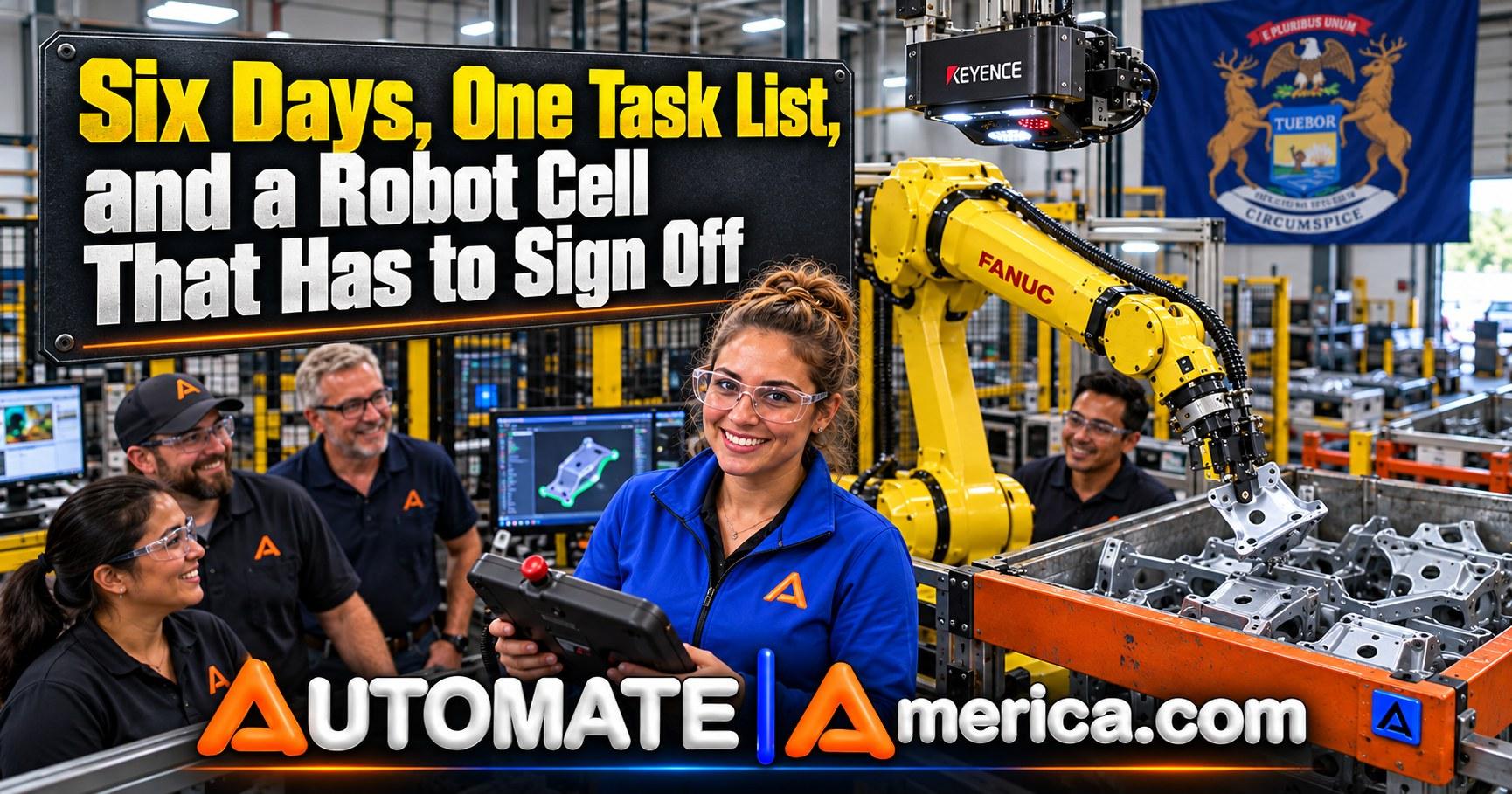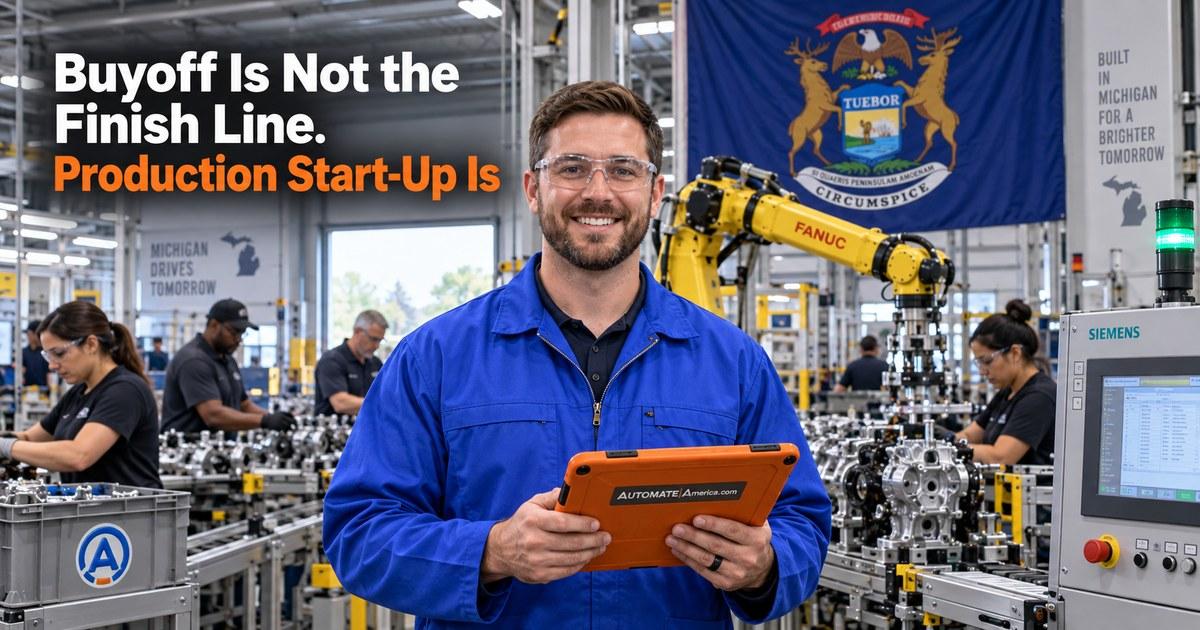
One controls engineer is wanted in Woodhaven, Michigan to take new automated assembly equipment through its final debug and commissioning, and then to stay with it through production start-up. The controls are Siemens: TIA Portal and WinCC, version 17 or version 20, with HMI layout work included. FANUC robots running Handling Tool on R-30iB controllers and Keyence VS series vision are listed as good to have rather than required, and previous Ford experience is called out as a plus. It pays $68 an hour straight time, $88.40 on overtime, $108.80 on Sundays and holidays, and $52 an hour for travel time, on a day shift of about ten hours a day, five to six days a week.
The two jobs inside one launch
Commissioning and start-up support are usually written as one line on a schedule, and they are not the same work. Commissioning ends when the equipment does what the specification says: the sequence runs, the robot reaches its positions, the vision system finds the part, the safety circuit behaves. It is measured against a document, and it has a clean finish — a buyoff.
Start-up support is measured against a Tuesday. The line has to make good parts at rate, with the operators who will run it every day, on material that arrives the way material actually arrives. That is where the faults nobody predicted show up: the pallet that locates fine cold and binds warm, the sensor that reads reliably until the sun comes through the bay door, the recipe that is correct and slower than the takt.
Staffing the first and not the second is one of the most expensive habits in manufacturing, because the cost lands as downtime on a line that is already supposed to be earning. This posting staffs both, with the same person, which is the part worth noticing.
Why the same engineer should do both
Continuity in controls is not sentiment; it is memory. The person who wrote the sequence knows which interlock was added late and why. The person who laid out the HMI knows which screen the operators asked to have simplified. When the line faults at six in the morning three weeks after buyoff, the engineer who built it reads the alarm and already has a shortlist, while a newcomer starts by learning the naming convention.
That is why a contract shaped as "two to three weeks of debug, then six to eight weeks of support, extension possible" is worth more to the plant than two separate hires, even at the same hourly rate.
Siemens is the requirement; the rest is the floor
The mandatory skill on this posting is Siemens TIA Portal with WinCC, specifically on version 17 or version 20, and specifically including HMI layout — not only logic, but the screens the operators will live in. Anyone who has inherited an HMI designed without them knows why that is stated out loud.
Around it sits the rest of a normal automotive cell: FANUC robots running Handling Tool on R-30iB controllers, and Keyence VS series vision. Both are listed as good to have. That split is honest and useful — it says the customer needs one person who can own the PLC and HMI outright, and who will not be lost when the robot or the camera is the thing that is wrong.
What "Ford experience a plus" actually means
The posting says previous Ford experience is a plus. It is not a requirement and it does not say who the customer is. What it signals is that the equipment is built to a documented automotive standard, and that an engineer who has worked to one before will lose less time to conventions: how programs are structured, how faults are named and handled, what a sign-off package has to contain.
Engineers who have carried that experience know it compounds. It is also the kind of thing that never appears on a resume as a skill, which is a good reason to write it down in your profile where a customer searching for it can find you.
Woodhaven, and why the location matters
Woodhaven sits downriver from Detroit, in the densest concentration of automotive manufacturing and automation talent in the country. For a great many controls engineers this is a drive, not a flight, and the contract is written as a day shift rather than nights — which, for ten-hour days over ten weeks, is a materially different life than the same scope on second shift.
Organisations like Automation Alley exist because so much of this industry is concentrated in these few counties, and the U.S. Bureau of Labor Statistics Occupational Outlook Handbook remains the most reliable public reference on the engineering technician and controls roles this work grows out of.
What a strong application shows here
Because the requirement is specific, the applications that stand out are specific too. Name the TIA Portal versions you have shipped on, and say plainly whether you have done HMI layout or only logic. Describe a start-up you stayed through, and what broke in week two that nobody expected in week one. If you have worked to an automaker's standards, say whose and on what equipment.
And keep your profile current, because ratings, reviews and completed contracts are the first things a customer reads when your application lands — often within minutes of the posting going live.
What the first fortnight actually looks like
Final debug on a new assembly line is rarely one big problem. It is forty small ones, discovered in an order nobody can plan: a gripper that drops one part in two hundred, an interlock that trips on a fast operator, a station that runs perfectly until the one upstream runs perfectly too and the buffer fills. The work is diagnostic before it is creative, and it rewards people who change one thing at a time and write down what happened.
Then the line is handed to production, and the questions change shape. Not "does it work" but "does it work all day, with these people, on this material, at this rate". An engineer who is still on site for that stretch converts every one of those questions into a program change or a training note instead of a ticket. That is the difference between a launch that settles in three weeks and one that is still limping at Christmas.
Why contracts like this are hard to fill with a requisition
A plant that needs one controls engineer for ten weeks is asking for something a headcount process handles badly. The role is too short for a hire, too specialised for a general agency, and too urgent for a search that starts with a job description in a committee. Meanwhile the person who fits it is often already working, and will never see the posting because they are not looking.
That mismatch is the whole reason an open marketplace exists. The rate is public, the scope is written by the people who need the work done, and professionals who are busy today can still see what is starting next month. It is also why the specificity in this posting matters: a controls engineer reading "TIA Portal v17 or v20, HMI layout included" knows in one line whether this is their contract, and applies or moves on without a phone call.
How this contract came to be public at all
Automate America is a marketplace for skilled professionals, and it is free to post, free to apply and free to hire. A customer posts the work at the rate they have chosen, that rate is public before anyone applies, and nobody bids anyone down to win it. Professionals with ratings, reviews and finished contracts apply directly.
For a plant or an integrator, one engineer for ten weeks starting in days is a hard thing to source through a requisition and a simple thing to post. After that the promotion is ours: the opening becomes emails, images, videos and articles like this one, in front of thousands of professionals, including people who are employed somewhere and would never open a job board. However it gets filled, Automate America stays the single approved supplier on the paperwork.
If you run a service company
The most expensive week in a service company is the one where a qualified engineer is on the payroll with nothing to bill. It never appears on an invoice, which is why it is so rarely discussed.
Applying your own available engineer to a contract like this one answers it directly. They stay on your payroll, they bill from late September into the back half of November, and they come back having carried a new automotive line from debug into daily production.
The contract, in one place
Controls Engineer, one needed. Woodhaven, Michigan. Final debug and commissioning of new automated assembly equipment, then production start-up support. Siemens TIA Portal and WinCC (v17 or v20, HMI layout) mandatory; FANUC Handling Tool and R-30iB, and Keyence VS series vision, good to have; previous Ford experience a plus. Starting September 23, 2026, running to about the end of November with an extension possible. Day shift, about 10 hours a day, 5 to 6 days a week. $68/hr straight time, $88.40/hr overtime, $108.80/hr Sunday and holiday, $52/hr travel time.
View the full contract and apply · Browse every open hourly contract · Search and request professionals · Find and follow customers · Join free
Next steps on Automate America
- Post your work free — Set the rate you want to pay. Posting and receiving applicants cost nothing.
- Create your free profile — Your completed work, platforms and reviews in one record that customers search.
- Search open contracts — Every open contract and what it pays, updated as they post.
- Find professionals — Search thousands of professionals by skill, platform and location.
- Training and certification — Build the skills the contracts above are actually asking for.
Explore more
- Browse every open contract
- Find skilled professionals
- See the companies hiring
- Work by occupation
- Training programs
- More from the Automate America blog


✉ Email the editor · 💬 Text Automate America today: 586-770-8083
Tony Wallace, Co-Founder · Automate America · Text first 586-770-8083 · TonyW@AutomateAmerica.com