The five-minute test that most industries already passed
Open your phone. Count the things you can summon in five minutes.
A ride. A pizza. A cart of groceries. A pallet moved across the country. A document notarized. A tutor, a dog walker, a handyman. Most of the real economy already works like this: a tap, a match, a price, a delivery window. You trust a rating, you pay through an app, and you keep moving.
Now imagine a production line goes down at 6:14 a.m. on a Tuesday and you need a controls engineer who actually knows Rockwell Studio 5000 and has laid hands on that exact robot family. What happens next in most plants is embarrassing. A plant manager starts texting. Someone calls a preferred integrator, who calls a sub, who calls a guy named Kevin, who is on vacation. Three recruiters email the same résumé by lunchtime. The line is still down. The losses are measured in five-figure-per-hour increments.
The rest of the economy gets next-day. Skilled industrial work is still running on 2003-era email chains.
This piece is about why — and why that era is finally ending.
Why nobody built this yet
The first question every plant manager asks is the fair one: if this is so obvious, why didn't a consumer app already do it?
Three reasons, and they all show up when you try.
1. The work is highly specialized. You can't interchangeably "dispatch" a controls engineer the way you dispatch a driver. A FANUC programmer is not an ABB programmer. Someone trained on Allen-Bradley PLC-5 legacy code is not someone fluent in ControlLogix. A panel wirer for 480V three-phase is not the same skill set as a safety-PLC integrator chasing a Category 3 certification. Platforms built for generic labor collapse the second you need a real filter.
2. The trust bar is higher. A bad driver gives you a bad ride. A bad controls engineer drops a line for a shift and costs a plant hundreds of thousands of dollars. Nobody rushes a hire they don't already know — and the industry's answer for decades was to only hire people the company already knew. That's why the supply side looked like a rolodex instead of a marketplace.
3. The billing is complicated. Time-and-a-half after forty, double-time on Sundays, per-diem on travel jobs, mileage on service calls, certified payroll for prevailing-wage work. Net-30 and net-60 from customers who still want hand-signed timesheets. Generic apps don't touch this. The older intermediated model handled it with opaque billing and multiple hand-offs — and a structural cost premium baked in for the trouble. That model is still the default in many corners of the trade. It hasn't aged well.
So skilled trades were left behind. Not because they didn't need it — because nobody wanted to solve the specialized, high-trust, complicated problem for an audience that was already barely getting paid on time.
What Automate America actually does
Automate America is a global marketplace for skilled professionals — industrial, commercial, and residential work worldwide. Automation and controls are the core, but the same mechanism serves electricians, mechanical technicians, field-service specialists, and the adjacent trades that keep a modern plant running. Thousands of professionals are active on it today — controls engineers, PLC programmers, robotics technicians, panel builders, commissioning leads, mechatronics engineers, industrial electricians, SCADA integrators, and safety-systems specialists — alongside the companies that need them.
A customer posts a contract. The listing goes live, and the professionals who match it are listed for the customer to invite. Applications come straight to the customer’s dashboard. Rates are transparent, the overtime and double-time rates the customer enters are on the contract, and timesheets and invoices generate on the platform so nobody argues about hours at month's end.
And it is genuinely free to use. You read that correctly. Post contracts, jobs, or RFQs for free. Keep your profile live for free. Apply for free. Build reputation for free. There is no placement fee — free to post, free to apply, free to hire.
Companies also have a second path: they don't have to wait to be found. You can search the marketplace and request a specific professional directly — filter by manufacturer experience, reviews, and geography, and reach out to the exact person you need.
A Tuesday morning that doesn't happen anymore
Back to the 6:14 a.m. scenario. Here is how that runs on Automate America — an illustration of the steps, not a timed record.
A plant leader posts a five-day commissioning contract with its base rate, its overtime rate and the per diem written on it. Primary skill: Rockwell ControlLogix plus a specific robot family. The posting goes live the moment it is published.
Applications come in. Two of the applicants carry previous customer reviews on exactly this robot family. One is 28 miles away. Another is in Ohio but has flown into this plant before.
The plant leader accepts the Ohio applicant. Automate America generates the agreement inside the platform, and the contractor e-signs it there.
No phone tag and no intermediary: the plant leader reads each applicant’s record and talks to the professional directly.
That's what "Uber for industrial professionals" actually means. Not an app with a car icon — a working supply-and-demand mechanism for work that has been operating without one for forty years.
Why professionals take the platform seriously
Three reasons the quality curve is steep, and they compound over time.
Reviews are tied to real contracts. You can't leave a review for someone you haven't actually worked with on the platform. That kills fake-review inflation on day one. A star rating is earned on jobs customers actually paid for.
Endorsements are connection-gated. Only contacts who have accepted a connection can endorse your skills. An endorsement means "I worked next to this person and I vouch for this specific skill" — not a stranger padding a profile.
The bar rises every quarter. The customers hiring here are real, and they leave honest reviews. Professionals who aren't ready get filtered out by the market itself. By the time someone has fifteen reviews and a 4.8 average, that's a portfolio no banner can fake — trusted professionals with completed contracts and customer reviews.
What changes for companies
Three line items on the P&L.
Risk. A supplier-to-supplier relationship replaces employer-to-employee. No long-term commitment, no unemployment-insurance drag, no W-2 ceremony when the project ends. Scale up for a commissioning spike, scale down when the line is humming. Less commitment, less risk.
Money. You stop paying the fully-loaded cost of a full-time specialist you need six weeks a year. You contract the specialist on demand and redirect the rest of that salary into capital upgrades, training your own team, or hiring a junior who grows into the role.
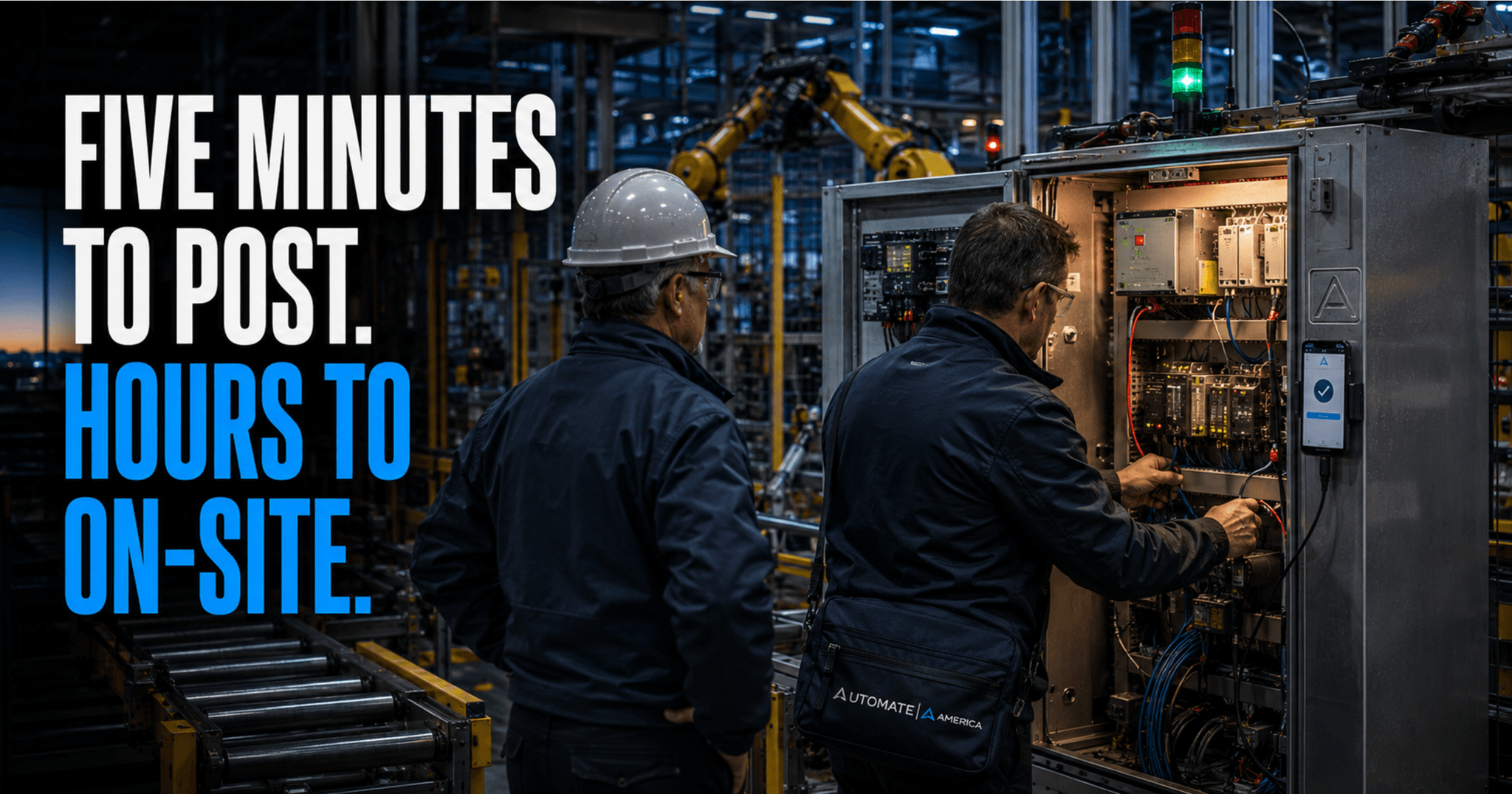
Time. Five minutes to post, and you see applications as they arrive. Compare that to thirty days of back-and-forth and you already see why the early customers on the platform are not letting the secret out at their own plant managers' meetings.
The bigger shift this is part of
Every industry gets its on-demand moment once the underlying demand is dense enough and the trust problem is solved. Rides happened when GPS and smartphones gave us both the "where" and the "who." Food delivery happened when real-time dispatch, payment, and rating could survive a luke-warm burrito complaint. Trucking happened when electronic logs and digital load boards finally beat the fax machine.
Skilled professionals get their moment when the skill filtering, the trust signal, and the billing mechanics all get solved together. That is exactly what Automate America is.
The question is no longer whether this marketplace exists — it exists, it works, and it has thousands of professionals and paying customers on it today. The question is whether your plant, your integration firm, or your contracting business is on it before your competitor is.
Skills, training, and where to go next
The professionals winning the best contracts keep their platform certifications current. For the two vendor stacks named above, the authoritative training paths are Rockwell Automation training (Allen-Bradley / ControlLogix) and ISA certification for process and safety control. For where the market is heading, Automation World and The Manufacturing Institute track the workforce shift in real time.
Links you'll want
- Register free — automateamerica.com/app/login
- Post a contract, job, or RFQ — automateamerica.com/app/automation_work_new/add
- Search active contracts — Hourly Contract search
- Search and request professionals — automateamerica.com/app/professionals/index
- Find and follow customers — automateamerica.com/app/customers/search
- Industry news + analysis — Automate America blog


Tony Wallace, Co-Founder · Automate America · Text/Call 586-770-8083 · info@automateamerica.com