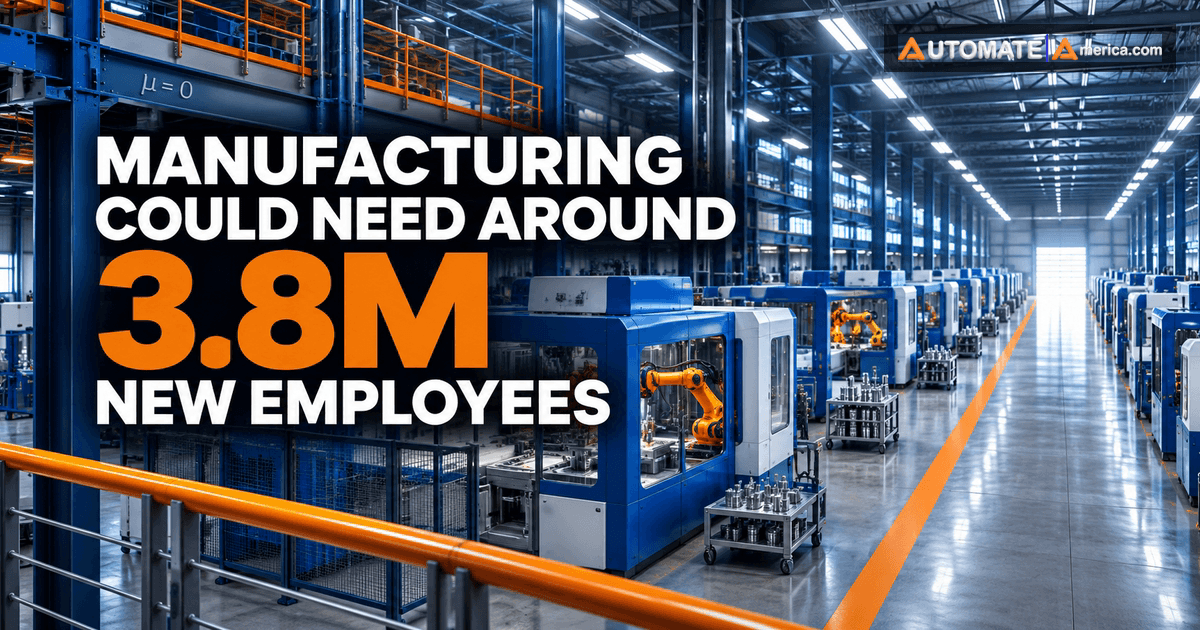
A Deloitte Insights study dated April 3, 2024 says the net need for new employees in manufacturing could be around 3.8 million between 2024 and 2033. It is a projection, and the study's own sentence says could. A national number like that says little about any one town. The contracts posted on Automate America this month have been in places such as Lake Orion, Auburn Hills and Wixom in Michigan and Spartanburg in South Carolina, and the people who fill them come from the schools and training programs in those places. Before you repeat a number, ask who published it, when, what it counts and which years it covers. Below are those questions, a look at what two local programs say about themselves, every contract open on Automate America this morning, and how one profile helps a skilled professional get found.
On this page
- What does the Deloitte study actually say?
- Who published the number, and when?
- Is it a count or a projection?
- Does it depend on a condition?
- Which questions should you ask of any workforce number?
- Where do local numbers and local training come from?
- Employment or contracting: which fits?
- Which contracts are open today?
- What does one profile do for a professional?
- How do you post a contract or apply?
- What do readers ask about all of this?
What does the Deloitte study actually say?
The sentence is on Deloitte Insights' own page: "The net need for new employees in manufacturing could be around 3.8 million between 2024 and 2033." The page carries the date 03 April 2024 and belongs to Deloitte's talent study with The Manufacturing Institute, Taking charge: Manufacturers support growth with active workforce strategies.
Three words in that sentence carry the meaning. "Could" says it is a projection. "Around" says it is rounded. "Between 2024 and 2033" says which years it covers. Take any of the three away and the number says something the study did not.
The Manufacturing Institute published its own release dated April 3, 2024 as well. Its wording for the same figure is "as many as 3.8 million additional employees could be needed in manufacturing between 2024 and 2033," on its page Manufacturers Need as Many as 3.8 Million New Employees by 2033, dated April 3, 2024. It also says "could." The two publishers word the figure a little differently, one "around," one "as many as," so the best practice is to quote the page you link and not a summary of it.
Who published the number, and when?
Two publishers stand behind the figure: Deloitte, and The Manufacturing Institute, the workforce development and education partner of the NAM. Both pages are dated April 3, 2024. A number's date matters because a figure from 2024 describes the years 2024 to 2033 as they looked in 2024, and a reader today is seeing it some time after it was written. The same two publishers issued an earlier edition, a Manufacturing Institute release dated May 4, 2021, whose page says the skills gap in the U.S. could result in 2.1 million unfilled jobs by 2030, from its own release page. That is a different edition with a different measure and different years, so it is not set against the 2024 figure here. Each is read on its own page, with its own date.
Open contracts on Automate America, each read open on its live page today: a robot programmer contract in Lake Orion, MI and a controls engineer contract in Windsor, Ontario. Each shows its posted rate and place, and applying is free.
Is it a count or a projection?
The study's sentence is a projection. It is not a head count of people, and it is not a tally of vacancies on any one day. Deloitte's endnote for the sentence says the figure comes from Deloitte analysis of U.S. Bureau of Labor Statistics data and estimates of private investments, so it is built from other numbers and a method.
The same study also has a survey. Deloitte says it "involved an online survey of more than 200 US manufacturers," along with interviews with more than 10 senior executives and secondary data on labor supply and demand. A survey answer tells you what the manufacturers who replied said. The 3.8 million is a separate projection with a different source, so the survey is not the basis for that figure. Whenever a number comes from a survey, the useful follow-up is how many answered. Here, more than 200 manufacturers did.
Does it depend on a condition?
Some workforce numbers are conditional, and this study has one. Deloitte's page says around half of these open jobs (1.9 million) could remain unfilled if manufacturers are not able to address the skills gap and the applicant gap. The words "skills gap" and "applicant gap" are Deloitte's own, and the sentence begins with a condition: it says what could happen if something is not done. The Manufacturing Institute words the same share as "as many as 5 in 10" on its release, and "more than 5 in 10 or 1.9 million" in its key takeaway. Three phrasings of one share are a good reason to quote the page you link, in its own words.
Which questions should you ask of any workforce number?
- Who published it, and is this their own page? A number repeated from a news item may have lost a word on the way.
- Is it a projection, an estimate, a survey answer or a count? "Could be" is a projection. "Approximately" is an estimate. "Of those surveyed" is a survey answer.
- Which years does it cover? Here, 2024 to 2033.
- Is it the newest edition? Two editions from the same publishers are dated 2021 and 2024, and each has its own figure.
- What does it count: jobs, openings or people? These are different measures, and one cannot be turned into another by arithmetic.
- Does it depend on a condition? "Could remain unfilled if" is conditional.
- Did the words change between the study and the repeat? Compare the study's sentence with the headline.
None of this judges anyone who repeats a number. It is simply the habit of reading the sentence behind the figure. The next section applies it close to home.
Where do local numbers and local training come from?
The best answer to a local question usually comes from a local source, read as carefully as a national one. In Michigan, Oakland Community College runs a PLC and robotic technician training program on its Auburn Hills campus, in partnership with Oakland County Michigan Works!, and describes it on its own page, with its schedule and funding. In South Carolina, Greenville Technical College's Mechatronics Technology program describes a technician who keeps a plant line from staying down, with electrical systems, fluid power, PLCs and robotics among the topics. When a school or an agency states a figure about its own graduates or its own region, apply the same questions: who counted, when, and what exactly was counted. A program's page is the right place to learn what it teaches. It does not replace a projection from a study.
Employment or contracting: which fits?
Every job in a projection is someone's working life. Steady employment is a good life that many people choose: the same place, a system learned deeply, a clear sense of what tomorrow holds. If you would rather move from project to project, contracting may be right for you. Both are fair choices, and neither is the lesser one. A professional who wants contract work can build a profile and apply at a posted rate, and a customer who wants a project done can post it free.
Which contracts are open today?
Every contract that reads open on Automate America this morning is listed here with its role, place, posted base rate, Overtime and Sunday/Holiday rate where the posting shows them, and a link to its own page, so you can read the whole posting before you decide. The full open contracts list always shows the current set.
What does one profile do for a professional?
On Automate America a professional needs one profile. A professional registers with a name, an email, a phone number and a password, and then edits one page with three sections, each field right where it sits. Every field says who sees it before you type: Public, Connections, Hired, On file only, or you and the Automate America team.
Section one is what makes a professional visible to customers: a photo of the person, not a company logo, a first name, a primary occupation, a city and a state, which are public, an About me, a base hourly rate and at least one skill, rated with stars, with years and a story in the professional's own words. The rate entered is the rate everyone sees. The last name is not public: only connections, and a customer who shortlists, requests or hires the professional, see it. Street address, banking and files are never public.
A professional who has a resume can start there. It is read into the profile, filling occupations, work history, skills and brands in empty fields without overwriting anything typed, and customers never see the resume itself, only the profile. No phone number or email address is taken from it. When every required field is filled and saved, the profile goes live by itself, with no waiting for approval.
Section three is optional and is where a professional stands out: fuller rates, work preferences, trades, software, work history, education, certifications and more, and a section left empty does not show on the public profile. Section two is the company, filled in when the professional is ready to post work, list products and services, or place an ad, which makes that member a customer on the same profile, with no second account.
Customers read the finished record: contracts finished, reviews and endorsements show on the public profile, and the profile can build a one-page resume with no email or phone on it. The Professionals page lets a customer search by skill and place, and the Companies page does the same for companies. Nothing is committed by building a profile or applying: a professional is committed only when accepting an offer.
How do you post a contract or apply?
A customer posts a contract, a job or an RFQ free on the post-work page and chooses the rate it posts at. The rate is not negotiated: the rate you see is the rate you are paid. A professional opens a contract's page and applies at the posted rate, with the profile described above. To begin, register or sign in. For more on how the week's posts connect to the people who do the work, read why plants still need robot programmers and Schneider Electric's agreement to buy Cognite and PTC, and browse the Automate America blog.
What do readers ask about all of this?
Is 3.8 million a count or a projection?
A projection. Deloitte Insights, in a study dated April 3, 2024, says the net need for new employees in manufacturing could be around 3.8 million between 2024 and 2033.
What years does the 3.8 million cover?
2024 to 2033, as the study's own sentence says.
Does it cost a customer anything to post a contract on Automate America?
No. Posting a contract is free, and professionals apply to it with their profiles at the posted rate.
What does a professional's profile show customers?
A customer can read the professional's trade, skills and brands, rate, finished contracts, reviews and endorsements, and the same profile carries the company if the professional also posts work.
What can you do next on Automate America?
- Post your work free — Set the rate you want to pay. Posting and receiving applicants cost nothing.
- Create your free profile — Your completed work, platforms and reviews in one record that customers search.
- Search open contracts — Every open contract and what it pays, updated as they post.
- Find professionals — Search thousands of professionals by skill, platform and location.
- Training and certification — Build the skills the contracts above are actually asking for.
Where can you find more contracts, professionals and training?
- Browse every open contract
- Find skilled professionals
- See the companies hiring
- Work by occupation
- Training programs
- More from the Automate America blog
FOLLOW AUTOMATE AMERICA
Tony Wallace, TonyW@AutomateAmerica.com
Make it a great day, we're here to help.