An honest question
Have you — a senior controls engineer, a robotics lead, a panel-shop owner, a plant maintenance manager — ever gotten one real piece of value out of LinkedIn?
Not vanity value. Not the dopamine hit of a congrats on a work anniversary. Not a "thought leader" post from a vendor who sold you a product that broke inside six months.
Real value. A contract. A hire. A genuinely useful technical conversation. A vendor relationship that worked.
Most of the honest answers you hear in this industry are: "No. Not really. Once, maybe. Years ago."
LinkedIn was built for a different audience — consultants, recruiters, marketers, SaaS salespeople — in a different era. It was never designed for the automation engineer who spends Tuesday in a panel shop and Thursday on a catwalk debugging a robot cell. For our work, LinkedIn is mostly noise interrupted by occasional spam.
That's the problem Automate America is solving on the networking side of the platform.
What's broken about the LinkedIn model, specifically
Four mechanisms combine to make LinkedIn a thin layer for industrial work.
1. Open-graph connection model. On LinkedIn, "connection" has no meaning. You've never worked with most of the people in your network. The endorsement a stranger gave you on "PLC Programming" is worth roughly the same as the one your cousin gave you on "Excel." The signal-to-noise ratio was broken by design — growth was the goal, and the platform optimized for nodes and edges instead of for real working relationships.
2. Recruiter spam overwhelms the inbox. A typical senior controls engineer gets dozens of recruiter DMs a week. Most come from people who did not read the profile, don't understand the skill stack, and are pitching roles in cities the engineer doesn't live in. The inbox is therefore unreadable, which means the rare real conversation that lands there is buried and never answered.
3. Algorithm optimizes for engagement, not utility. LinkedIn shows you what generates likes and comments. That is not what helps you do your job. It's why your feed is motivational posts and AI-generated listicles, and almost none of the useful technical conversation about the RSLogix 5000 fault you've been chasing for three days.
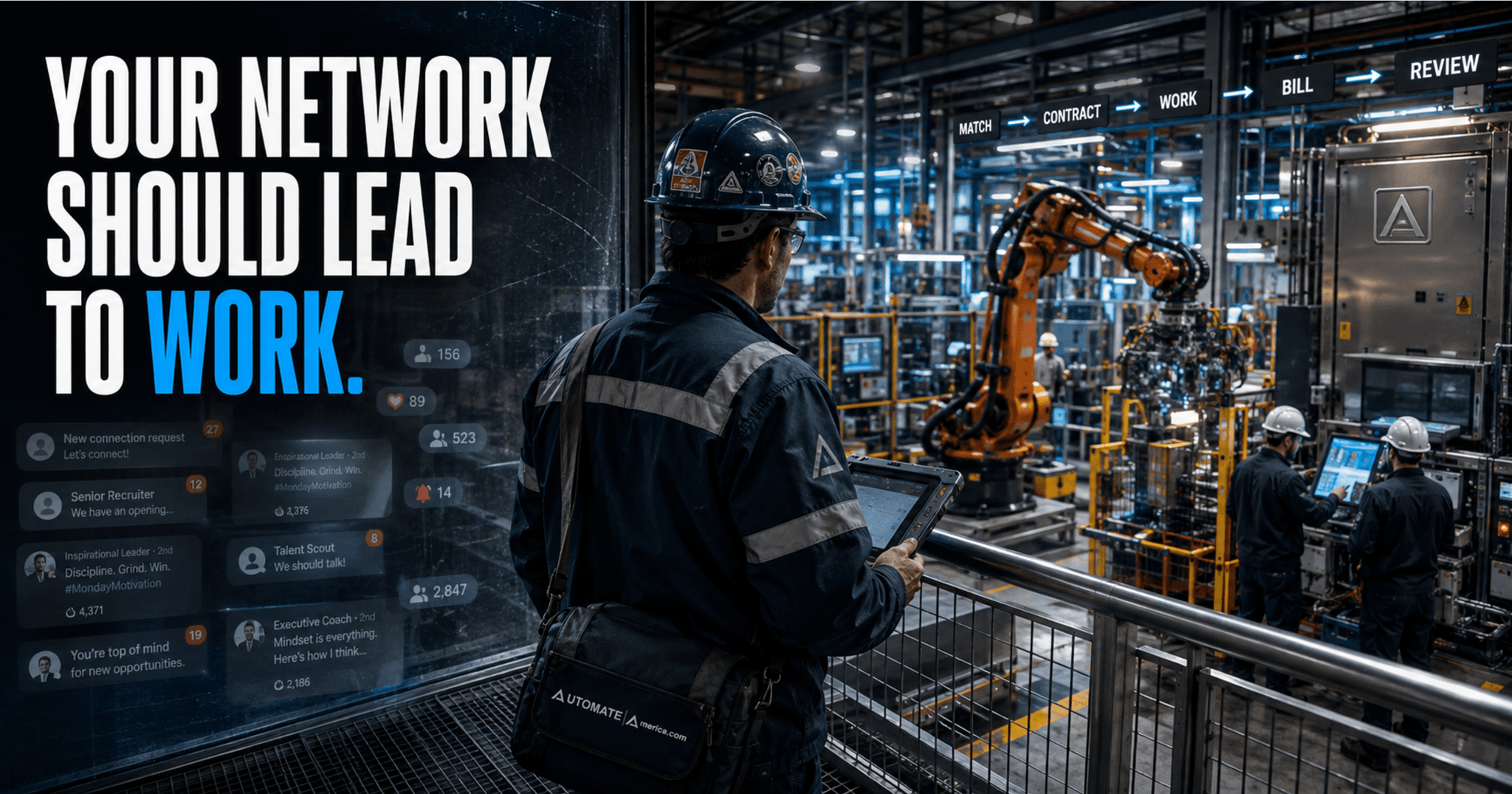
4. No native workflow for actual work. LinkedIn can introduce you to someone. That's where it stops. It cannot help you scope the work, price the work, contract the work, bill the work, or review the work. The "connection" was supposed to be the means. LinkedIn made it the end.
What changes on Automate America
Automate America is a global marketplace and professional network for skilled professionals — industrial, commercial, and residential work worldwide, with the automation trades at its core. Thousands of professionals today, growing.
The network mechanics are fundamentally different:
Connections are real or they don't exist. Either you've worked with someone on a contract that ran through the platform, you've been introduced by a mutual connection, or you've explicitly accepted each other's connection request. No LION-style mass-connect, no fake follower growth, no "500+ connections" vanity count. Your network is small at first. It's also real.
Endorsements are connection-gated. Only accepted connections can endorse you on specific skills. No stranger can hit a "PLC Programming" button on your profile because they don't know you can do it. The endorsements that show up are from people who've stood next to you on a real job.
Reviews are contract-gated. If you want to review someone's work, you must have actually worked with them on a contract the platform tracked. This collapses the "5-star reciprocity" problem that every other platform has. A 4.8 average across fifteen reviews on Automate America means something. On LinkedIn, a recommendation is just someone who owed you a favor.
Skills are structured. You don't just type "PLC programming" as a string. You pick the manufacturer (Rockwell, Siemens, Allen-Bradley, Mitsubishi, Omron), the generation (ControlLogix, CompactLogix, PLC-5, SLC-500, S7-1500, S7-1200), the years of experience, and the certification level. Customers searching for exactly ControlLogix 5580 with safety-PLC experience find exactly that. Nobody's keyword-mining.
The feed is what the network is actually working on — real contract openings, real professionals, real schools and training programs, real reviews posted to real work. Content types interleave, but nothing is ranked by engagement-bait.
The workflow LinkedIn never built
The clearest difference: once two people on Automate America recognize they want to work together, the platform takes them all the way through the work.
A customer finds a contractor and extends an offer. The platform generates the agreement from customizable templates. Both parties e-sign. The contract is live. The contractor logs hours against it. Those hours roll into a timesheet. The timesheet routes for customer approval. The approved timesheet rolls into an invoice at the billing-cycle close. The invoice is paid on agreed net terms. The platform logs everything. At contract end, both sides can leave a review — and those reviews compound into the profile reputation.
That's the full circuit. Matchmaking → contracting → working → billing → reviewing. All in one place. LinkedIn does only the very first step of that. Everything else is Automate America, and it is free to use.
What it actually feels like to use
If you are a senior controls engineer signing up for the first time, here's the shape of it.
You fill out your profile — occupations (primary plus up to four secondaries), skills (by manufacturer, generation, and years), work experience, education, certifications, rate card. That takes about 25 minutes. You register with just your name, email, and phone number to start.
You make it public. You set your availability. That's it. Your profile is now indexed, searchable by customers, and appears in the feed alongside relevant contracts.
A week later, you've gotten two inbound matches on live contracts in your geography. You've applied to one. You've been shortlisted on another. You've received a connection request from a plant engineer you worked with in 2019 who signed up three months ago.
In the same week on LinkedIn, you would have gotten zero real leads, twenty recruiter DMs, and an algorithm insisting you react to a motivational post. That is the delta. Week one. It gets wider from there.
A network that's free to use
The network is free to use — always. Your profile, posts, applications, reviews, endorsements, connections, and messaging to accepted connections cost nothing. It's free to post, free to apply, and free to hire. Companies don't have to wait to be found, either: they can search the marketplace and request a specific professional directly.
What the network is for, and what it isn't
Automate America is not a social network. It is not a place to broadcast motivational takes. It is not a place to perform professionalism for a crowd. It is a working network — one whose job is to put you next to the customers, contractors, schools, and service providers you will actually do business with.
If that sounds smaller than LinkedIn's billion-user roster, that's the whole point. Ten connections that matter are more valuable than a thousand that don't. Reviews from customers who paid you are more valuable than recommendations from someone who owed you a favor. Endorsements from people you've stood next to on a catwalk are more valuable than ones from a college roommate you haven't spoken to in eleven years.
We built this for the skilled trades because the industrial trades never got a network of their own. You deserve one that works.
Skills, training, and where to go next
A structured profile is only as strong as the certifications behind it. The authoritative training paths for the dominant control stacks are Rockwell Automation training (Allen-Bradley / ControlLogix), Siemens SITRAIN, and ISA certification for process and safety control. For the wider industry conversation, Automation World is a reliable read.
Links you'll want
- Register free and build your profile — automateamerica.com/app/login
- Search and request professionals by skill + location — automateamerica.com/app/professionals/index
- Post a contract, job, or RFQ — automateamerica.com/app/automation_work_new/add
- Browse active contracts — Hourly Contract search
- Industry news — Automate America blog


Tony Wallace, Co-Founder · Automate America · Text/Call 586-770-8083 · info@automateamerica.com