The number that never makes it into a report
Ask an owner what their real problem is and you will rarely hear "finding work." You will hear about the week.
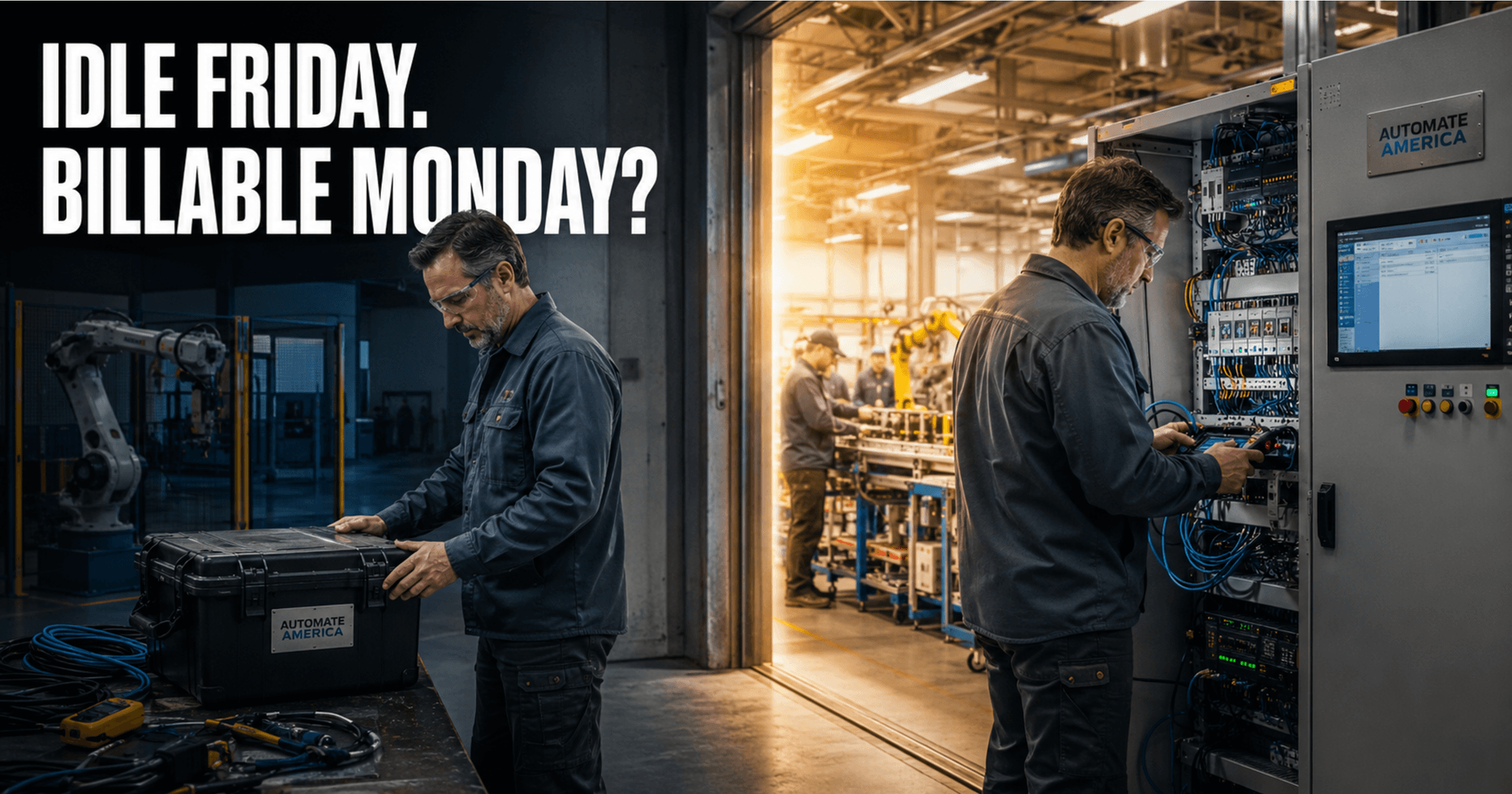
A project wraps on Friday. The next one starts in three weeks. An excellent engineer — somebody you spent years training, who you cannot afford to lose — has nothing to bill against on Monday. Payroll runs anyway.
Nobody writes that down. It gets absorbed, quarter after quarter, and it is very often the whole difference between a good year and a flat one. It is also the reason perfectly healthy firms lay people off in a soft month and then scramble to rehire in a hard one.
A bench is inventory, and inventory can be sold
Here is the reframe worth sitting with: an available engineer is not an expense, they are unsold capacity. Manufacturing figured this out decades ago. A machine that is idle is not a cost problem, it is a scheduling problem.
There are open contracts posted on Automate America every week — and they are community projects, open to every member of the network. When your people are free, you apply them to that work. They stay on your payroll, doing what they are good at, for a customer who needed exactly that skill this month.
Idle Friday, billable Monday. That is the whole mechanic.
It runs in the other direction too
The same marketplace solves the opposite problem, which is the half most firms never use.
When work outruns your payroll, you can take a contract larger than your own headcount and bring the extra hands in from the network. You bid jobs you would otherwise decline. You do not hire for a peak that ends and then carry those people through the trough. And when the job is out of town, you can source someone local rather than putting a senior engineer on a plane for six weeks — which is a travel bill and a burnout risk you simply stop paying.
What it does to retention
This is the part owners tell us about afterwards. Fewer layoffs in the slow months means the people you invested in are still there when the work comes back. Engineers notice when a firm finds them interesting work in a quiet quarter instead of letting them go. It is a retention tool that happens to also be a revenue tool.
The paperwork problem, solved
The reason this has not been normal practice is not that nobody thought of it. It is that subcontracting into a large manufacturer used to mean becoming an approved supplier at that manufacturer — vendor registration, insurance certificates, payment terms, a new AP relationship, all for six weeks of work.
Automate America is the vendor of record on both sides. The customer contracts with us. You contract with us. You do not have to clear anyone's supplier list, and you do not have to work out how a particular multinational wants to be invoiced. One vendor, thousands of professionals.
Where to start
Look at who comes free in the next three weeks. Then look at what is open and put them forward. If you have work of your own that you cannot staff, post it free at the rate you want to pay — there are professionals in this network whose firms have capacity this month.
More from us: why the best engineer for a job is rarely looking for one, and what is open on the board this week.
Next steps on Automate America
- Post your work free — Set the rate you want to pay. Posting and receiving applicants cost nothing.
- Create your free profile — Your completed work, platforms and reviews in one record that customers search.
- Search open contracts — Every open contract and what it pays, updated as they post.
- Find professionals — Search thousands of professionals by skill, platform and location.
- Training and certification — Build the skills the contracts above are actually asking for.
Explore more
- Browse every open contract
- Find skilled professionals
- See the companies hiring
- Work by occupation
- Training programs
- More from the Automate America blog


✉ Email the editor · 💬 Text Automate America today: 586-770-8083
Tony Wallace, Co-Founder · Automate America · 586-770-8083 · info@automateamerica.com