There is a moment on every new line that never appears in the project plan. The last runoff part passes inspection. Somebody signs something. The integrator loads their cases into a van and drives away. And the machine, which until this morning had a team of five people watching it, is now expected to make parts on its own, every shift, for years.
The weeks that follow are where a new line either finds its rate or quietly fails to. And they are staffed, almost everywhere, by accident.
Commissioning proves one thing. Production proves another.
Commissioning answers a narrow question: can this machine make a good part? It is answered under ideal conditions — the build team is present, the material is hand-picked, the schedule has slack in it, and everyone watching knows the system intimately because they designed it.
Production asks a much harder question: can it make good parts on the night shift, on the fourth consecutive Saturday, on the material that actually showed up, with an operator who started on Tuesday? Nothing in a runoff tests that. It cannot.
So the failures that surface after handover have a completely different character from the ones found during the build. They are rarely dramatic. A sensor that reads fine at twenty degrees and drifts at thirty-five. A robot that faults on one part number out of forty because the fixture has a tolerance nobody stacked up. A gripper that holds perfectly until the third hour, when the air system is under load from the rest of the plant.
Individually, none of these is a crisis. Collectively, they are the reason a line sits at seventy percent of rate for a quarter.
The hidden cost is not downtime. It is your own engineers.
Here is the part that does not show up on any capital budget.
When a new line is throwing small faults, somebody has to clear them. In most plants that somebody is the controls or maintenance engineer who already has a full plate — and who is also the only person capable of finding the root cause of those faults.
So they spend the shift clearing alarms. And because they spend the shift clearing alarms, they never get four uninterrupted hours to work out why the alarms happen. The line stays marginal, the faults keep coming, and the one person who could end the cycle is fully consumed by it.
That is a sequencing problem, plain and simple. The plant has exactly the right person and has pointed them at the wrong work at the wrong moment.
Production support is its own discipline
It is tempting to think anybody who can program the system can also support it. In practice, the skill sets diverge quickly.
A build engineer optimises for elegance and maintainability — code somebody can read in three years. A production support engineer optimises for diagnosis speed. How fast can you tell whether that fault is mechanical, electrical or logical? How quickly can you find the rung that latched, read the robot's alarm history, and decide whether to clear and continue or stop and investigate?
There is also a temperament to it that is genuinely rare. Standing at a line that is running, with people watching, making a call in ninety seconds, is not the same job as sitting in an office with the machine safely powered down. Some outstanding engineers hate it. The ones who are good at it tend to be very good at it, and they usually came up through maintenance rather than design.
What this looks like on a real contract
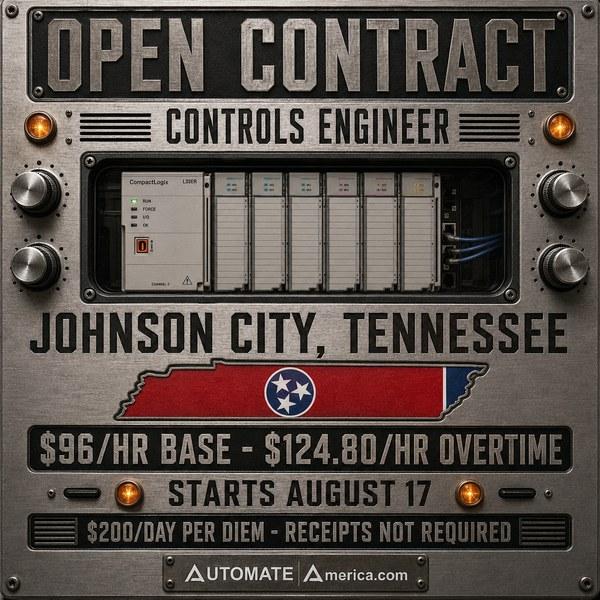
A water heater manufacturer in Johnson City, Tennessee is in exactly this window right now, and the posting reads like a textbook case.
The machine has an Allen-Bradley CompactLogix PLC, a couple of Kinetix 5500 servo drives, two FANUC weld robots and three more FANUC robots moving material between them. It was recently installed and is entering production. Two controls engineers are needed, proficient in both Allen-Bradley and FANUC — one on first shift, one on second, Monday through Saturday, for four to six weeks.
The scope, in the customer's own framing, is to put out immediate fires, keep the line moving and keep parts being produced. And critically: to give their own engineers the bandwidth to work on the problem areas without being consumed by production support.
That last sentence is the whole argument of this article, written by somebody living it.
The terms are $96.00 an hour base, $124.80 an hour on overtime, and a $200 per day per diem with no receipts required. Eight hours a day, six days a week, starting August 17. View and apply here.
The skills that actually get used
For anyone weighing whether this kind of work suits them, the stack on this contract is a fair map of the discipline generally: Studio 5000 and RSLogix 5000 on the Allen-Bradley side, CompactLogix and Kinetix 5500 in the cabinet, and FANUC's Arc Tool and Handling Tool on R-30iA and R-30iB controllers.
If you want to move toward this work, the vendors themselves publish the most direct paths. Rockwell Automation's Studio 5000 documentation is the reference for the controls half, and FANUC America's training programs cover the robot side, including the operation and programming courses that map directly onto weld and handling applications.
Beyond the software, the competencies that matter are unglamorous and universal: lockout/tagout discipline, reading a fault history before touching anything, and the judgment to know when a clear-and-continue is safe and when it is hiding something that will bite you at 2am.
Why this work is structured as contract work
A ramp ends. That is the defining feature.
Six weeks from now the line will be stable, the faults will be understood, and the plant will not need two extra controls engineer standing beside it. Hiring permanently for a temporary peak creates a different problem three months later — which is precisely why this category of work has always been contracted, long before anybody built a marketplace for it.
For the professional, the appeal is straightforward: it is well-paid, it is finite, and it is technically interesting in a way that maintenance-by-rotation often is not. You see a system at its most revealing — the point where its real behaviour and its designed behaviour are still arguing.
The part service companies keep missing
There is a second reader for a contract like this one, and they are the one most often overlooked.
If you run a service company, a posting like this is not a job for one person. It is work for your bench. Non-billable hours are the single largest cost most service firms carry, and they are almost invisible — an engineer between projects still draws a salary, still costs overhead, and produces nothing.
On Automate America, service companies apply their available employees directly to open contracts. That turns idle bench time into billable work inside a week. It also means you can take on work larger than your own headcount, because you are not limited to what you can staff permanently — a two-person contract in Tennessee does not require you to have two spare people in Tennessee.
What we are, plainly
Automate America is a free, fair and open marketplace — all the work and all the people in one place. It is free to post, free to apply and free to hire.
A company writes what it needs and names the rate it is willing to pay. Nothing is negotiated down and nobody sits in the middle of the conversation. From there we carry the marketing: the contract gets written up, designed, published and pushed across every channel we have, at no cost to the company that posted it. Trusted professionals — with completed contracts, customer ratings, reviews and endorsements on their profiles — apply directly, and the customer decides who to talk to.
Work runs from emergency call-outs through engagements of up to a year, onsite, remote or hybrid, anywhere in the world, across every profession. Posting takes minutes, and qualified applicants arrive within minutes of it going live.
If your plant has a ramp coming, a shutdown scheduled, or a machine that has been waiting on a requisition for a month: post your own work, free.
The last thought
Every plant celebrates the install. The ribbon-cutting is for the day the machine arrives.
But a line does not become an asset on the day it is commissioned. It becomes one on the day it stops needing somebody to stand next to it — and getting from the first day to the second is a job with a name, a skill set and a price. Budget for it and the ramp takes six weeks. Ignore it and it takes a quarter, paid for out of your best engineer's calendar.
So here is what I would genuinely like to hear, and I expect disagreement: is production support work a plant should always contract out, or is covering your own ramp the only way a team ever really learns the machine? I have seen both argued well by people who have done it. Tell me where I have this wrong.
Follow Automate America
LinkedIn · Facebook · Instagram · X · YouTube · TikTok
Next steps on Automate America
- Post your work free — Set the rate you want to pay. Posting and receiving applicants cost nothing.
- Create your free profile — Your completed work, platforms and reviews in one record that customers search.
- Search open contracts — Every open contract and what it pays, updated as they post.
- Find professionals — Search thousands of professionals by skill, platform and location.
- Training and certification — Build the skills the contracts above are actually asking for.
Explore more
- Browse every open contract
- Find skilled professionals
- See the companies hiring
- Work by occupation
- Training programs
- More from the Automate America blog
Tony Wallace
Co-Founder, Automate America
AutomateAmerica.com