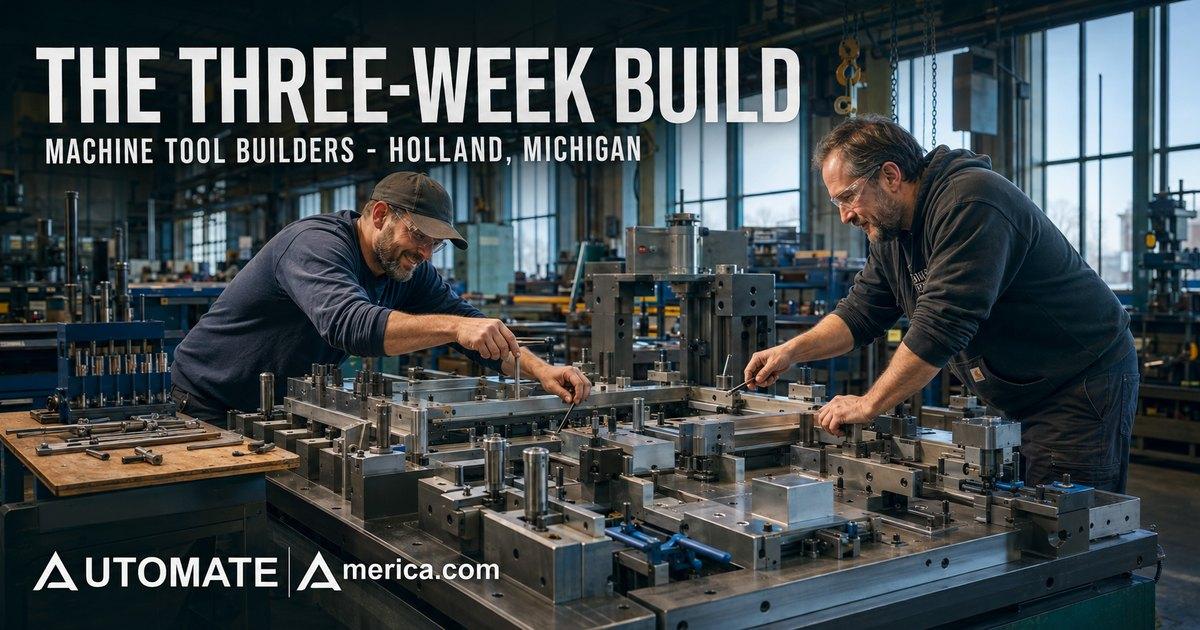
A manufacturer in Holland, Michigan is standing up new headliner equipment and needs two machine tool builder, starting August 24, for two to three weeks. Ten-hour days, five days a week, day shift, at $64.00 straight time and $83.20 overtime. The number that matters is the weekly one: fifty hours comes to $3,392. But the more useful thing about this contract is not the rate — it is that a two-week job exists as a posting at all, because that is the staffing model West Michigan actually runs on.
Nobody Hires for a Year to Cover Three Weeks
A new line does not need the same people for the same length of time. The build window for a set of fixtures is measured in weeks. The production life of the equipment is measured in years. Those two facts have never lined up, and the gap between them is where staffing goes wrong.
Historically it gets filled badly. A plant pulls whoever is already on payroll and free, which means the people who know that equipment best get taken off something else. Or the schedule slips until someone is available. Or a premium gets paid at the last minute to whoever can start Monday. None of those is a plan; they are all the same decision made late.
The alternative is to treat a three-week build as what it is — a defined piece of work with a start, a scope and an end — and post it. That is the entire argument for a marketplace, and it is easier to see on a small contract than a large one.
What the Work Actually Is
This contract is tool build. The scope is new fixtures built per prints; cylinders, clamps and nests mounted; and plug-and-play electrical cable and pneumatic hose routed, dressed and landed.
Worth being precise about that last part, because it changes who should apply. “Plug and play” means the electrical and pneumatic runs arrive pre-terminated. The builder routes them, dresses them into trays, and lands the connectors. There is no panel build and no controls programming in this job. Someone who reads a print and makes the steel match it is exactly qualified. Someone waiting for a PLC contract should keep waiting for a PLC contract.
That precision is worth more than a longer description would be. A scope that says what the work is not saves two weeks of wrong applicants.
The Weekly Number Is the Honest Unit
Hourly rates are how contracts get compared and a poor way to understand them. A $64 rate on a 40-hour week and a $64 rate on a 50-hour week are not the same job.
This one is ten hours a day, five days a week. So the arithmetic is forty hours at $64.00 and ten hours at $83.20 — $2,560 plus $832, or $3,392 a week. Across a two-to-three week run that is $6,784 to $10,176. Sunday and holiday work, if it comes up, is $102.40, though this is a five-day day-shift build and should be read as available rather than scheduled.
The part that gets undersold is that the overtime is in the schedule. On a lot of contracts overtime is a possibility that depends on how the job goes. On a posted ten-hour day it is ten guaranteed overtime hours every week, known before anyone accepts.
Why Holland, Michigan Is Not a One-Plant Town
The reason to take a three-week contract in one place rather than another is what surrounds it, and this is where Holland is genuinely unusual.
One of the largest automation integrators in North America — JR Automation — is headquartered in Holland, with more than 2,000 employees across 27 facilities in North America, Europe and Asia. LG Energy Solution built its first US electric-vehicle battery plant in Holland in 2010 and has since committed $1.7 billion to expanding it, adding roughly 1,200 jobs. There are 21 motor-vehicle-parts manufacturers in the Holland area and more than 200 food processors along the lakeshore. Gentex sits next door in Zeeland; Haworth, Autokiniton and Challenge Manufacturing are all in the immediate radius.
Statewide, Michigan operates roughly 28,000 industrial robots — more than any other state in the country, according to Brookings Institution research.
West Michigan became an automation-equipment hub for a specific and unglamorous reason: automotive, medical device and office furniture supply chains all landed in the same region, and every one of them needs machines built. That concentration is why a builder finishing a job in Holland is not then looking at a relocation. The next contract is a drive, not a move.
What This Means If You Build Tooling
The short-burst contract has a reputation problem. It reads as unstable next to a permanent role, and for a long time it was — because finding the next one was your problem alone, and the gap between contracts was unpaid and unstructured.
What has changed is the finding. A profile that carries your completed work, the platforms you have built on, and customer reviews is a record rather than a claim. Work comes to it. Three weeks at $3,392 followed by another contract twenty miles away is a different proposition from three weeks followed by nothing.
It is also worth saying that two openings on one contract is common, and underused. Builders who have worked together are faster than two strangers who happen to be available, and a plant standing up new equipment on a deadline knows it. If you work well with someone, apply together.
What This Means If You Run the Plant
If you are the person who has to staff a build window, the posting above is the whole demonstration. It cost nothing to post. The rate was set by the company, not negotiated up by an intermediary. It went in front of thousands of professionals and the service companies that hold experienced builders on the bench — which matters, because a service company can supply two people at once for a short run, and an individual cannot.
Short work is the hardest thing to staff and the easiest thing to post. If the reason your last build ran late was that you could not find two sets of hands for three weeks, that is a solved problem now.
The Contract, In Full
- Role: Machine Tool Builder — 2 openings
- Location: Holland, Michigan
- Application: Headliner manufacturing equipment
- Scope: New fixtures per prints; mount cylinders, clamps and nests; run plug-and-play electrical cable and pneumatic hose
- Start: August 24, 2026
- Duration: 2–3 weeks
- Schedule: 10 hours a day, 5 days a week, day shift
- Rate: $64.00 straight time · $83.20 overtime · $102.40 Sunday/holiday
See the full contract and apply →
Next steps on Automate America
- Post your work free — Set the rate you want to pay. Posting and receiving applicants cost nothing.
- Create your free profile — Your completed work, platforms and reviews in one record that customers search.
- Search open contracts — Every open contract and what it pays, updated as they post.
- Find professionals — Search thousands of professionals by skill, platform and location.
- Training and certification — Build the skills the contracts above are actually asking for.
Explore more
FOLLOW AUTOMATE AMERICA


✉ Email the editor·💬 Text Automate America: 586-770-8083
Tony Wallace, Co-Founder · Automate America
Text first: 586-770-8083 or call·info@automateamerica.com