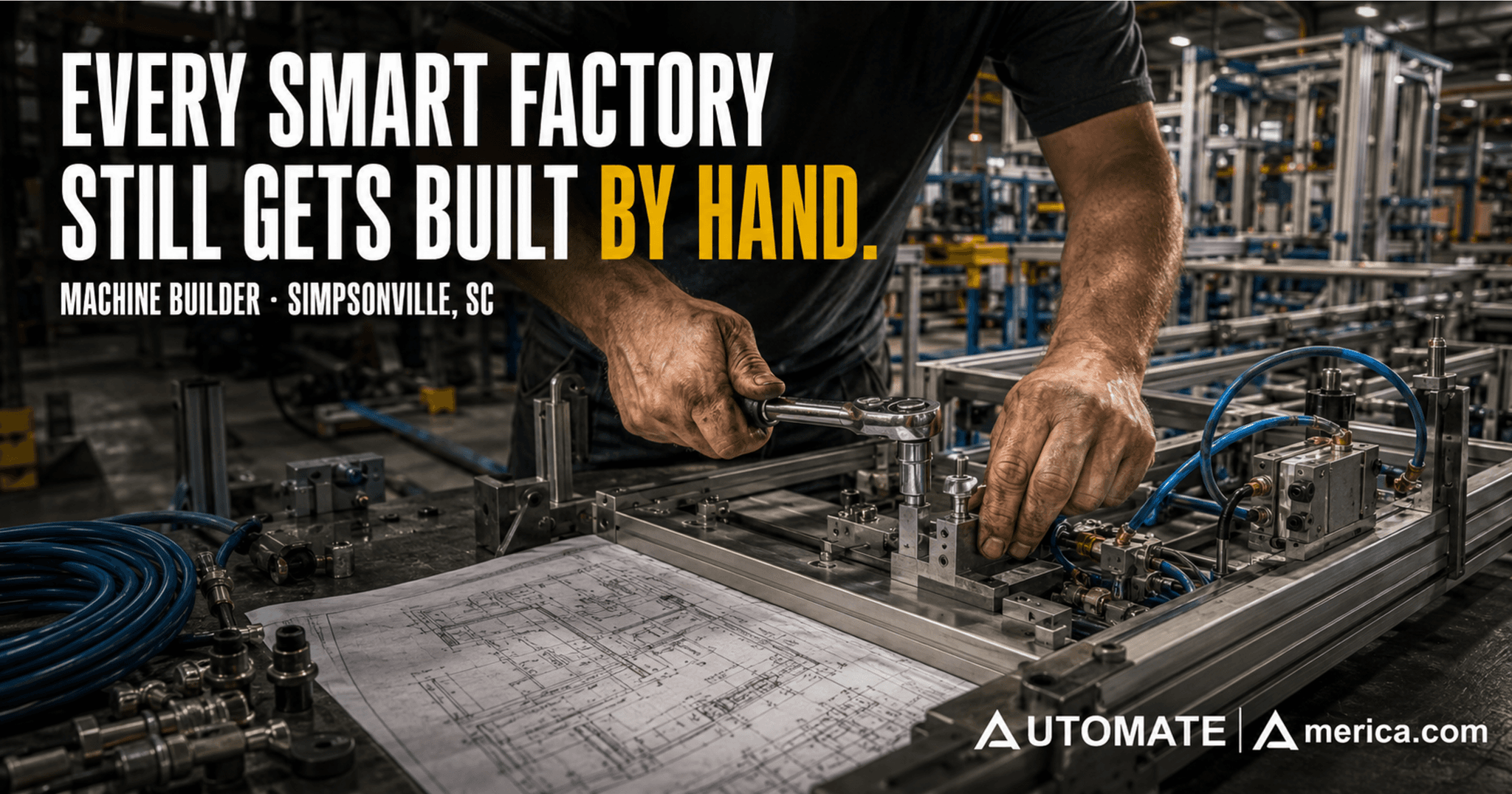
Every Smart Factory Still Gets Built by Hand: A Machine Builder Contract in Simpsonville, SC
Quick answer: An automotive build already under way in Simpsonville, South Carolina needs a mechanical machine builder. It is the mechanical side of new automated assembly equipment — reading blueprints, general mechanical assembly of details, and running pneumatic hoses to build up new systems. No electrical work. The contract runs 10 weeks initially with potential for more work, pays $56.00 per hour, runs a days shift, 8 hours a day, Monday through Friday, and starts immediately; expenses are possible for well-qualified candidates. You can view and apply on the contract page free. If you are the one hiring, you can post your own work free or search the marketplace and request a professional directly. The short version of why this role exists: automotive assembly is getting radically smarter, and every one of those smart systems still has to be physically built, fitted and made true by a human being before it runs a single cycle.
The week the industry showed off its future
Last week, eight hundred and fifty exhibitors filled the Shanghai New International Expo Centre for AMTS 2026, the largest automotive-manufacturing-engineering exhibition in the world. Seventy thousand people walked more than twenty zones — body engineering, painting, final assembly, testing, intelligent logistics — and sat through summits on next-generation body forming and final assembly. The vocabulary on the floor was AI smart factories, digital twins, machine vision, embodied intelligence.
It is genuinely the most interesting moment automotive assembly has had in decades. The trade press is reporting that the assembly line is no longer even linear, and that automakers are pushing AI deep into assembly operations.
And here is the thing almost nobody in that hall says out loud. Not one of those systems turns a single cycle until a person reads the print, fits the details, runs the pneumatic lines, and makes the whole thing true. What looks from the outside like the low-tech half of automation is actually its foundation. The smarter the factory gets, the harder it leans on the hands that build it.
Those hands belong to the machine builder. And right now, a pair of them is needed in Simpsonville.
The contract
- Role: Mechanical machine builder (one builder)
- Location: Simpsonville, South Carolina — Greenville County, in the Upstate
- Application: Automated assembly machinery for automotive manufacturing
- Scope: The mechanical side of automated assembly equipment — reading blueprints, general mechanical assembly of details, running pneumatic hoses to build up new systems
- Start: Immediate · Duration: 10 weeks initially, with potential for more work
- Schedule: Days shift · 8 hours per day · Monday–Friday (some overtime may be needed)
- Rate: $56.00 per hour · expenses possible for well-qualified candidates
Ten focused weeks, a clear scope, a straight five-day week, and a start date measured in days rather than quarters. That combination is the market telling you something specific: this is live build work on a real schedule, not a placement that has been sitting in a queue.
What the mechanical side actually decides
There is a gap between a builder who can make a machine run and a builder who can make it run right for ten years. The first gets the equipment moving. The second is the reason nobody has to touch it again.
That gap lives almost entirely in the mechanical build. The tolerances a builder sets are the tolerances the robot inherits for the life of the line. A fixture that holds a part two-tenths off does not announce itself on day one — it announces itself in scrap rate, in weld quality, in a cell that mysteriously needs babysitting every third shift. No amount of downstream code fixes a machine that was built wrong. Every controls engineer who has ever been called out to "fix the program" on a cell that was mechanically out of true knows exactly what this paragraph is about.
This is why the trade carries so many names — machine builder, machine tool builder, toolmaker, tool and die maker, fixture builder — and why the good ones are never idle. They are the people who lay equipment out on bare concrete, work alongside the riggers and millwrights to set it, and then assemble the part-holding, test and welding fixtures that decide whether any of the clever automation above them ever gets to do its job.
Why the pneumatics are the tell
Read the scope again and notice what is in it: running pneumatic hoses to build up new systems. That one line tells you what kind of equipment this is. Compressed air is what gives automated assembly equipment its clamping, its actuation, its cycle — and it is unforgiving of sloppiness. Routed badly, a line chafes and leaks; plumbed badly, an actuator starves at exactly the wrong moment in the sequence, and the fault that shows up on the HMI has nothing to do with the actual problem.
Builders who want to formalize or deepen that side of the trade have credible, specific places to do it. The National Fluid Power Association is the industry body for fluid power technology, and the Compressed Air and Gas Institute covers the compressed-air side specifically. For the metalworking and machining credentials underneath all of it, the National Institute for Metalworking Skills offers nationally recognized certifications that map directly onto machine-building work.
Locally, South Carolina is unusually serious about this. readySC — a division of the SC Technical College System and one of the oldest workforce-training programs in the country — builds customized training for manufacturers standing up new operations, and the system's advanced-manufacturing programs feed machining, mechatronics and CNC talent straight into the Upstate. It is not an accident that so much automotive equipment gets built in this corner of the state.
On Automate America, machine builders work shoulder to shoulder with the rest of that bench — maintenance technicians, manufacturing engineers and quality engineers — the same crew you will be building beside on the floor.
Building in the Palmetto State
Simpsonville sits in Greenville County, in the middle of one of the densest automotive manufacturing corridors in the United States. The Upstate has spent two decades turning itself into a place where vehicles, components and the equipment that makes them are all built within an hour's drive of each other. For a builder, that density is the whole point: the work does not end when the contract does, because the next machine is always going up somewhere down the road.
It also happens to be a genuinely good place to spend ten weeks. Ask anyone who has worked a build there in the summer.
How Automate America works — and why specialized builds fill here
Automate America is a global marketplace of thousands of skilled professionals across hundreds of occupations, in every industry — industrial, commercial and residential — worldwide. A marketplace, where the company and the professional can actually see each other.
It works two ways, and both are free. A company can post a contract, a job, or an RFQ and let professionals apply — or skip the waiting entirely and search the marketplace and request the exact professional it needs, directly. Professionals can browse open hourly contracts, apply in a couple of clicks, and follow the companies whose work they want to be first in line for. Every professional carries their own record — trusted professionals with completed contracts and customer reviews.
For the hiring side, the usual hesitations answer themselves. Is it really free to post? Yes — posting a contract, a job, or an RFQ costs nothing. Will you get buried in unqualified applicants? No — you see profiles of experienced industry professionals and you decide who to talk to. How fast does specialized work fill? It depends on the rate, the location and the dates — you see applications as they arrive. And if you need a hand at any point, you are one message away at info@automateamerica.com.
That is how a machine builder gets added to a live build without moving the line date — which is exactly what is happening in Simpsonville right now.
Whose hands go on it
At some point, choosing your next build stops being a job search and starts being a statement about the kind of builder you are. Ten weeks from now the equipment in Simpsonville will be standing, the fixtures will be holding tolerance, and some automated assembly system will be quietly doing exactly what it was designed to do — because somebody read the print, ran the lines, and made it true.
The machine is going up either way. The only open question is whose hands go on it. If they are yours, the contract is right here.
More open work and industry writing lives on the Automate America news and contracts hub.
Frequently asked questions
What does a mechanical machine builder actually do?
They physically build the machines and precision fixtures that automated production lines depend on — reading blueprints, assembling mechanical details, and running pneumatic hoses to stand new systems up before any automation runs.
Where is this contract and what does it pay?
Simpsonville, South Carolina, in Greenville County. It pays $56.00 per hour, and expenses are possible for well-qualified candidates.
Do I need electrical or controls experience?
No. This is the mechanical side of the build — blueprints, general mechanical assembly of details, and pneumatics.
What is the schedule, and when does it start?
A days shift, 8 hours a day, Monday through Friday, with some overtime possible. It runs 10 weeks initially with potential for more work, and it starts immediately.
How do I apply?
View and apply on the contract page at Automate America — it is free. You can also be requested directly by companies searching the marketplace for a builder with your background.


Tony Wallace, Co-Founder · Automate America · Text/Call 586-770-8083 · info@automateamerica.com