Michigan Builds the Machines That Build the Bricks: Three ABB Robot Contracts in Auburn Hills
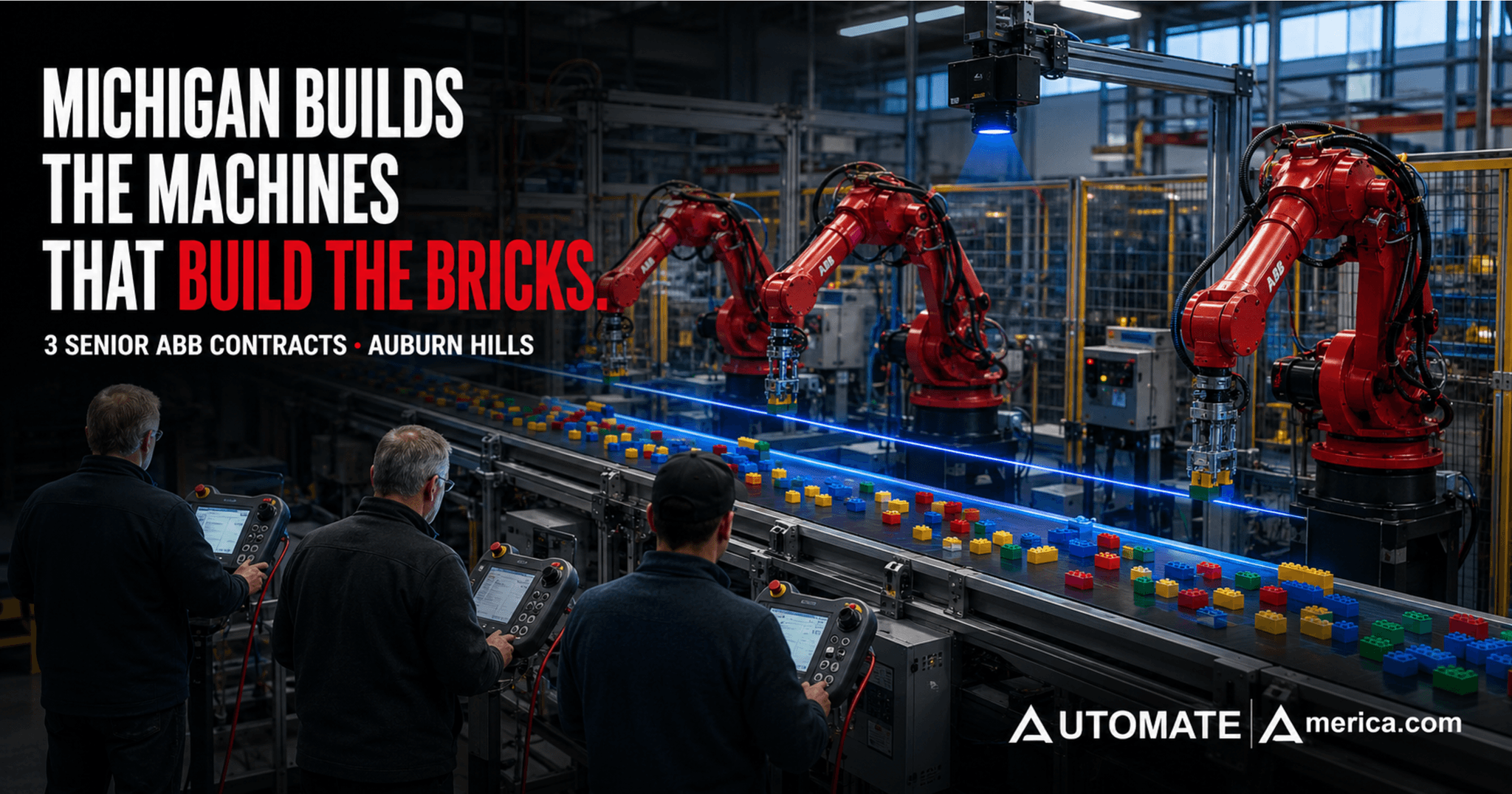
Quick answer: An automated-assembly build in Auburn Hills, Michigan needs three senior ABB robot programmers. The required skills are ABB IRC 4 and IRC 5, plus vision, line tracking, and the ability to fully commission an ABB IRC5 robot — at a senior level. It starts August 17, 2026 and runs mid-August through the end of October; days, 10-hour days, around 60 hours a week. It pays $52.00 straight time, $67.60 overtime, and $83.20 double time. You can view and apply on the contract page free, or, if you are hiring, post your own work free or search the marketplace and request a professional directly. And there's a fun detail in the mix: these are the automated assembly systems behind the most famous building brick on earth.
The deep end of robot programming
Think about what it actually takes for a robot to pick a part off a line that never stops. It has to see the part with vision, lock onto the moving conveyor, track it, and place it perfectly — all while the belt keeps rolling. Nothing holds still. On an ABB system that means integrated vision combined with conveyor / line tracking on the IRC5 controller: the robot's work object is locked to a pulse generator on the moving line, so the robot compensates for the motion and picks on the fly. Getting that commissioned clean is one of the harder things you can ask a robot programmer to do.
Here's the gap this contract lives in. Plenty of programmers can run a robot through a taught path, where the part is always in the same place. Far fewer can do vision and line tracking together, on live-moving product, and commission it so it simply works — shift after shift. That short list is exactly who this posting needs, and it needs three of them, all senior.
The contract
- Role: Robot Programmer — 3 needed, senior level
- Location: Auburn Hills, Michigan (Oakland County, metro Detroit)
- Application: Automated assembly systems
- Must know: ABB IRC 4 / IRC 5 · vision · line tracking · full IRC5 commissioning
- Start: August 17, 2026 · Runs: mid-August through end of October
- Schedule: Days · 10-hour days · ~60 hours/week
- Rate: $52.00 straight time · $67.60 overtime · $83.20 double time
Note the shape of it: a hard August 17 start, 10-hour days, and three seats rather than one. When a build needs three senior programmers on the same clock, it is because the work is parallel and time-boxed — three cells, or three shifts of commissioning, that all have to be right before production ramps. That's a good problem to be the answer to.
Why ABB, and why this is senior work
ABB is one of the world's "big four" industrial-robot makers, and its FlexPicker has led high-speed pick-and-place for more than twenty years. But speed on paper is not the same as a cell that runs untouched. The difference is commissioning — calibrating the vision, tuning the line tracking, getting the end-of-arm behavior and recovery logic right so the robot keeps picking cleanly when the conveyor speed drifts or a part shows up rotated. That is senior work by definition, and it does not scale by throwing junior hands at it. It scales by finding people who have done it before. Three of them.
The bricks, and the mitten
There's something fitting about where this work sits. The brand at the far end of these assembly systems is the most famous building toy in the world — the little Danish brick, founded in 1932, whose name comes from the Danish "leg godt," meaning "play well." It is the largest toy company on earth, and it makes something on the order of a hundred billion brick elements a year — better than a thousand every second. An entire civilization of play, mass-produced to a tolerance most people never think about.
And where do a lot of the machines that build things actually get built and commissioned? Michigan. The state shaped like a mitten — hold up your right hand and point to Auburn Hills, low and to the right of the palm — has spent a century being the place that builds the equipment that builds everything else. It is a good and slightly poetic pairing: the state that builds the machines, standing up the systems behind the brick the whole world builds with. (To be clear about the facts: the brand's own US factory is being built in Virginia; this contract is the automated-assembly and commissioning work, done in Michigan, where that kind of work has always been done best.)
Why this fills on Automate America
Automate America is a global marketplace of thousands of skilled professionals across hundreds of occupations, in every industry — industrial, commercial and residential — worldwide. A marketplace, where the company and the professional can see each other directly. It works two ways, both free: a company can post a contract, a job, or an RFQ and let professionals apply, or search the marketplace and request the exact professional it needs. Professionals can browse open hourly contracts, apply in a couple of clicks, and follow the companies whose work they want to see first. Everyone carries their own record — trusted professionals with completed contracts and customer reviews.
For the hiring side, the usual hesitations answer themselves. Is it really free to post? Yes — posting a contract, a job, or an RFQ costs nothing. Will you get buried in unqualified applicants? No — you see profiles of experienced industry professionals and you decide who to talk to. How fast does specialized work fill? It depends on the rate, the location and the dates — you see applications as they arrive. And if you need a hand, you are one message away at info@automateamerica.com.
Filling three senior, vision-and-line-tracking ABB seats with a hard August 17 start is exactly the kind of narrow, parallel, time-boxed ask a general job board handles worst and a marketplace handles best. Robot programmers here work alongside the rest of the bench — controls engineers, automation engineers and maintenance technicians — the crew that keeps automated assembly running.
If you can make a moving line look easy
By the end of October, three ABB cells in Auburn Hills will be seeing parts, tracking a moving line, and placing them clean — and some of the machines that help build the world's favorite bricks will be quietly doing their job. None of that happens without three senior programmers who know vision, line tracking, and IRC5 commissioning cold.
If you're one of them, the contract is right here. And since there are three seats, you probably already know the other two people who belong on this crew — send it their way.
More open work and industry writing lives on the Automate America news and contracts hub.
Frequently asked questions
What ABB experience is required?
ABB IRC 4 and IRC 5, plus vision, line tracking, and the ability to fully commission an ABB IRC5 robot — at a senior level. All three programmers are senior.
Why three programmers?
The build needs three senior hands on the same clock — parallel, time-boxed commissioning work that all has to be right before production ramps.
Where is it, and when does it start?
Auburn Hills, Michigan (metro Detroit), on automated assembly systems. It starts August 17, 2026 and runs mid-August through the end of October.
What is the schedule and rate?
Days, 10-hour days, about 60 hours a week. It pays $52.00 straight time, $67.60 overtime, and $83.20 double time.
How do I apply?
View and apply free on the contract page at Automate America. You can also be requested directly by companies searching the marketplace for ABB vision and line-tracking programmers.
Next steps on Automate America
- Post your work free — Set the rate you want to pay. Posting and receiving applicants cost nothing.
- Create your free profile — Your completed work, platforms and reviews in one record that customers search.
- Search open contracts — Every open contract and what it pays, updated as they post.
- Find professionals — Search thousands of professionals by skill, platform and location.
- Training and certification — Build the skills the contracts above are actually asking for.
Explore more
- Browse every open contract
- Find skilled professionals
- See the companies hiring
- Work by occupation
- Training programs
- More from the Automate America blog


✉ Email the editor · 💬 Text Automate America today: 586-770-8083
Tony Wallace, Co-Founder · Automate America · Text/Call 586-770-8083 · info@automateamerica.com