Change the Code Without Stopping the Line: A FANUC Live-Line Contract in Muncie, Indiana
Quick answer: An automotive transmission-parts line in Muncie, Indiana needs a FANUC robot programmer to change existing code while the line keeps running — no full shutdown. The work is material handling plus a little MIG welding on FANUC R-30iB; you read the code, debug it alongside the PLC programmer, and implement changes without taking the whole line down. It starts immediately and runs about 2–3 weeks (through mid-August), on a 12-hour-a-day, 7-day-a-week schedule. It pays $64 base, $96 overtime, with a $178/day per diem (no receipts), a $51 travel-day per diem, and $0.720/mile — for those living outside the plant's 50-mile radius. You can view and apply on the contract page free, or, if you are hiring, post your own work free or search the marketplace and request a professional directly.
The part plants don't say out loud
Here's a quiet truth about robot programming: the most valuable programmer on the roster usually isn't the one who builds a cell from scratch on a clean install with all the time in the world. It's the one they trust to fix a cell that's already producing — without stopping it.
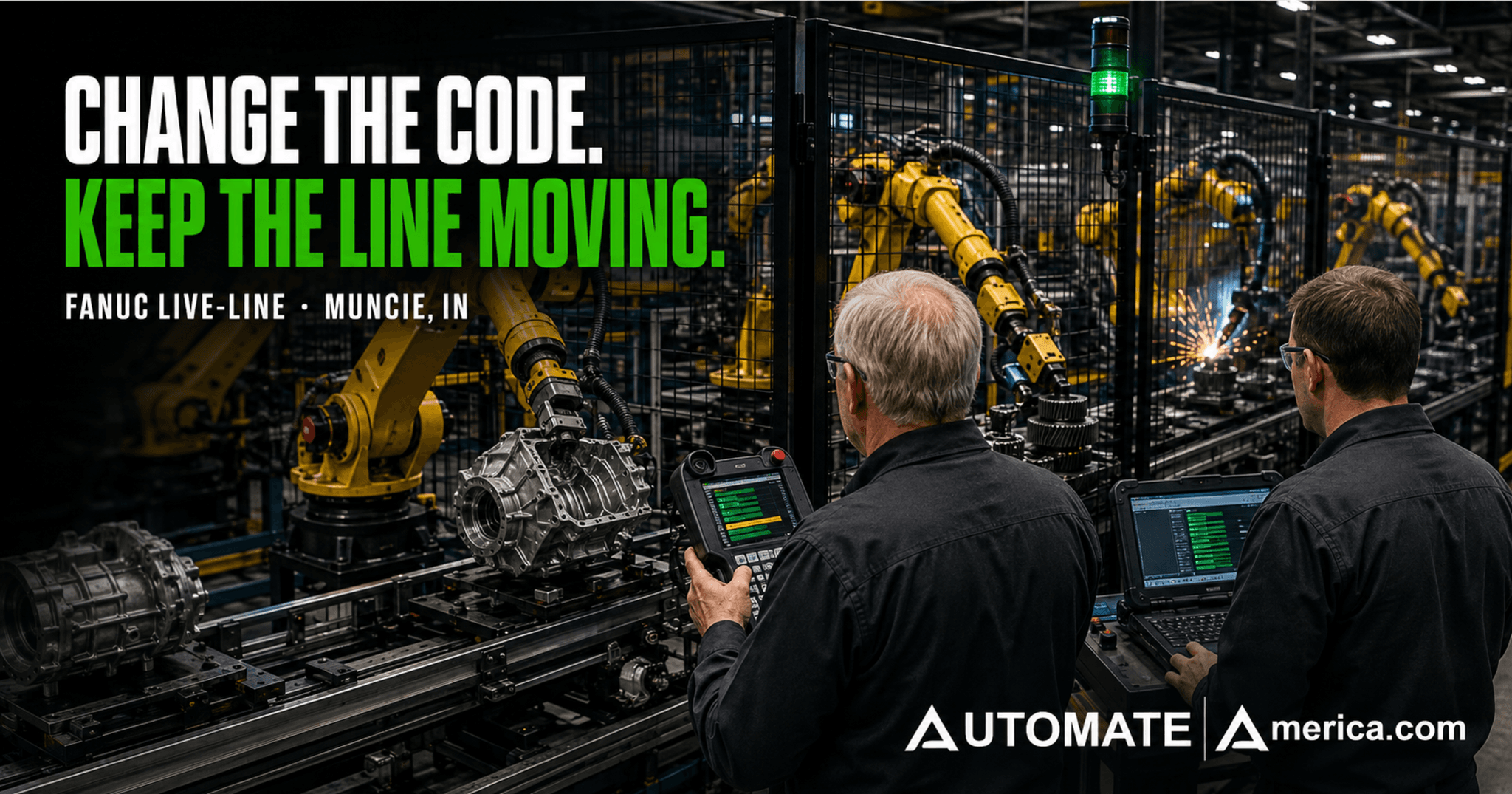
That is precisely what this contract is. The transmission line in Muncie keeps running — FANUC robots welding, handling parts, cycling — and something in the existing code needs to change. The catch, stated plainly on the posting, is "implement changes to existing code while not taking down the whole line." So you go in live. You read the program, you find the bug, you work with the PLC programmer to prove out the fix, and you make the change while the robots keep moving around you.
It is the automation equivalent of working on a running engine, and it is not for everyone. Which is the point.
Why live-line editing is its own skill
On a FANUC R-30iB — the current-standard controller, running HandlingTool for material handling and ArcTool for welding — editing a powered-down cell is routine. You lock it out, you make your changes, you test, you release. Editing a cell that is in production, synchronized with a PLC, without dropping a cycle or crashing a fixture, is a completely different discipline. It demands that you understand not just the robot's TP code but how it hands off to the PLC, where the interlocks live, and exactly which motion you can touch without cascading a fault down the line.
That's the gap this posting lives in. Plenty of programmers can edit a robot that's off. Far fewer can do it on a line that can't afford to stop. The contract even names the tell: "knowledge of PLC will assist with debug." This is collaborative, high-stakes, real-time work — and the pay reflects it.
The contract, and the paycheck
- Role: Robot Programmer — 1 needed (FANUC)
- Location: Muncie, Indiana (Delaware County, East-Central Indiana)
- Application: Material handling & a little MIG welding · automotive transmission parts
- Stack: FANUC R-30iB — read and edit existing code live; PLC knowledge aids debug
- Start: Immediate · Duration: ~2–3 weeks (through mid-August)
- Schedule: 12 hours/day, 7 days/week
- Rate: $64 base · $96 overtime · $32 travel time
- Expenses: $178/day per diem (no receipts) · $51 travel-day per diem · $0.720/mile (for those outside the plant's 50-mile radius)
Be honest with yourself about the shape of it: twelve-hour days, seven days a week, no easing in. But run the math on the other side. On an eighty-four-hour week, most of your hours land at the $96 overtime rate, and on top of the wages sits $178 a day in per diem that needs no receipts, plus mileage. Two to three weeks of that is a serious number for a short, intense sprint — the kind of contract that funds a slow month, or three.
Muncie has always built transmissions
There's a fitting bit of history under this one. Muncie, Indiana didn't just happen to end up with a transmission line — the town gave its name to one of the most legendary gearboxes in American automotive history. When GM brought 4-speed manual transmission production in-house in 1963, it built them at its Muncie factory, and the "Muncie 4-speed" — the M20, M21 and M22 — went into Corvettes, Camaros, Chevelles and GTOs straight through the muscle-car era. Warner Gear had been building transmissions in Muncie long before that.
The gearboxes are still being built here; what's changed is that robots build them now. And those robots don't stop for history any more than they'll stop for a code change — which is exactly why this contract exists.
Why this fills on Automate America
Automate America is a global marketplace of thousands of skilled professionals across hundreds of occupations, in every industry — industrial, commercial and residential — worldwide. A marketplace, where the company and the professional can see each other directly. It works two ways, both free: a company can post a contract, a job, or an RFQ and let professionals apply, or search the marketplace and request the exact professional it needs. Professionals can browse open hourly contracts, apply in a couple of clicks, and follow the companies whose work they want to see first. Everyone carries their own record — trusted professionals with completed contracts and customer reviews.
For the hiring side, the usual hesitations answer themselves. Is it really free to post? Yes — posting a contract, a job, or an RFQ costs nothing. Will you get buried in unqualified applicants? No — you see profiles of experienced industry professionals and you decide who to talk to. How fast does specialized work fill? It depends on the rate, the location and the dates — you see applications as they arrive. And if you need a hand, you are one message away at info@automateamerica.com.
A live-line FANUC fix with an immediate start is exactly the kind of urgent, high-trust, short-fuse ask a general job board handles worst and a marketplace handles best. Robot programmers here work alongside the rest of the bench — controls engineers, automation engineers and maintenance technicians — the crew that keeps a transmission line producing.
If you're good under that kind of pressure
Three weeks from now the line will still be running, the bugs will be gone, and nobody outside the cell will know how close any of it came — because the person who went in never let it flatline. That's the whole job, and it's a specific kind of person: reads someone else's code fast, stays calm next to a running line, and gets the change right the first time.
If that's you, the contract is right here. It starts immediately, so it won't sit long.
More open work and industry writing lives on the Automate America news and contracts hub.
Frequently asked questions
What FANUC experience is required?
FANUC R-30iB, with strong debug and coding skills for material handling and a little MIG welding. You must be able to read and change existing code without taking the whole line down; PLC knowledge helps with debug.
What makes this job different from a normal robot-programming contract?
The line stays running. You implement changes live, in sync with the PLC programmer, on a producing transmission cell — no full shutdown. That's a senior, high-stakes skill.
Where is it, and when does it start?
Muncie, Indiana. It starts immediately and runs about 2–3 weeks, through mid-August.
What is the schedule and pay?
12 hours a day, 7 days a week. $64 base, $96 overtime, $32 travel time, plus a $178/day per diem (no receipts), a $51 travel-day per diem, and $0.720/mile for those outside the plant's 50-mile radius.
How do I apply?
View and apply free on the contract page at Automate America. You can also be requested directly by companies searching the marketplace for a live-line FANUC programmer.


Tony Wallace, Co-Founder · Automate America · Text/Call 586-770-8083 · info@automateamerica.com