From Cane and Beet to Candy Bar — The Automation Behind America's Sugar and Confectionery Industry
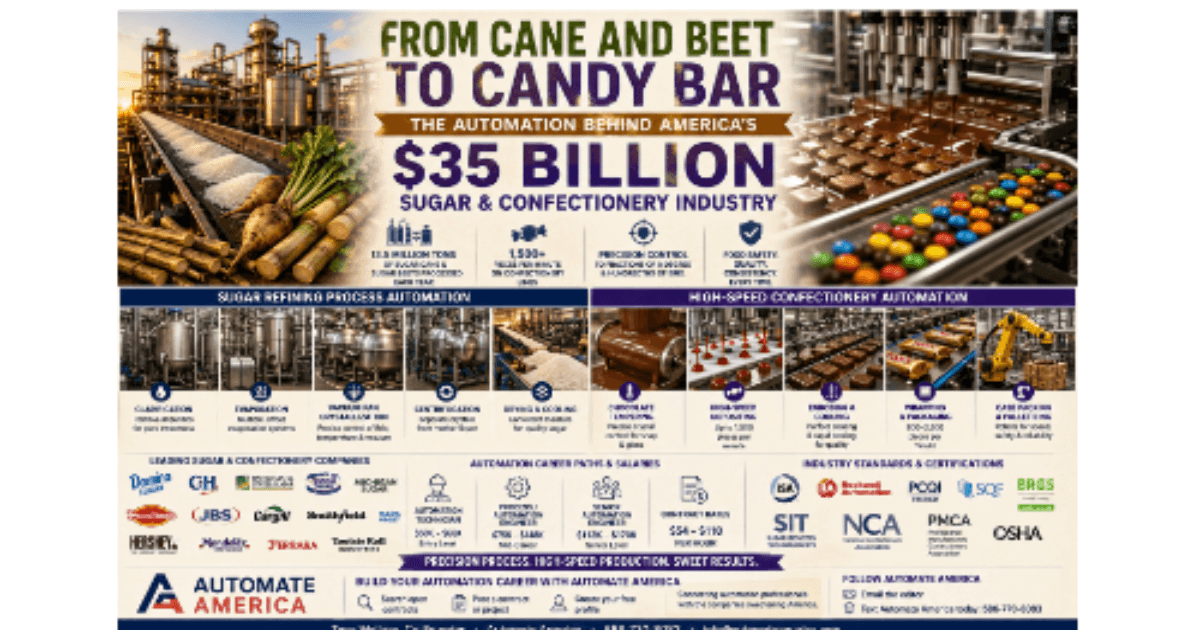
Sugar refining and confectionery manufacturing combine continuous process control with high-speed production lines to produce the sweeteners and confections Americans buy every day. American sugar refineries process 9 million tons of raw cane sugar and 4.5 million tons of sugar beets annually, operating 24/7 during harvest seasons with crystallization, centrifugation, and drying processes controlled to fractions of a degree and hundredths of a Brix point. The confectionery industry downstream — chocolate, candy, gum, and sugar confections — runs production lines depositing, enrobing, cooling, wrapping, and packing at speeds exceeding 1,500 pieces per minute. A single chocolate bar line at a plant like Mars Wrigley's Hackettstown NJ facility produces millions of bars per week. The automation professionals in these industries manage both the continuous process control of sugar refining and the discrete high-speed production of confectionery manufacturing.
The US sugar industry spans cane refineries, beet processing plants, and corn wet mills producing high-fructose corn syrup. American Sugar Refining (West Palm Beach FL) operates under the Domino Sugar and C&H Sugar brands at refineries in Yonkers NY, Baltimore MD, Chalmette LA, and Crockett CA, processing raw cane sugar into refined granulated, powdered, and liquid sugar products. United States Sugar Corporation (Clewiston FL) grows and processes sugarcane in South Florida's Everglades Agricultural Area. American Crystal Sugar Company (Moorhead MN, farmer-owned cooperative) is the largest US sugar beet processor, operating factories in Hillsboro ND, Drayton ND, East Grand Forks MN, Crookston MN, and Moorhead MN. Michigan Sugar Company (Bay City MI) and Western Sugar Cooperative (Denver CO) process sugar beets across the Midwest and Mountain West. In confectionery, Mars Wrigley (McLean VA, 18,000+ US employees) manufactures M&Ms, Snickers, Twix, Skittles, and Wrigley gums at plants in Hackettstown NJ, Cleveland TN, Waco TX, Albany GA, and Chicago IL. The Hershey Company (Hershey PA, 10,000 US employees) produces Hershey's, Reese's, Kit Kat (US license), and Jolly Rancher at its iconic Hershey PA complex and plants in Robinson IL, Stuarts Draft VA, and Hazleton PA. Mondelez International (Chicago IL) manufactures Oreo, Cadbury, Toblerone, and Sour Patch Kids. Ferrara Candy (Chicago IL, Ferrero subsidiary) produces Trolli, Black Forest, Brach's, and Nerds. Tootsie Roll Industries (Chicago IL) manufactures Tootsie Rolls, Dots, and Junior Mints.
Sugar Refining Process Control and High-Speed Confectionery Lines
Sugar refining automation engineers manage the continuous process systems that convert raw sugar into refined products. Cane sugar refining involves affination (washing raw sugar crystals), melting, clarification (carbonation or phosphatation to remove impurities), decolorization (bone char, granular activated carbon, or ion exchange resins), evaporation through multiple-effect evaporators, vacuum pan crystallization, centrifugation, and drying. Each stage requires precise temperature, pressure, Brix (dissolved solids concentration), pH, and color measurement. Brix refractometers from Anton Paar, Vaisala (Helsinki Finland), and K-Patents (Vantaa Finland) measure sugar concentration in real time. Vacuum pan automation controls crystallization by managing vacuum level, steam input, feed rate, and massecuite level to grow sugar crystals to target size (0.3 to 1.5 mm) while avoiding false grain formation. DCS platforms from ABB (Zurich Switzerland), Honeywell (Charlotte NC), Emerson DeltaV (Austin TX), and Yokogawa (Sugar Land TX) manage the refinery-wide continuous process. Sugar beet processing adds upstream steps — washing, slicing into cossettes, diffusion extraction of sucrose from beet slices, and juice purification. Pay for sugar refining process engineers and crystallization specialists depends on experience, the employer and the region.
Confectionery manufacturing automation manages the high-speed production lines that transform sugar, cocoa, milk, and other ingredients into finished candies and chocolates. Chocolate production involves roasting, winnowing, grinding, conching (48 to 72 hours of continuous mixing and aeration), tempering to precise crystallization temperatures (88-90 degrees Fahrenheit for dark chocolate, 84-86 for milk), and molding or enrobing. Tempering machines from Aasted (Farum Denmark), Selmi (Santa Vittoria d'Alba Italy), and Buhler manage the critical crystal form V development that gives chocolate its snap, gloss, and shelf stability. Candy depositing lines from Baker Perkins (Peterborough UK), Bosch Packaging (now Syntegon, Waiblingen Germany), and Winkler und Dunnebier (Rengsdorf Germany) deposit gummies, hard candies, and lollipops into starch or silicone molds at 1,000 to 1,500 pieces per minute. Wrapping machines from Theegarten-Pactec (Dresden Germany) and Loesch (Altendorf Germany) wrap individual candies at rates of 800 to 2,500 pieces per minute. Pay for confectionery automation engineers and packaging line engineers depends on experience, the employer and the region.
Certifications and Sugar Industry Career Paths
Sugar refining and confectionery automation careers require process control expertise and food safety knowledge specific to these industries. Allen-Bradley (Rockwell Automation) and Siemens certifications cover the PLC systems controlling individual machines and packaging lines. DCS certifications from ABB, Honeywell, Emerson, or Yokogawa apply to continuous sugar refining processes. The Sugar Industry Technologists (SIT, New York NY) is the primary professional organization for sugar refining engineers, offering annual conferences and technical publications. The National Confectioners Association (NCA, Washington DC) provides industry resources and the Annual Sweets and Snacks Expo. PMCA (Professional association for chocolate and confectionery, Bethlehem PA) offers production training courses. PCQI and HACCP certifications are required for food safety compliance. SQF and BRC certifications are standard across confectionery manufacturing. ISA Certified Automation Professional (CAP) provides vendor-neutral process control credibility. The Pennsylvania School of Confectionery Arts and various culinary institutes offer confectionery production training. OSHA certifications are mandatory, with emphasis on sugar dust explosion prevention (NFPA 652 and 654) and confined space entry for sugar storage bins and silos. Pay for entry-level sugar automation technicians, mid-career process engineers and senior engineers depends on experience, the employer and the region. Contract rates are set by each contract and shown before anyone applies.
Sweetness at Industrial Scale Requires Precision Automation
Every granule of sugar in every kitchen pantry and every candy bar on every convenience store shelf was produced by automated crystallization, centrifugation, and high-speed production lines operating at extraordinary precision. The sugar and confectionery industries combine continuous process control with discrete high-speed manufacturing in ways that challenge automation professionals across every discipline. Automate America connects sugar refining and confectionery automation professionals with the companies sweetening America.
Build Your Automation Career With Automate America
Ready to put sugar refining and confectionery automation skills to work? Search open hourly automation contracts, post a contract or project, or create your free Automate America profile to get matched with work. Hiring teams can search skilled professionals and connect with customers and end users nationwide. Explore related career paths for process engineers, controls engineers, quality engineers.
Industry training, standards & news
- Training & certification: ISA automation & control certification, Rockwell Automation (Allen-Bradley) PLC training.
- Industry news: Food Processing and Food Engineering.
- Standards & workforce: USDA National Agricultural Statistics Service and NIST Manufacturing Extension Partnership.
Related reading on Automate America
- Grain Milling & Flour Processing Automation Careers
- Brewing & Beverage Automation Careers
- Cosmetics & Personal Care Automation Careers


Tony Wallace, Co-Founder · Automate America · 586-770-8083 · info@automateamerica.com