From Grain to Glass — The Automation Behind America's Beverage Industry
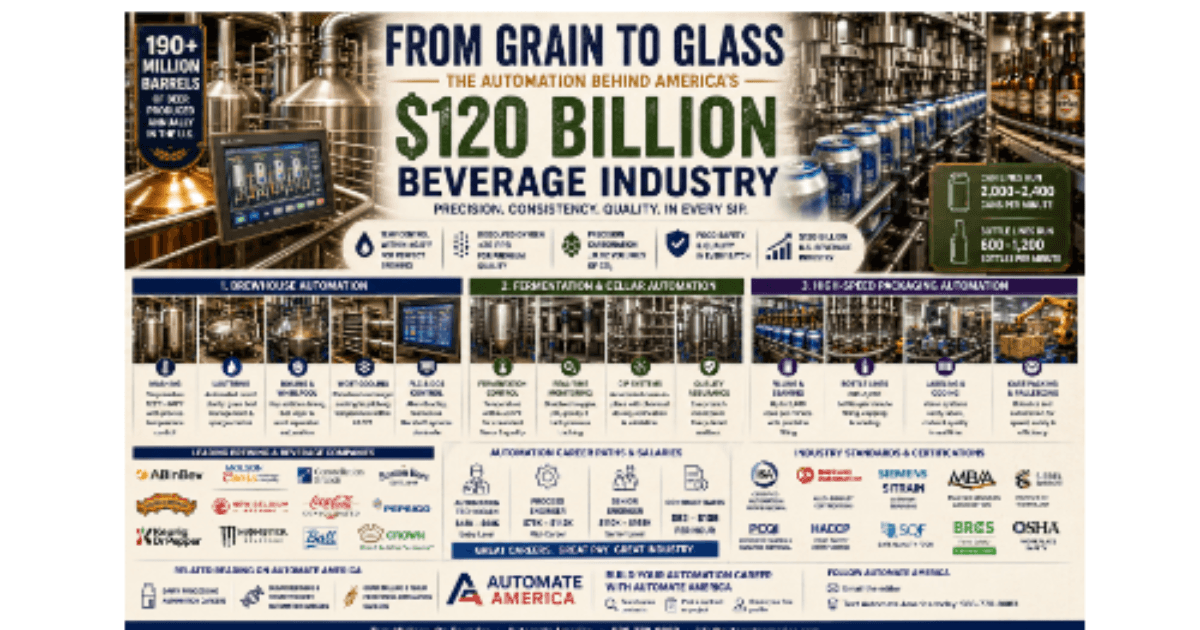
Brewing and beverage manufacturing is one of the most automation-intensive food production sectors in the United States, combining precision batch processing with high-speed packaging lines that fill, cap, label, and case-pack thousands of containers per minute. The US beer market alone is enormous, and the broader non-alcoholic beverage industry — soft drinks, bottled water, juices, energy drinks, and ready-to-drink coffee and tea — is a major market of its own. A single large brewery or beverage plant processes hundreds of thousands of gallons per day through automated mashing, lautering, boiling, fermentation, filtration, carbonation, and packaging operations where temperature control within 0.5 degrees Fahrenheit, dissolved oxygen below 20 parts per billion, and carbonation levels precise to 0.02 volumes of CO2 determine product quality. The automation professionals who manage these processes bridge the gap between food science and industrial controls engineering.
The US brewing and beverage sector spans global corporations and thousands of craft producers. Anheuser-Busch InBev (St. Louis MO, 18,000+ US employees) operates 12 US breweries including its flagship facility in St. Louis producing over 20 million barrels per year with packaging lines running 2,000 cans per minute. Molson Coors (Chicago IL, 6,000 US employees) operates breweries in Golden CO, Milwaukee WI, Fort Worth TX, and Albany GA. Constellation Brands (Victor NY) produces Corona, Modelo, and other brands at its massive Nava Mexico and Obregon Mexico brewing complexes and US wine and spirits facilities. Boston Beer Company (Boston MA) produces Samuel Adams and Truly Hard Seltzer at breweries in Boston MA, Cincinnati OH, and Breinigsville PA. Sierra Nevada Brewing (Chico CA and Mills River NC) operates two highly automated craft breweries. New Belgium Brewing (Fort Collins CO and Asheville NC, Kirin subsidiary) runs advanced automated brewing and packaging. Coca-Cola Consolidated (Charlotte NC), PepsiCo (Purchase NY), Keurig Dr Pepper (Burlington MA), and Monster Beverage (Corona CA) operate dozens of high-speed beverage production and bottling plants across the country. Ball Corporation (Westminster CO) and Crown Holdings (Yardley PA) manufacture the aluminum cans these beverages fill.
Brewhouse Automation, Fermentation Control, and High-Speed Packaging — Three Pillars of Beverage Manufacturing
Brewhouse automation engineers manage the PLC and DCS systems that control the mashing, lautering, boiling, whirlpooling, and wort cooling processes that convert grain and water into fermentable liquid. Modern automated brewhouses from GEA (Dusseldorf Germany), Krones (Neutraubling Germany), Alfa Laval (Lund Sweden), and BrauKon (Truchtlaching Germany) manage mash temperatures through precisely timed step profiles — protein rests at 122 degrees Fahrenheit, saccharification at 148-158 degrees, and mash-out at 170 degrees — using steam-jacketed vessels with PID-controlled valves. Lauter tun automation manages grain bed depth, runoff clarity (turbidity sensors), and sparge water distribution. Brew kettle automation controls boil vigor, hop addition timing, whirlpool rest, and wort cooling through plate heat exchangers to target pitching temperatures within 0.5 degrees. Allen-Bradley ControlLogix and CompactLogix PLCs dominate US brewery controls, with Siemens S7-1500 and Beckhoff TwinCAT common in European-designed systems from Krones and GEA. Pay for brewhouse automation engineers and process control engineers depends on experience, the employer and the region.
Fermentation and cellar automation manages the biological conversion of sugars to alcohol and CO2 across tanks ranging from 200-barrel craft vessels to 5,000-barrel production fermenters. Temperature is controlled within 0.5 degrees through glycol-jacketed cooling systems with proportional valves. Dissolved oxygen monitoring (optical sensors from Hach, Hamilton, and Mettler Toledo), pH tracking, and specific gravity measurement (Anton Paar density meters) provide real-time fermentation progress data. CIP (Clean-in-Place) systems run automated cleaning cycles between batches using caustic, acid, and sanitizer solutions verified by conductivity and temperature sensors. Packaging lines at large breweries and beverage plants are among the fastest production lines in food manufacturing — can lines from Krones, KHS (Dortmund Germany), and Sidel (Parma Italy) run 2,000 to 2,400 cans per minute through filling, seaming, pasteurization, labeling, date coding, and case packing. Bottle lines run 600 to 1,200 bottles per minute. Pay for packaging automation engineers and quality control automation engineers depends on experience, the employer and the region.
Certifications and Brewing Industry Career Paths
Brewing and beverage automation careers require process control expertise combined with food safety and beverage-specific knowledge. Allen-Bradley (Rockwell Automation) certifications are essential because ControlLogix and CompactLogix PLCs control the majority of US brewery and beverage plant automation. Siemens S7-1500 and TIA Portal certifications cover European-designed brewing systems. The Master Brewers Association of the Americas (MBAA, St. Paul MN) offers the Master Brewer certification and educational programs in brewing science, quality assurance, and brewery engineering. The Siebel Institute (Chicago IL) and UC Davis (Davis CA) offer brewing science programs that include brewery automation and process control coursework. PCQI (Preventive Controls Qualified Individual) and HACCP certifications demonstrate food safety competence required by FDA regulations. ISA Certified Automation Professional (CAP) provides vendor-neutral process control credibility. Krones, GEA, and KHS offer equipment-specific training on packaging line automation. OSHA certifications are mandatory, with emphasis on confined space entry for tank cleaning and CO2 monitoring in fermentation areas. Pay for entry-level brewing automation technicians, mid-career process engineers and senior engineers managing plant-wide beverage automation depends on experience, the employer and the region. Contract rates are set by each contract and shown before anyone applies.
Every Can, Bottle, and Keg Runs on Automation
From the precisely controlled mash temperatures that convert starches to fermentable sugars, through the weeks-long fermentation process monitored by dissolved oxygen and density sensors, to the packaging lines filling 2,000 cans per minute — brewing and beverage manufacturing is automation at its most demanding. The combination of biological processes, food safety regulation, high-speed packaging, and quality requirements creates constant demand for automation professionals who understand both process control and the science of beverage production. Automate America connects brewing and beverage automation professionals with the companies quenching America's thirst.
Build Your Automation Career With Automate America
Ready to put brewing and beverage automation skills to work? Search open hourly automation contracts, post a contract or project, or create your free Automate America profile to get matched with work. Hiring teams can search skilled professionals and connect with customers and end users nationwide. Explore related career paths for process engineers, controls engineers, quality engineers.
Industry training, standards & news
- Training & certification: ISA automation & control certification, Siemens SITRAIN automation training.
- Industry news: Beverage Industry and Automation World.
- Standards & workforce: Brewers Association and NIST Manufacturing Extension Partnership.
Related reading on Automate America
- Dairy Processing Automation Careers
- Sugar Refining & Confectionery Automation Careers
- Grain Milling & Flour Processing Automation Careers


Tony Wallace, Co-Founder · Automate America · 586-770-8083 · info@automateamerica.com