Feeding America's Pets and Farm Animals — The Automation Behind America's Animal Nutrition Industry
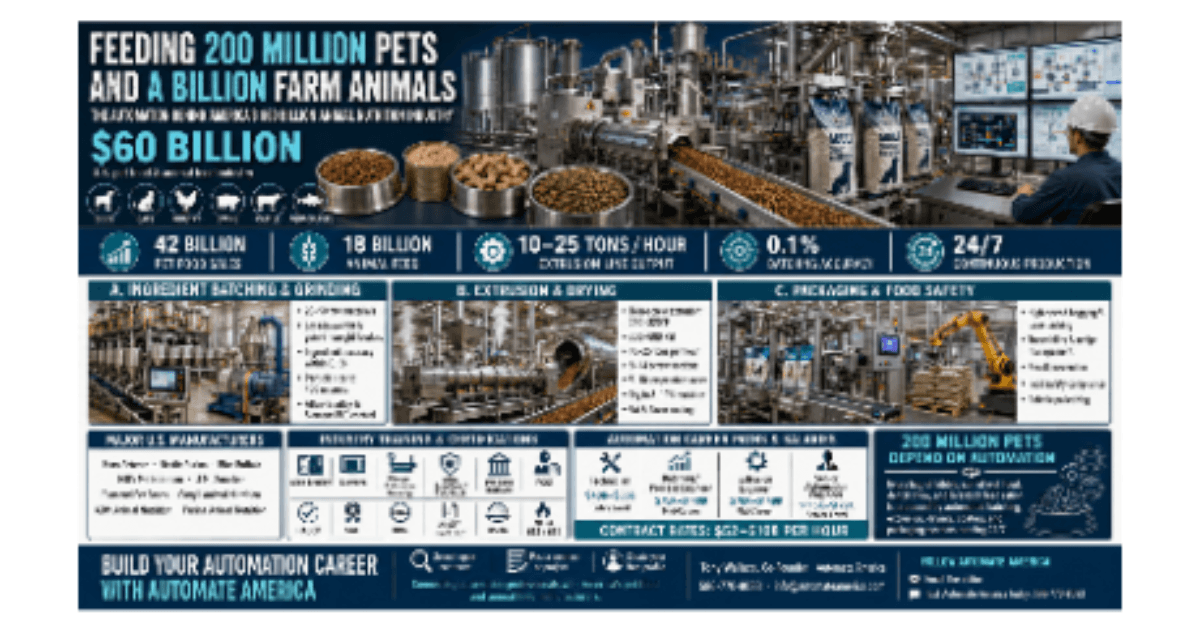
Pet food and animal feed manufacturing combines extrusion technology, precision batching, and high-speed packaging automation to produce dry kibble, wet canned food, treats, and livestock feed at enormous scale. The pet food segment keeps growing as premium, organic, and fresh pet food categories expand. Animal feed production — for poultry, swine, cattle, and aquaculture — serves the foundation of American agriculture. A single pet food extrusion line produces 10 to 25 tons per hour of finished kibble, running 24/7 with automated ingredient batching, grinding, mixing, preconditioning, extrusion, drying, coating, and packaging. The automation professionals who manage these processes work with specialized extrusion equipment, complex recipe management systems, and food safety protocols where contamination recalls can destroy brands worth billions.
The US pet food and animal feed industry is dominated by major food companies and specialized manufacturers. Mars Petcare (Franklin TN, 30,000+ US employees) produces Pedigree, Whiskas, Royal Canin, Iams, and Nutro brands at manufacturing plants in Franklin TN, Columbus OH, Mattoon IL, Fort Smith AR, Henderson NC, Greenville SC, and Topeka KS. Nestle Purina PetCare (St. Louis MO, 10,000+ US employees) manufactures Purina Pro Plan, Purina ONE, Fancy Feast, and Friskies at 21 US manufacturing facilities. General Mills Blue Buffalo (Wilton CT) produces natural and whole-ingredient pet food at plants in Richmond IN, Joplin MO, and Heartland IA. Hill's Pet Nutrition (Topeka KS, Colgate-Palmolive subsidiary) manufactures Science Diet and prescription veterinary diets at facilities in Topeka KS and Richmond IN. J.M. Smucker (Orrville OH) produces Meow Mix, Milk-Bone, and Rachael Ray Nutrish. Diamond Pet Foods (Meta MO, Schell and Kampeter Inc.) operates 5 US manufacturing plants producing private-label and branded pet food. Cargill Animal Nutrition (Minneapolis MN, 12,000+ US employees) and ADM Animal Nutrition (Quincy IL) are the two largest US animal feed producers, operating dozens of feed mills across the country. Purina Animal Nutrition (Shoreview MN, Land O'Lakes subsidiary) produces livestock and equine feed.
Extrusion, Batching, and Packaging — Three Stages of Pet Food Automation
Ingredient batching and grinding automation manages the precise weighing, conveying, and size reduction of 20 to 50 raw materials — meat meals, grain flours, starches, vitamins, minerals, fats, and flavor additives — that comprise pet food formulas. Automated batching systems from Sterling Systems and Controls (Sterling IL), NorthWind Technical Services (Sabetha KS), and Automated Process Equipment Corporation (APEC, Lake Odessa MI) use loss-in-weight and gain-in-weight feeders controlled by Allen-Bradley or Siemens PLCs to achieve tight ingredient accuracy against target weight. Hammer mills and roller mills from Andritz (Muncy PA), CPM Roskamp Champion (Waterloo IA), and RMS Roller Grinder (Harrisburg SD) reduce particle size to specifications as fine as 400 microns. Pay for batching automation engineers and recipe management system engineers depends on experience, the employer and the region.
Extrusion is the heart of dry pet food manufacturing. Twin-screw extruders from Wenger Manufacturing (Sabetha KS), Buhler (Uzwil Switzerland, US office Plymouth MN), Clextral (Tampa FL, French-based), and Andritz (Muncy PA) cook, shape, and texturize pet food at temperatures of 250-320 degrees Fahrenheit and pressures of 300-600 PSI, producing 10 to 25 tons per hour of expanded kibble. The extruder barrel contains 8 to 14 modular screw sections and 5 to 10 independent temperature zones, each controlled by PLC with precise steam injection, water addition, and screw speed management. The preconditioner upstream mixes dry ingredients with steam and water for 60 to 120 seconds at 180-210 degrees to initiate starch gelatinization. Downstream, dryers from Wenger, Buhler, and Geelen Counterflow (Haelen Netherlands) bring the kibble down to a shelf-stable moisture level in multi-pass conveyor dryers with zone-controlled temperature and airflow. Coating drums apply fat, flavor enhancers, and palatants. Pay for extrusion automation engineers and dryer and coating system engineers depends on experience, the employer and the region.
Certifications and Pet Food Industry Career Paths
Pet food and animal feed automation careers require process control expertise, extrusion technology knowledge, and food safety certification. Allen-Bradley (Rockwell Automation) ControlLogix and CompactLogix certifications are essential because these PLCs control the majority of US pet food and feed production lines. Siemens S7-1500 certifications cover European-origin equipment from Buhler, Clextral, and Geelen Counterflow. Wenger Manufacturing offers extrusion technology training courses at their Technical Center in Sabetha KS — the most directly applicable equipment training in the industry. AFIA (American Feed Industry Association, Arlington VA) provides the Safe Feed/Safe Food certification program and the Pet Food Institute (Washington DC) coordinates industry standards and training. PCQI (Preventive Controls Qualified Individual) certification is required under FSMA for all pet food and animal feed facilities. HACCP certification demonstrates food safety systems knowledge. SQF and BRC auditor awareness training is valuable because most major pet food manufacturers maintain third-party food safety certifications. The FDA's Current Good Manufacturing Practice (CGMP) regulations for animal food (21 CFR Part 507) apply to all feed mills and pet food plants. OSHA certifications are mandatory, with emphasis on dust explosion prevention (NFPA 652 and 654) in grain and ingredient handling areas, and confined space entry for bins and silos. Pay for entry-level pet food automation technicians, mid-career extrusion and process engineers and senior engineers managing plant-wide pet food manufacturing automation depends on experience, the employer and the region. Contract rates are set by each contract and shown before anyone applies.
200 Million Pets Depend on Automation
Americans spend more on pet food than baby food, and every bag of premium kibble, can of gourmet wet food, and dental chew treat is produced by automated extrusion, batching, and packaging systems running 24/7. The growth of premium pet food, food safety regulation, and production scale creates consistent demand for automation professionals who understand both extrusion technology and process control. Automate America connects pet food and animal feed automation professionals with the companies nourishing America's animals.
Build Your Automation Career With Automate America
Ready to put pet food and animal feed automation skills to work? Search open hourly automation contracts, post a contract or project, or create your free Automate America profile to get matched with work. Hiring teams can search skilled professionals and connect with customers and end users nationwide. Explore related career paths for process engineers, controls engineers, quality engineers.
Industry training, standards & news
- Training & certification: ISA automation & control certification, Rockwell Automation (Allen-Bradley) PLC training.
- Industry news: Food Processing and Food Engineering.
- Standards & workforce: NIST Manufacturing Extension Partnership and The Manufacturing Institute.
Related reading on Automate America
- Grain Milling & Flour Processing Automation Careers
- Meat & Protein Processing Automation Careers
- Dairy Processing Automation Careers


Tony Wallace, Co-Founder · Automate America · 586-770-8083 · info@automateamerica.com