From Wheat Field to Bread Aisle — The Automation Behind Every Pound of Flour Milled in America
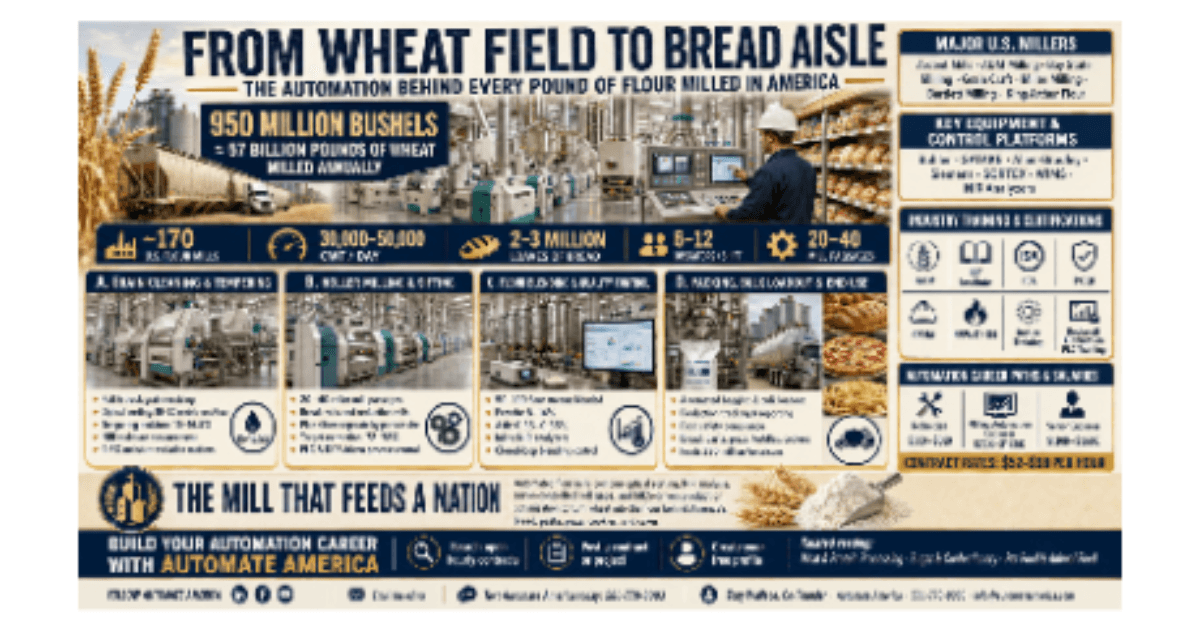
Grain milling is one of the oldest continuous manufacturing processes in the world, and one of the most heavily automated. The United States mills approximately 950 million bushels of wheat annually — roughly 57 billion pounds — into flour, semolina, and wheat byproducts at approximately 170 flour mills operated by a handful of large milling companies and dozens of regional millers. A modern flour mill operates 24 hours a day, 7 days a week, with as few as 6 to 12 operators per shift managing a process that receives railcars of wheat, cleans and tempers the grain, breaks it through a series of 20 to 40 roller mill passages, sifts the resulting stock through plan sifters with thousands of square feet of sieving area, and produces 50 to 100 different flour streams blended to meet customer specifications for protein content, ash content, moisture, and particle size distribution — all controlled by PLC and DCS systems that monitor hundreds of process variables simultaneously. A single large flour mill can produce 30,000 to 50,000 hundredweight (cwt) of flour per day — enough to bake 2 to 3 million loaves of bread.
The US flour milling industry is dominated by several major companies. Ardent Mills (Denver CO, 6,000 employees) is the largest flour miller in North America, formed in 2014 through the combination of ConAgra Mills, Cargill's flour milling operations, and CHS milling. Ardent Mills operates over 40 flour mills, mixers, and innovation centers across the US, Canada, and Puerto Rico, including major mills in Commerce City CO, Buffalo NY, Hastings MN, and Saginaw TX. ADM Milling (Chicago IL, Archer-Daniels-Midland subsidiary) operates flour mills in Shawnee Mission KS, Lincoln NE, Enid OK, Baldwinsville NY, and other locations as part of ADM's broader agricultural processing operations (40,000 employees). Bay State Milling (Quincy MA, privately held) operates mills in Clifton NJ, Winona MN, Indianola IA, and Tolleson AZ. King Arthur Flour (Norwich VT, employee-owned) operates a flour milling and distribution facility. Grain Craft (Chattanooga TN) operates mills in multiple states. Miller Milling (Minneapolis MN) produces flour and grain-based ingredients. Bartlett Milling (Kansas City MO, Savage Enterprises subsidiary) operates mills in the Midwest and South. On the equipment side, Buhler (Uzwil Switzerland, with US operations in Minneapolis MN) is the dominant manufacturer of roller mills, plan sifters, purifiers, and complete milling systems — Buhler says most of the world's wheat is processed on its equipment. SATAKE (Hiroshima Japan, with US operations in Houston TX) manufactures optical sorters, milling equipment, and rice processing systems.
Cleaning, Milling, and Blending — Precision Processing at Industrial Scale
Grain cleaning and tempering automation engineers manage the front-end systems that receive wheat from rail or truck, clean it through multiple passes of separators, aspirators, destoners, scourers, and optical color sorters, and temper (add moisture to) the wheat for 8 to 24 hours to achieve the optimal moisture content for milling. Optical sorters from SATAKE, Buhler (SORTEX), and Key Technology (Walla Walla WA) use high-speed cameras and air ejectors to remove discolored kernels, foreign material, and insect-damaged grain at rates of 10 to 30 metric tons per hour. Tempering systems must precisely control water addition based on incoming wheat moisture (measured by near-infrared analyzers from Perten Instruments, now PerkinElmer, or Foss Analytics) because even a small moisture variation affects milling performance and flour quality. Pay for grain handling and cleaning automation engineers depends on experience, the employer and the region.
The milling process itself is a multi-stage reduction operation where wheat kernels pass through a series of paired roller mills — break rolls that crack the kernel open and release the endosperm, and reduction rolls that gradually reduce the endosperm particles to flour fineness — with plan sifters between each passage that separate the milled stock into fractions by particle size. A modern mill has 20 to 40 passages, each with specific roll gap settings, roll speeds, roll corrugation patterns (for break rolls), and sifter cloth meshes that must be set and maintained to achieve the target extraction rate (the share of the wheat kernel converted to flour). Buhler's Mercury MES (Manufacturing Execution System) and WIMS (Windmill Integrated Mill System) platforms provide automated process monitoring, roll gap adjustment, and production reporting. Allen-Bradley ControlLogix and Siemens S7-1500 PLCs manage the sequential operation of roller mills, sifters, purifiers, and pneumatic transport systems throughout the mill. Flour blending systems at the back end of the mill combine multiple flour streams to meet customer specifications for protein, ash, and moisture, with inline NIR (Near-Infrared) analyzers providing real-time composition data for closed-loop blending control. Pay for milling automation engineers and flour quality and blending system engineers depends on experience, the employer and the region.
Certifications and Grain Milling Career Paths
Grain milling automation careers require a combination of process control knowledge, food safety expertise, and understanding of milling science — a specialized discipline with its own terminology, physics, and quality metrics. Allen-Bradley (Rockwell Automation) PLC certifications are essential because most US flour mills use ControlLogix or CompactLogix for mill automation. Siemens S7-1500 and TIA Portal certifications apply to mills with Siemens-based control systems. Buhler-specific training (available through Buhler's Minneapolis MN office and Uzwil Switzerland headquarters) is the most directly applicable equipment training because Buhler roller mills, sifters, and automation platforms dominate the global milling industry. The International Association of Operative Millers (IAOM, Overland Park KS) is the primary professional organization for the milling industry, offering annual conferences, correspondence courses in milling science, and networking opportunities. Kansas State University (Manhattan KS) operates the IGP Institute (International Grains Program) which offers short courses in flour milling, feed manufacturing, and grain quality — the most respected milling education program in North America. North Dakota State University (Fargo ND) and Purdue University (West Lafayette IN) have cereal science and grain science programs. PCQI (Preventive Controls Qualified Individual) certification is required for food safety compliance under FSMA. OSHA certifications are mandatory with particular emphasis on grain dust explosion prevention (NFPA 61 and 652), confined space entry for bins and silos, and lockout/tagout for roller mills and conveyor systems. Pay for entry-level mill automation technicians, mid-career milling automation engineers and senior engineers managing mill-wide automation systems or multi-mill optimization depends on experience, the employer and the region. Contract rates are set by each contract and shown before anyone applies.
The Mill That Feeds a Nation
Every sandwich, pizza, cake, cookie, tortilla, and pasta dish in America starts with flour milled from wheat by automated systems that have been refined over centuries. The modern flour mill combines ancient knowledge of grain with advanced automation — optical sorting, NIR analysis, servo-controlled roll gaps, and MES-driven production optimization. Automate America connects grain milling automation professionals with the companies milling the flour that feeds 330 million Americans every day.
Build Your Automation Career With Automate America
Ready to put grain milling and flour processing automation skills to work? Search open hourly automation contracts, post a contract or project, or create your free Automate America profile to get matched with work. Hiring teams can search skilled professionals and connect with customers and end users nationwide. Explore related career paths for process engineers, controls engineers, PLC programmers.
Industry training, standards & news
- Training & certification: ISA automation & control certification, Rockwell Automation (Allen-Bradley) PLC training.
- Industry news: World Grain and Food Engineering.
- Standards & workforce: North American Millers' Association and NIST Manufacturing Extension Partnership.
Related reading on Automate America
- Meat & Protein Processing Automation Careers
- Sugar Refining & Confectionery Automation Careers
- Pet Food & Animal Feed Automation Careers


Tony Wallace, Co-Founder · Automate America · 586-770-8083 · info@automateamerica.com