From Milking Parlor to Grocery Shelf — The Automation Behind America's Dairy Industry
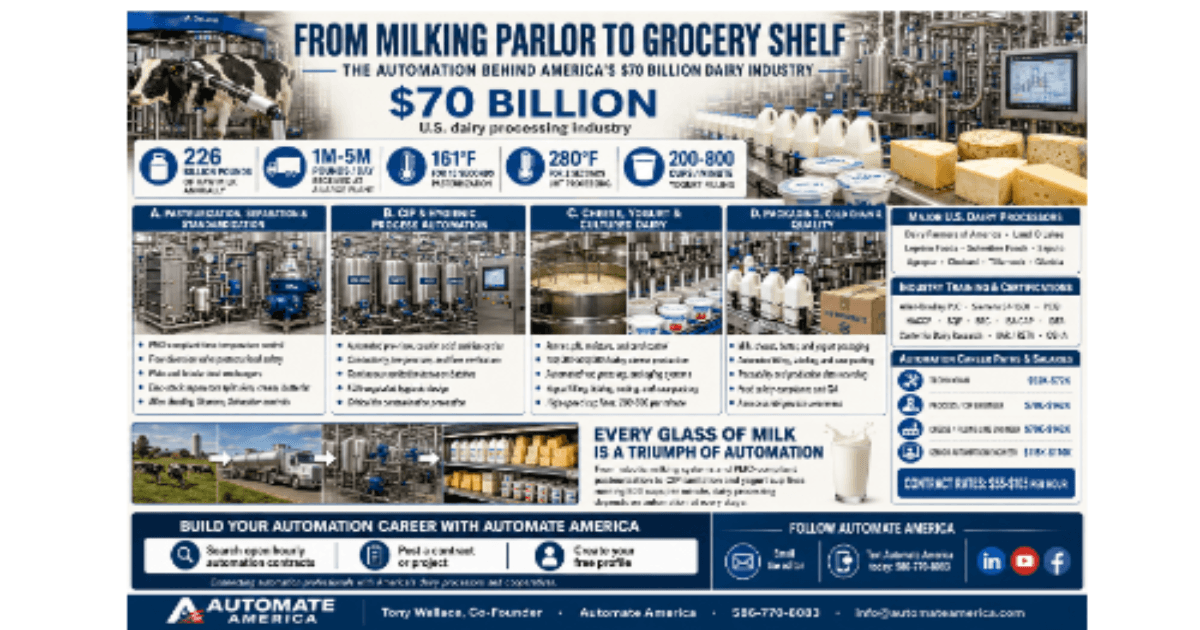
Dairy processing is one of the most heavily automated food manufacturing sectors in the United States, driven by strict FDA and USDA food safety requirements, perishability that demands speed at every stage, and the sheer scale of an industry that processes 226 billion pounds of raw milk annually. A modern dairy processing plant receives 1 million to 5 million pounds of raw milk per day, pasteurizes it at precisely 161 degrees Fahrenheit for 15 seconds (or 280 degrees for 2 seconds for ultra-high temperature processing), separates it into skim milk, cream, and butterfat fractions, and transforms it into fluid milk, cheese, yogurt, butter, ice cream, whey protein, and milk powder — all under continuous Clean-in-Place (CIP) sanitation protocols that run automated cleaning cycles between every production batch. The automation professionals who manage these processes work with specialized hygienic equipment, CIP-validated control systems, and food safety protocols where a single contamination event can trigger recalls affecting millions of consumers.
The US dairy processing industry is dominated by cooperatives and large-scale processors. Dairy Farmers of America (Kansas City KS) is the largest US dairy cooperative, processing its member farms' milk at manufacturing facilities across the country. Land O'Lakes (Arden Hills MN, 10,000 employees) is a farmer-owned cooperative producing butter, cheese, and dairy ingredients at plants in Kiel WI, Spencer WI, and Kent OH. Leprino Foods (Denver CO, 4,800 employees) is the world's largest mozzarella producer, operating plants in Lemoore CA, Tracy CA, Greeley CO, Remus MI, Roswell NM, and Waverly NY. Schreiber Foods (Green Bay WI, 9,000 employees) produces cheese, yogurt, and cream cheese at facilities in Green Bay WI, Clinton MO, Monett MO, and Carthage MO. Saputo (Montreal QC, with extensive US operations) produces cheese, dairy ingredients, and fluid milk at over 30 US plants. Agropur (Longueuil QC) operates 8 US dairy processing plants. Chobani (New Berlin NY, 2,000+ employees) operates the world's largest yogurt manufacturing plant in New Berlin NY (1.3 million square feet) and a second plant in Twin Falls ID. Tillamook County Creamery Association (Tillamook OR) produces cheese and dairy products. Glanbia (Twin Falls ID, Ireland-based) manufactures nutritional dairy ingredients including whey protein isolate.
Pasteurization, Separation, and CIP — Continuous Processing Under Food Safety Constraints
Dairy process automation engineers manage the DCS and PLC systems that control receiving, pasteurization, separation, standardization, and product manufacturing. The pasteurization system — a plate heat exchanger or tubular heat exchanger with flow diversion valves, temperature recording devices, and timing pumps — must comply with the Pasteurized Milk Ordinance (PMO) which specifies exact time-temperature combinations and requires that the flow diversion valve automatically diverts under-pasteurized milk back to the raw balance tank. These systems are controlled by PLCs from Allen-Bradley (Rockwell Automation), Siemens, and Schneider Electric with FDA 21 CFR Part 11 compliant data recording. Separation and standardization — using disc-stack centrifugal separators from Alfa Laval (Lund Sweden), GEA (Dusseldorf Germany), and SPX Flow (Charlotte NC) — require precise control of feed rate, back pressure, and discharge timing to separate raw milk into skim, cream, and butterfat at the correct fat percentages. Clean-in-Place (CIP) automation manages multi-step wash cycles (pre-rinse, caustic wash, intermediate rinse, acid wash, final rinse, sanitize) that clean every pipe, valve, and vessel between production runs without disassembly, using conductivity, temperature, and flow sensors to verify cleaning effectiveness. Pay for dairy process automation engineers and CIP systems engineers depends on experience, the employer and the region.
Cheese manufacturing automation involves specialized processes including vat pasteurization, starter culture addition, rennet coagulation, curd cutting, cooking, draining, pressing, and aging — each requiring precise temperature, time, pH, and moisture control. Automated cheesemaking systems from Tetra Pak (Lund Sweden), APT (Schroeder WI, formerly Scherping Systems), and Stoelting (Kiel WI) manage production of 40-pound blocks or 640-pound barrels at rates of 100,000 to 500,000 pounds of cheese per day per plant. Yogurt manufacturing at Chobani, Dannon (White Plains NY, Danone subsidiary), and General Mills (Minneapolis MN, Yoplait brand) uses high-speed filling lines running 200 to 800 cups per minute with volumetric or weight-based filling, lidding, date coding, and case packing fully automated. Pay for cheese automation engineers and yogurt and filling line engineers depends on experience, the employer and the region.
Certifications and Dairy Industry Career Paths
Dairy processing automation careers require process control expertise combined with food safety knowledge. Allen-Bradley (Rockwell Automation) certifications are the most valuable because ControlLogix and CompactLogix PLCs dominate US dairy plant controls, from pasteurization and CIP to packaging lines. Siemens S7-1500 certifications apply to some newer installations and European-origin dairy equipment from GEA and Tetra Pak. Alfa Laval and GEA equipment-specific training covers the separators, homogenizers, and heat exchangers central to dairy processing. Preventive Controls Qualified Individual (PCQI) certification from the Food Safety Preventive Controls Alliance (FSPCA) is increasingly required or preferred for automation engineers working in FDA-regulated food plants. HACCP (Hazard Analysis Critical Control Points) training demonstrates food safety systems knowledge. SQF (Safe Quality Food) and BRC (British Retail Consortium) auditor awareness training is valuable because most dairy processors maintain third-party food safety certifications. ISA Certified Automation Professional (CAP) provides vendor-neutral process control credibility. Dairy-specific training through the International Dairy Foods Association (IDFA, Washington DC) and the Center for Dairy Research (University of Wisconsin-Madison) covers dairy science and processing technology. OSHA certifications are mandatory. Ammonia refrigeration system awareness (IIAR and RETA certifications) is critical because dairy plants use large ammonia refrigeration systems. Pay for entry-level dairy automation technicians, mid-career process engineers and senior engineers managing plant-wide dairy automation depends on experience, the employer and the region. Contract rates are set by each contract and shown before anyone applies.
Every Glass of Milk Is a Triumph of Automation
From the robotic milking systems in modern dairy barns to the high-speed filling lines that package 800 yogurt cups per minute, the dairy industry runs on automation. The combination of perishability, food safety regulation, and massive scale creates constant demand for automation professionals who understand both process control and the unique requirements of food-grade manufacturing. Automate America connects dairy processing automation professionals with the cooperatives and processors feeding America.
Build Your Automation Career With Automate America
Ready to put dairy processing automation skills to work? Search open hourly automation contracts, post a contract or project, or create your free Automate America profile to get matched with work. Hiring teams can search skilled professionals and connect with customers and end users nationwide. Explore related career paths for process engineers, controls engineers, quality engineers.
Industry training, standards & news
- Training & certification: ISA automation & control certification, Rockwell Automation (Allen-Bradley) PLC training.
- Industry news: Dairy Foods and Food Engineering.
- Standards & workforce: NIST Manufacturing Extension Partnership and The Manufacturing Institute.
Related reading on Automate America
- Meat & Protein Processing Automation Careers
- Brewing & Beverage Automation Careers
- Cosmetics & Personal Care Automation Careers


Tony Wallace, Co-Founder · Automate America · 586-770-8083 · info@automateamerica.com