The Fourth Utility — The Automation Behind Every PSI of Compressed Air in American Manufacturing
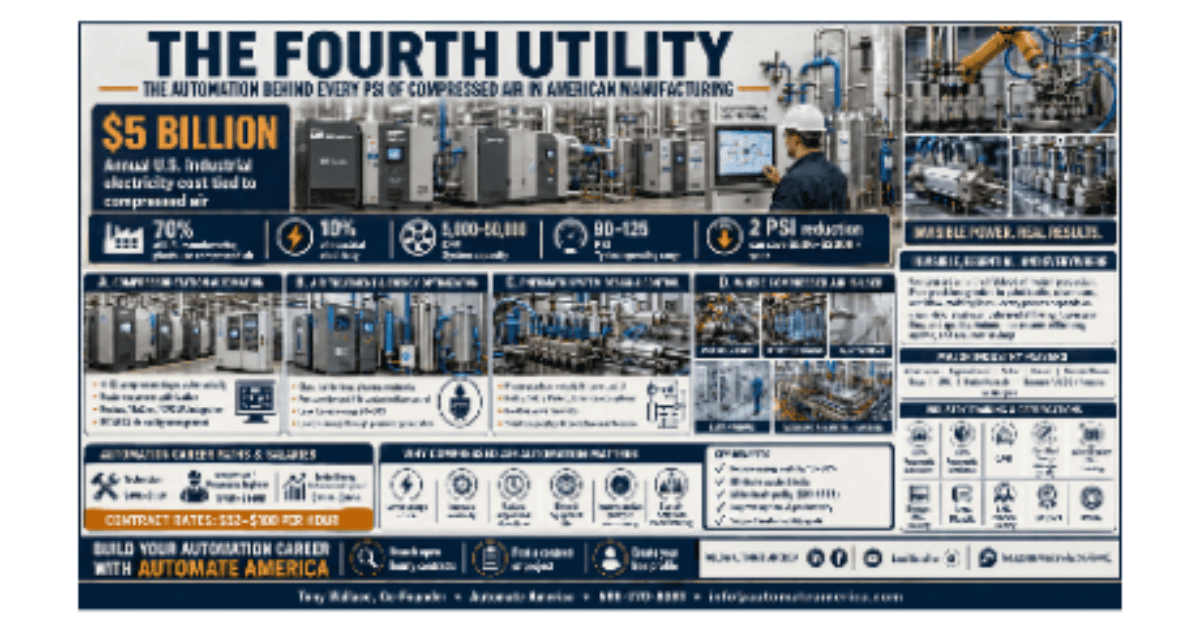
Compressed air is called the fourth utility — after electricity, water, and natural gas — because virtually every manufacturing plant in America depends on it. Most US manufacturing facilities use compressed air systems, and they consume a significant share of all industrial electricity in the country. A typical automotive assembly plant operates 500 to 2,000 pneumatic cylinders, valves, and actuators powered by central compressor stations producing 5,000 to 50,000 cubic feet per minute (CFM) at pressures of 90 to 125 PSI. The automation professionals who design, install, and optimize these systems work at the intersection of fluid power engineering, energy management, and industrial controls — managing equipment where even a small reduction in system pressure can save a large plant real money in electricity, and where moisture or contamination in the air supply can shut down a paint line, destroy pharmaceutical products, or ruin electronic components.
The compressed air and pneumatics industry includes compressor manufacturers, pneumatic component makers, and system integrators. Atlas Copco (Rock Hill SC, Sweden-based, 53,000 employees worldwide) is the global leader in compressed air equipment, manufacturing rotary screw, centrifugal, and reciprocating compressors, dryers, and filters at facilities in Rock Hill SC and other US locations. Ingersoll Rand (Davidson NC, 16,000 employees) produces rotary screw and centrifugal compressors, dryers, and air treatment equipment at manufacturing facilities in Davidson NC, Sedalia MO, and Mocksville NC. Sullair (Michigan City IN, Hitachi subsidiary, 1,000+ employees) manufactures rotary screw compressors, portable compressors, and vacuum systems. Kaeser Compressors (Fredericksburg VA, Germany-based) manufactures rotary screw compressors, blowers, and vacuum packages for the US market at their Fredericksburg VA facility. Gardner Denver (Milwaukee WI, now part of Ingersoll Rand) produces a wide range of compressed air and vacuum equipment. On the pneumatics side, Festo (Islandia NY, Germany-based, 21,000 employees worldwide) is the global leader in pneumatic and electric automation components — cylinders, valves, actuators, grippers, and motion systems. SMC Corporation (Noblesville IN, Japan-based, 20,000+ employees) is the world's largest pneumatic component manufacturer. Parker Hannifin (Cleveland OH, 58,000 employees) produces pneumatic cylinders, valves, FRLs (filter-regulator-lubricators), and motion control systems through its Pneumatics Division. Emerson (St. Louis MO) manufactures pneumatic valves and actuators through its ASCO and Aventics brands. IMI Precision Engineering (Birmingham UK, with US operations) produces Norgren and Buschjost pneumatic components.
Compressor Station Automation and Pneumatic System Design — Energy Meets Precision
Compressor station automation engineers manage the control systems that operate, sequence, and optimize multi-compressor installations. A large manufacturing plant may have 4 to 12 rotary screw compressors rated at 200 to 500 horsepower each, producing a combined 10,000 to 40,000 CFM. Master sequencer controllers from Atlas Copco (Optimizer 4.0), Ingersoll Rand (Xe-Series controller), and Kaeser (Sigma Air Manager 4.0) manage compressor staging — starting and stopping compressors and adjusting variable speed drive compressors to match fluctuating demand while minimizing energy consumption. These systems integrate with building management systems (BMS) and plant SCADA through Modbus, BACnet, or OPC-UA protocols. Air treatment — dryers (refrigerated, desiccant, and membrane), filters (particulate, coalescing, and activated carbon), and condensate management systems — must be automated to maintain air quality standards per ISO 8573 classifications, where Class 1 air (required for food, pharmaceutical, and electronics manufacturing) demands particulate below 0.1 microns, oil content below 0.01 mg per cubic meter, and pressure dew point below minus 94 degrees Fahrenheit. Pay for compressor station automation engineers and energy optimization specialists depends on experience, the employer and the region.
Pneumatic system design and automation involves the selection, installation, and programming of valves, cylinders, actuators, and control systems that convert compressed air into mechanical motion throughout the manufacturing process. Modern pneumatic systems use proportional valves, servo-pneumatic positioners, and fieldbus-connected valve manifolds from Festo, SMC, Parker, and Emerson that enable precise position, velocity, and force control previously achievable only with hydraulic or electric actuators. Festo's motion terminal VTEM and SMC's EX600 wireless fieldbus systems represent the latest evolution toward Industry 4.0 pneumatics with integrated IoT sensors reporting cycle counts, response times, and leakage indicators to predictive maintenance platforms. Pay for pneumatic system designers at machine builders and system integrators and field service engineers specializing in pneumatic valve and actuator troubleshooting depends on experience, the employer and the region. Compressed air auditors — specialists who survey plant air systems, identify leaks (many plants lose a large share of their compressed air to leaks), and recommend efficiency improvements — are a specialty of their own.
Certifications and Compressed Air Industry Career Paths
Compressed air and pneumatics automation careers require a blend of fluid power knowledge, energy management expertise, and industrial controls programming. The International Fluid Power Society (IFPS) offers the Pneumatic Specialist and Pneumatic Mechanic certifications — the most recognized credentials in fluid power. The Compressed Air and Gas Institute (CAGI, Cleveland OH) provides training, standards, and performance verification programs for compressed air equipment. Certified Energy Manager (CEM) certification from the Association of Energy Engineers (AEE, Atlanta GA) is valuable because compressed air energy optimization is a major focus area for plant energy management. Allen-Bradley (Rockwell Automation) and Siemens PLC certifications cover the master sequencer and SCADA systems used in compressor stations. Festo offers extensive pneumatics training through Festo Didactic — their training centers in Mason OH and other locations provide hands-on courses in pneumatic circuit design, proportional valves, and servo-pneumatics. SMC provides pneumatic training programs through their Technical Training Center. Parker Hannifin offers fluid power training. ISO 8573 compressed air quality knowledge is essential for engineers working in regulated industries. OSHA certifications are mandatory with particular emphasis on compressed gas safety, lockout/tagout for pressurized systems, and hearing protection in compressor rooms. Pay for entry-level pneumatics technicians, mid-career compressor automation engineers and senior engineers managing plant-wide compressed air systems or specializing in energy optimization depends on experience, the employer and the region. Contract rates are set by each contract and shown before anyone applies.
Invisible, Essential, and Everywhere
Most people never think about compressed air, but manufacturing cannot function without it. Every pneumatic cylinder firing on an assembly line, every air-blown PET bottle at a beverage plant, every paint spray booth, every cleanroom pressurization system depends on reliable compressed air delivered at the right pressure, flow, and quality. Automate America connects compressed air and pneumatics professionals with the companies powering American manufacturing — one cubic foot at a time.
Build Your Automation Career With Automate America
Ready to put compressed-air and pneumatics automation skills to work? Search open hourly automation contracts, post a contract or project, or create your free Automate America profile to get matched with work. Hiring teams can search skilled professionals and connect with customers and end users nationwide. Explore related career paths for controls engineers, maintenance technicians, automation engineers.
Industry training, standards & news
- Training & certification: National Fluid Power Association, ISA automation & control certification.
- Industry news: Hydraulics & Pneumatics and Automation World.
- Standards & workforce: NIST Manufacturing Extension Partnership and The Manufacturing Institute.
Related reading on Automate America
- Conveyor & Material Handling Automation Careers
- Grain Milling & Flour Processing Automation Careers
- Battery Manufacturing Automation Careers


Tony Wallace, Co-Founder · Automate America · 586-770-8083 · info@automateamerica.com