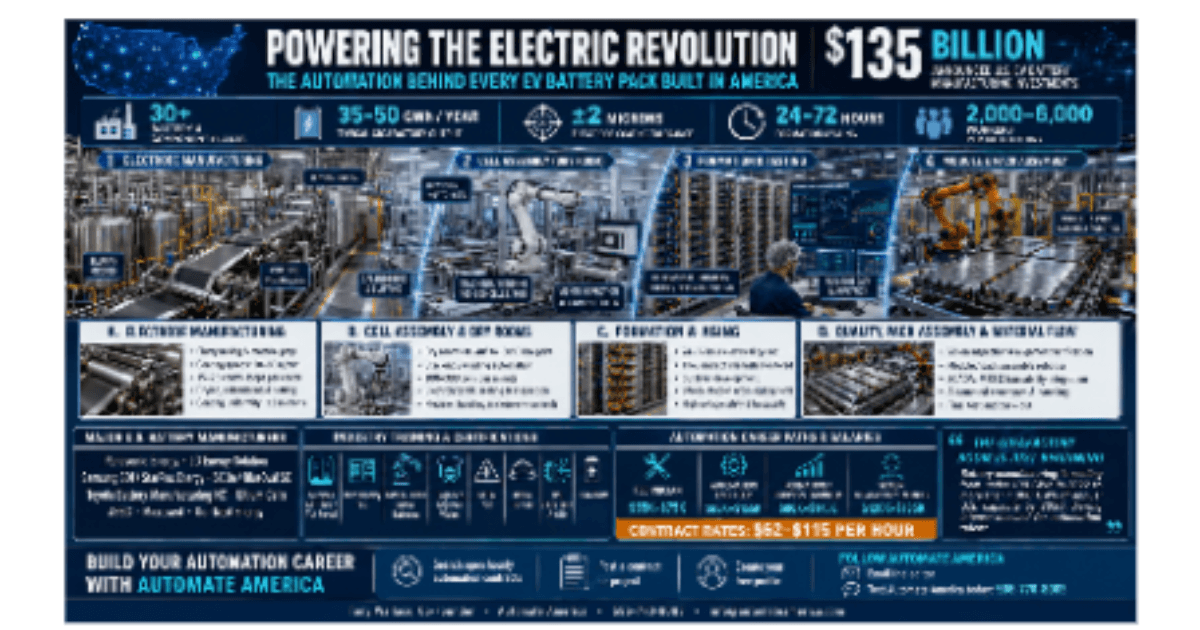
Powering the Electric Revolution — The Automation Behind Every EV Battery Pack Built in America
Battery manufacturing is one of the fastest-growing industrial sectors in the United States, driven by a wave of announced investments in electric vehicle battery gigafactories. The Inflation Reduction Act of 2022 triggered a domestic manufacturing boom that is reshaping American industry — over 30 battery and battery component plants are under construction or recently opened across Georgia, Tennessee, Kentucky, Michigan, Ohio, Kansas, and the Carolinas. The automation professionals who build, program, and maintain these production lines manage some of the most advanced manufacturing processes on the planet, where electrode coating tolerances of 2 microns, cleanroom environments rivaling semiconductor fabs, and formation cycling that takes 24 to 72 hours per cell define the daily challenge. A single gigafactory employs a large workforce, with automation engineers among the most critical roles.
The US battery manufacturing sector has transformed since 2022. Panasonic Energy (Newark NJ, with manufacturing in Sparks NV and De Soto KS) operates a gigafactory in Nevada supplying Tesla and a second facility in De Soto KS. LG Energy Solution (Holland MI and Queen Creek AZ) operates battery cell production in Michigan and is constructing new capacity in Arizona. Samsung SDI (Kokomo IN) is building a facility with Stellantis under the StarPlus Energy joint venture. SK On (Commerce GA and Stanton TN) operates two plants in Georgia through SK Battery America and is expanding in Tennessee through the BlueOval SK joint venture with Ford. Toyota Battery Manufacturing North Carolina (Liberty NC) is investing in a battery campus. Ultium Cells (Lordstown OH, Spring Hill TN, and Lansing MI), a joint venture between GM and LG, operates three US plants. AESC (Florence SC and Bowling Green KY), originally a Nissan subsidiary now majority-owned by Envision Group, manufactures cells at two US locations. Microvast (Clarksville TN) produces lithium-ion cells for commercial vehicles. Our Next Energy (Van Buren Township MI) is scaling solid-state battery production.
Electrode Manufacturing, Cell Assembly, and Formation — Three Stages of Extreme Precision
Battery cell production divides into three major automation stages, each requiring specialized engineering talent. Electrode manufacturing — the front end — involves mixing slurries of active materials (lithium iron phosphate, nickel manganese cobalt, or lithium nickel cobalt aluminum oxide for cathodes; graphite or silicon-graphite for anodes), coating the slurry onto aluminum or copper foil at speeds of 20 to 80 meters per minute with coating thickness uniformity of plus or minus 2 microns, drying in multi-zone ovens at precisely controlled temperatures, calendering (compressing) to target density and porosity, and slitting to final width. The coating process alone involves 15 to 25 control loops per coater managing slot-die gap, pump pressure, web tension, oven zone temperatures, and line speed. Pay for electrode coating engineers and mixing and slurry process engineers depends on experience, the employer and the region.
Cell assembly — the middle stage — takes place in dry rooms maintained at dew points of minus 40 to minus 60 degrees Celsius because lithium reacts violently with moisture. Automated stacking or winding machines from equipment manufacturers like Manz AG (Reutlingen Germany), PNE (South Korea), CKD Corporation (Komaki Japan), and Wuxi Lead Intelligent (China) assemble electrode sheets and separators into jelly rolls or stacked cell structures at speeds of 100 to 300 cells per minute. Electrolyte filling, sealing, and initial quality inspection complete the cell build. Pay for cell assembly automation engineers and dry room HVAC and environmental control engineers depends on experience, the employer and the region. Formation and aging — the back end — involves the initial charging and discharging of every cell through precisely controlled electrical cycles lasting 24 to 72 hours that form the solid electrolyte interface (SEI) layer critical to cell performance and longevity. Formation equipment from Bitrode (Fenton MO), Maccor (Tulsa OK), Arbin Instruments (College Station TX), and Neware (Shenzhen China) manages thousands of channels simultaneously. Pay for formation engineers depends on experience, the employer and the region.
Certifications and Battery Industry Career Paths
Battery manufacturing automation careers require a combination of process control, robotics, vision system, and electrical safety expertise. Siemens S7-1500 and TIA Portal certifications are essential because most Asian and European battery equipment uses Siemens PLCs. Allen-Bradley (Rockwell Automation) certifications cover plant-wide SCADA, MES integration, and material handling systems that American integrators typically install around the imported cell production equipment. FANUC, ABB, and KUKA robotics certifications apply to material handling, inspection, and packaging cells. Cognex and Keyence vision system training covers electrode inspection, cell alignment verification, and defect detection. Arc flash safety training (NFPA 70E) is critical because formation and testing involve high-voltage DC systems up to 800V. OSHA 10 and 30-Hour certifications are mandatory. IPC certifications (J-STD-001 for soldering, A-610 for electronic assemblies) apply to module and pack assembly. The NAATBatt (National Alliance for Advanced Transportation Batteries, Chicago IL) provides industry networking and workforce development resources. The Battery Innovation Center (Newberry IN) offers testing and development services. Pay for entry-level battery manufacturing technicians, mid-career automation engineers and senior engineers managing gigafactory production lines depends on experience, the employer and the region. Contract rates are set by each contract and shown before anyone applies, and demand is intense for engineers experienced with electrode coating, formation systems, and dry room automation.
The Gigafactory Boom Is Just Beginning
The United States is on track to have over 1,000 GWh of annual battery manufacturing capacity by 2030, up from less than 100 GWh in 2022. Every gigawatt-hour requires automated electrode coating lines, dry room cell assembly systems, formation and testing channels, and module/pack assembly robotics. The talent shortage is acute — battery manufacturers are recruiting from semiconductor, pharmaceutical, and food processing industries because the automation fundamentals transfer. Automate America connects battery manufacturing automation professionals with the companies building the energy infrastructure of the electric future.
Build Your Automation Career With Automate America
Ready to put battery manufacturing automation skills to work? Search open hourly automation contracts, post a contract or project, or create your free Automate America profile to get matched with work. Hiring teams can search skilled professionals and connect with customers and end users nationwide. Explore related career paths for process engineers, controls engineers, manufacturing engineers.
Industry training, standards & news
- Training & certification: ISA automation & control certification, Rockwell Automation (Allen-Bradley) PLC training.
- Industry news: Automation World and Battery Council International.
- Standards & workforce: US DOE vehicle battery research and NIST Manufacturing Extension Partnership.
Related reading on Automate America
- Conveyor & Material Handling Automation Careers
- Compressed Air & Pneumatics Automation Careers
- Dairy Processing Automation Careers


Tony Wallace, Co-Founder · Automate America · 586-770-8083 · info@automateamerica.com