Most people in manufacturing aren’t ready to hear what’s already happening to automotive automation work — and the ones who are have quietly changed how they staff a build. The line that will run on a Texas plant floor next year isn’t waiting on a Texas plant floor. It’s being wired, programmed, and proven in Germany right now, and it will cross the Atlantic already knowing how it’s supposed to behave.
That sentence describes a specific kind of engineer, and there aren’t many of them. The person who can stand up a Siemens cell overseas and then commission the same cell after it lands stateside carries a skill set that doesn’t post about itself. If that’s you, you read job descriptions and see project plans — and you already know whether the contract below is yours.
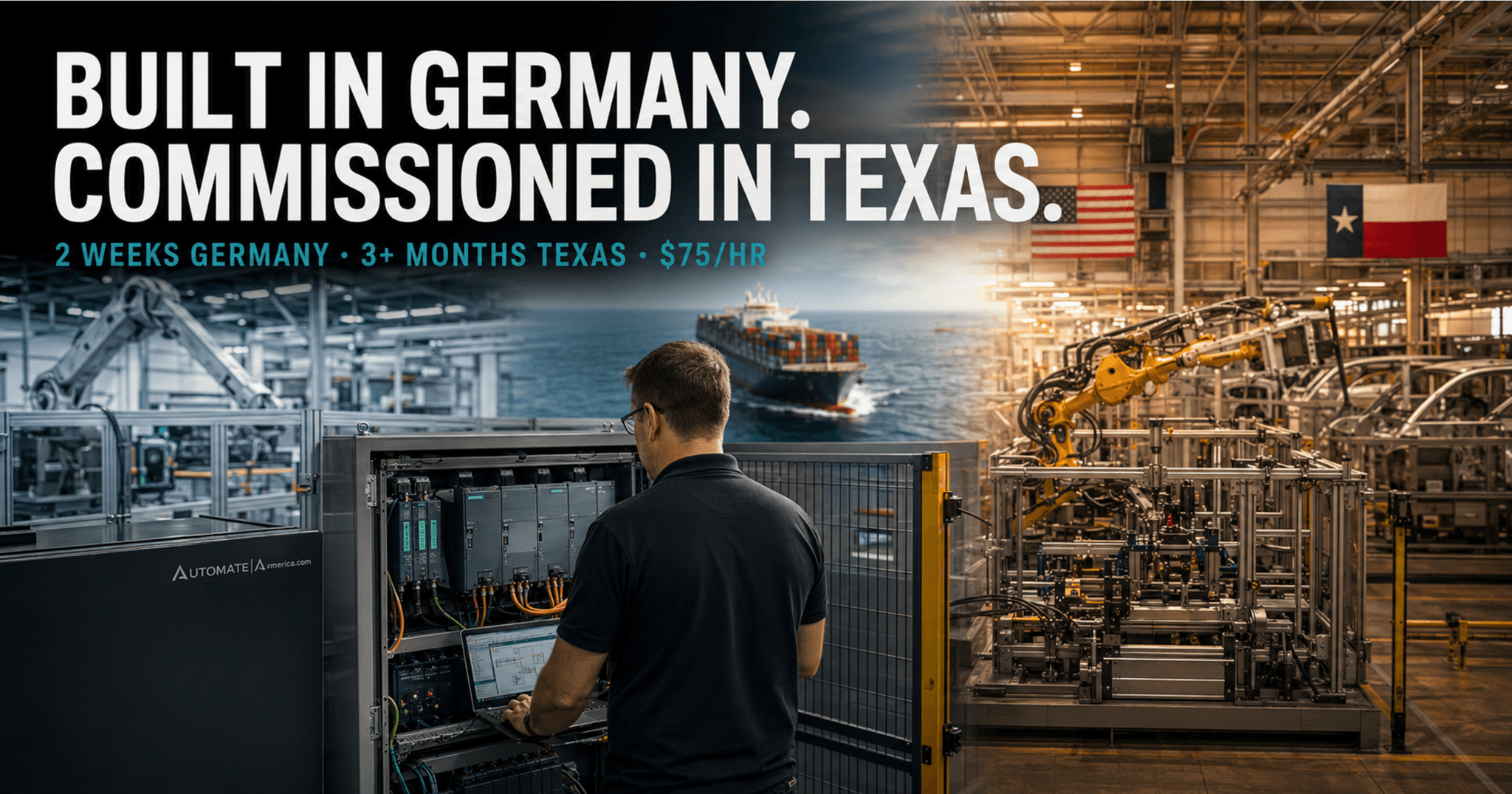
There’s one open now on Automate America, and it follows that exact arc: two weeks in Germany, then three-plus months in Texas.
The contract at a glance
An automotive automation builder needs a Siemens PLC programmer for an automotive parts manufacturing system. The work starts in Germany around June 18 with roughly two weeks of offline and online programming, hardware commissioning, and software commissioning. When the equipment transitions to Texas, the same programmer carries it through hardware and software commissioning and into production support for the remainder of the project — about three-plus months.
The stack is unmistakably Siemens:
- Siemens TIA Portal, minimum V18-19 or higher
- Siemens servo drives (S120, G150, and similar) with technology objects
- Siemens Safety
- PLC programming in SCL (Structured Control Language), FBD (Function Block Diagram), and Graph
- Keyence / MVTec HALCON 2D and 3D vision experience is an advantage
It calls for at least five years of PLC programming and hardware commissioning, at least three years in automotive (or a similar PLC software standard), English written and spoken, and a valid VISA or working permit for the USA. The rate is $75/hour, with travel and expenses paid for the international and domestic legs. It’s a day-shift schedule, planned at ten hours a day, six days a week.
Why this build looks the way it does
Cross-border automotive builds aren’t a quirk of one project. They’re the shape the industry is taking. European integrators design, assemble, and run a line through factory acceptance in their own shops — where the mechanical and controls teams are — and then ship the proven system to the US facility for installation and final commissioning. The advantage is obvious once you’ve lived it: you find and fix the hard problems on home turf, then the stateside phase is about integration and ramp, not discovery.
What’s changed is the destination. Texas has become the center of gravity for new US manufacturing. Reshoring and foreign direct investment have pulled an enormous volume of work onshore, with the state consistently leading national totals and large builds — Foxconn in Houston, Wistron in Dallas — ramping toward production. And the single hardest seat to fill on any of those projects is the controls engineer who can program, commission, and support a line. That scarcity is the reason a contract like this one exists in the form it does: the work goes where the right specialist is, not the other way around.
What Automate America actually is
Here’s where most readers get the wrong idea, so let’s clear it directly: a lot of plant managers and engineering directors assume a posting like this comes from a staffing agency advertising its own bench. That’s not what this is.
Automate America is a marketplace and an automation service company — not a competitor posting its own needs. Thousands of automation professionals are on the platform, across hundreds of occupations. Companies post contracts, jobs, and RFQs for free, and they see profiles of experienced professionals as they apply. Specialized work — a Siemens-and-Keyence automotive build that crosses an ocean — fills here precisely because the narrow group of people who can do it are already on the platform.
If you run engineering projects, this is the part worth sitting with. The tension every operations leader knows is real: you have more work than people during a build, and you know it won’t last forever, so hiring everyone you need right now means bench time and layoffs four months later. You’re the kind of leader who already sees that a three-month commissioning scope isn’t an employee role — it’s a specialist contract. That clarity is the only reason most plants stay on schedule.
How the work shows up across the floor
Think about where a programmer with this profile actually creates value, and you start to see why the scope is written the way it is.
What would have to be true for a build like this to feel routine instead of risky? Just one thing, really: the right specialist, available on the right dates, who has done both the overseas commissioning and the stateside ramp before. Name that one condition and the whole project de-risks. That condition is exactly what a marketplace of skilled professionals exists to satisfy.
On the German leg, the work is offline and online programming against the real hardware, bringing servo axes and safety architecture to life, and proving the sequence before anything ships. SCL handles the structured logic, Graph carries the sequential machine states, FBD covers the interlocks — and the Keyence or HALCON vision layer gets integrated and taught against actual parts. On the Texas leg, the same hands that wrote the code commission it on site, work through the inevitable integration surprises, and stay through production support so the line doesn’t just power on, it stays running. That continuity — same programmer, both ends — is the entire point.
The skills behind the seat
If you’re aiming at work like this, depth in the Siemens ecosystem is what separates the candidates. Structured Control Language fluency, comfort with servo technology objects, and real Siemens Safety experience are the differentiators — not nice-to-haves. Vision integration with Keyence hardware in a HALCON environment is the kind of plus that turns a strong applicant into the obvious hire.
For engineers building toward this tier, Siemens runs formal training worth knowing about:
- Siemens SITRAIN — SIMATIC and TIA Portal training, the official program covering the SIMATIC controller family and TIA Portal.
- SITRAIN — TIA Portal Programming course, which walks through programming, commissioning, and testing your own programs in the environment.
Pair formal coursework with real commissioning miles, and a build like this one becomes the contract you’re qualified for, not the one you’re reaching for.
What you actually get
Strip away the spec sheet and the offer is unusually clean. Two weeks in Germany on an automotive build, with travel and expenses covered. Then three-plus months in Texas on the same system, seeing it from bare hardware to running production. A rate of $75 an hour. And the kind of résumé line that does work for you for years — the contract that took you across the Atlantic and back on a real automotive program.
You’re allowed to want that. Wanting a project with a clear scope, a defined window, covered travel, and genuine technical weight — that’s not a luxury, that’s matching the work to the engineer.
A year from now
A year from now, this is the build someone points to as the one that changed the trajectory — the summer they spent commissioning in Germany and the fall they spent bringing a line up in Texas. It might as well be the person reading this.
And if you’ve read this far, you already know whether the stack is yours. It told you the moment you saw “TIA Portal, servo drives, Siemens Safety.” The decision was made a few paragraphs ago; the apply button is just where it lands.
If you run automation projects rather than work them, the same platform is open to you from the other side — post your contract, job, or RFQ for free and see who applies. If this Siemens contract is yours, read the full scope and apply here.
Apply / Post
- Apply — Siemens PLC Programmer, Germany → Texas: Apply on Automate America →
- Post your own opportunity (free): Post a contract free →
- Browse all hourly contracts: Hourly contracts
Follow Automate America
LinkedIn · Facebook · Instagram · X / Twitter · YouTube · TikTok
— Tony Wallace
Founder, Automate America