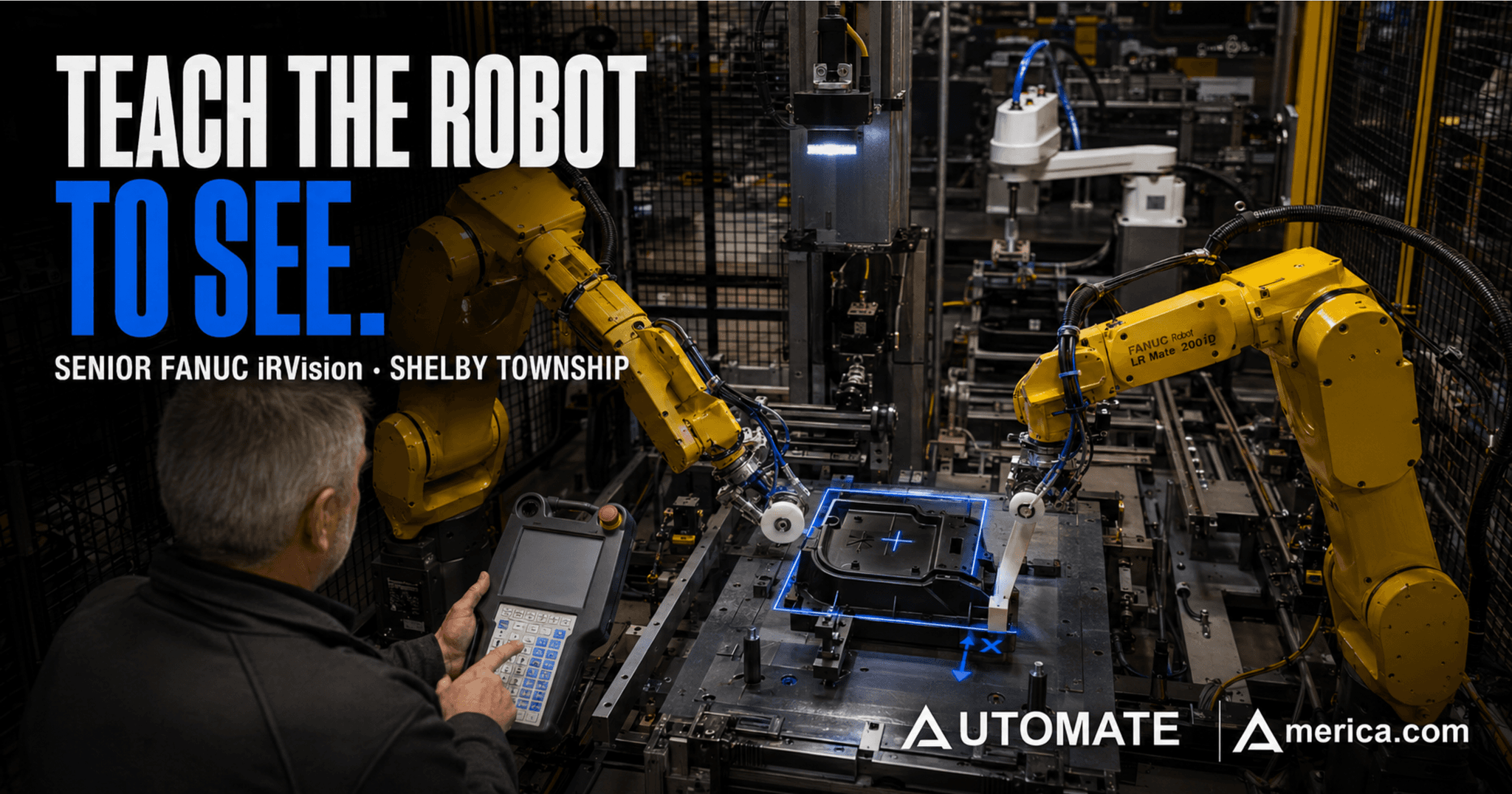
Teach the Robot to See: A Senior FANUC iRVision Contract in Shelby Township, Michigan
Quick answer: An automotive parts line in Shelby Township, Michigan needs one senior FANUC robot programmer for 2D iRVision pick-and-place work — two robots placing tape on a part at a three-second cycle, with fixed cameras sending positional offsets to the robots. Line 11 is complete and needs touch-ups; lines 12 and 13 need commissioning setup and Auto Debug support (you pull backups from line 11 and modify), with SCARA robots also in the mix. Required FANUC experience: Handling Tool, iRVision, R-30iA and R-30iB. It starts ASAP for about two weeks, days, 6:00 a.m. to 4:00 p.m., on a flexible, intermittent schedule worked around live customer production. It pays $48.00 straight time, $62.40 overtime, and $76.80 double time. You can view and apply on the contract page free, or, if you are hiring, post your own work free or search the marketplace and request a professional directly.
The biggest carmaker you've never heard of
Here is something most people never think about while they are driving: the single largest company that built the car they are sitting in is very often one whose name appears nowhere on the vehicle. It is not the badge on the hood. It is a supplier — and in North America, that supplier is frequently Magna.
Magna International is the largest automotive parts supplier in North America and the third largest in the world: on the order of 156,000 employees, more than 330 manufacturing and assembly plants across 28 countries, building bodies, chassis, seating, exteriors, electronics and more for over 800 vehicle nameplates. You have almost certainly ridden in Magna's work. You have almost certainly never seen its name, because it is not on the car. That is the tier this contract lives in — the parts everyone depends on and nobody photographs.
What "2D iRVision pick and place" actually means
A robot running a blind, taught path assumes the part is always in exactly the same place. Real parts are not. They shift, they rotate a few degrees, they arrive a little off from where they were yesterday. That is where FANUC's 2D iRVision comes in: a fixed camera looks at the part, finds its X-Y position and its rotation, and sends the robot an offset. The robot corrects itself and places accurately — every cycle, even as the part wanders.
On this cell, that has to happen twice per line, on three lines, at a three-second cycle per robot. Fixed cameras send the offsets. Line 11 already does it and just needs touch-ups. Lines 12 and 13 do not yet — they need full commissioning setup and Auto Debug support, built by pulling backups off line 11 and modifying them. SCARA robots are part of the mix. And the whole thing sits in a cell tight enough that, in the contract's own honest words, it is "hard to teach."
That last detail is not a warning label. It is the entire reason the word "senior" is in the title.
Why "senior" is doing real work in that title
Ask what it actually takes to make a vision-guided pick repeatable at three seconds, in a cell you can barely fit an arm into, on a line that is still running production around you. Not in theory — on the floor, this week, with the customer watching their own output the whole time.
The honest answer is a programmer who has done it before. Someone who knows how a fixed-camera offset drifts and how to calibrate it out. Someone who can read another engineer's line-11 backup, understand why it was built that way, and adapt it to lines 12 and 13 without introducing a new failure. Someone who can teach points cleanly in cramped quarters and Auto Debug the cell until it runs untouched. That is a short list of people, and this contract was posted precisely because the plant needs one of them, fast.
- Role: Senior Robot Programmer — 1 needed
- Location: Shelby Township, Michigan (Macomb County, metro Detroit)
- Application: Automotive parts manufacturing (Magna)
- Stack: FANUC — Handling Tool, iRVision, R-30iA, R-30iB (SCARA robots also involved)
- The work: 2D iRVision pick & place — line 11 touch-ups; lines 12 & 13 commissioning + Auto Debug (backups from 11, modified); 3-second cycle, fixed-camera offsets, tight quarters
- Start: ASAP · Duration: about 2 weeks (into early August)
- Schedule: Days, 6:00 a.m.–4:00 p.m., flexible and intermittent around live customer production
- Rate: $48.00 straight time · $62.40 overtime · $76.80 double time
A short, sharp, well-paid contract
Not every good contract is a long one. This is a two-week specialist strike: get in, commission two lines, make the vision picks repeatable, and get out — with the plant running clean behind you. The rate reflects the intensity rather than the length. Straight time is $48.00, overtime steps up to $62.40, and double time reaches $76.80. For a senior who can move fast in a hard cell, a compressed contract like this is not a lesser job than a three-month placement. It is often the better one: high skill, high rate, clean exit, on to the next.
Why Shelby Township, and why it fills here
Shelby Township sits in Macomb County, in the dense automotive-supplier belt north of Detroit — the part of Michigan where the parts of the parts get made. A contract like this concentrates here because the whole ecosystem does: the integrators, the plants, the robots, and the people who know them are all within a short drive of each other.
Automate America is a global marketplace of thousands of skilled professionals across hundreds of occupations, in every industry — industrial, commercial and residential — worldwide. A marketplace, where the company and the professional can see each other directly. It works two ways, both free: a company can post a contract, a job, or an RFQ and let professionals apply, or search the marketplace and request the exact professional it needs. Professionals can browse open hourly contracts, apply in a couple of clicks, and follow the companies whose work they want to see first. Everyone carries their own record — trusted professionals with completed contracts and customer reviews.
For the hiring side, the usual hesitations answer themselves. Is it really free to post? Yes — posting a contract, a job, or an RFQ costs nothing. Will you get buried in unqualified applicants? No — you see profiles of experienced industry professionals and you decide who to talk to. How fast does specialized work fill? It depends on the rate, the location and the dates — you see applications as they arrive. And if you need a hand, you are one message away at info@automateamerica.com.
A two-week ask for a senior FANUC vision specialist is exactly the kind of narrow, urgent, right-now need a general job board handles worst and a marketplace handles best. Robot programmer here work alongside the rest of the bench — controls engineers, maintenance technicians and manufacturing engineers — the crew that keeps a parts line producing.
You already know if it's yours
At some point in a career, you stop chasing the easy cells and start being the person they call for the hard one. If you read "3-second cycle, tight quarters, hard to teach" and felt something closer to interest than dread, you already know how this ends.
Two weeks from now, lines 12 and 13 will be placing tape clean at three seconds a cycle, and nobody watching the parts come off will have any idea how tight the teaching was — because the senior who set it up made it look easy. If that's you, the contract is right here. If it's someone you came up with, send it their way.
More open work and industry writing lives on the Automate America news and contracts hub.
Frequently asked questions
What FANUC experience is required?
Handling Tool, iRVision, and the R-30iA and R-30iB controllers, at a senior level. The work is 2D iRVision pick and place with fixed cameras sending offsets, and SCARA robots are also involved.
What exactly is the job?
Two robots placing tape on a part at a three-second cycle, across three lines. Line 11 is complete and needs touch-ups; lines 12 and 13 need commissioning setup and Auto Debug support, built from line 11's backups.
Where is it, and when does it start?
Shelby Township, Michigan (metro Detroit), for an automotive parts manufacturer. It starts ASAP and runs about two weeks, into early August.
What is the schedule and rate?
Days, 6:00 a.m. to 4:00 p.m., on a flexible, intermittent schedule worked around live production. It pays $48.00 straight time, $62.40 overtime, and $76.80 double time.
How do I apply?
View and apply free on the contract page at Automate America. You can also be requested directly by companies searching the marketplace for a programmer with your FANUC vision background.
Next steps on Automate America
- Post your work free — Set the rate you want to pay. Posting and receiving applicants cost nothing.
- Create your free profile — Your completed work, platforms and reviews in one record that customers search.
- Search open contracts — Every open contract and what it pays, updated as they post.
- Find professionals — Search thousands of professionals by skill, platform and location.
- Training and certification — Build the skills the contracts above are actually asking for.
Explore more
- Browse every open contract
- Find skilled professionals
- See the companies hiring
- Work by occupation
- Training programs
- More from the Automate America blog


✉ Email the editor · 💬 Text Automate America today: 586-770-8083
Tony Wallace, Co-Founder · Automate America · Text/Call 586-770-8083 · info@automateamerica.com