Why Aerospace Manufacturing Automation Is Experiencing Unprecedented Demand
The aerospace industry is in the middle of a production ramp-up unlike anything in its history. Boeing and Airbus together hold a combined order backlog exceeding 13,000 aircraft. Supply chain disruptions, quality control challenges, and an aging workforce have forced manufacturers to accelerate automation investments. US aerospace and defense spending on artificial intelligence and generative AI is expected to grow sharply by the end of the decade. For automation professionals skilled in CNC machining, robotic systems, composite fabrication, and quality inspection technology, aerospace manufacturing offers some of the most technically challenging and financially rewarding careers in the industry.
This is not just about assembling planes faster. Aerospace manufacturing demands precision measured in thousandths of an inch, materials that did not exist a decade ago (carbon fiber reinforced polymers, ceramic matrix composites), and quality standards that trace every fastener and rivet back to its source material batch. The automation systems used in aerospace are among the most sophisticated in any manufacturing sector, and the technicians and engineers who operate, program, and maintain them are correspondingly well-compensated.
Core Technology Areas in Aerospace Manufacturing Automation
CNC Machining remains the foundation of aerospace parts manufacturing. Five-axis CNC machining centers from Mazak, DMG Mori, and Haas produce structural components, engine parts, and landing gear assemblies from titanium, Inconel, and aluminum alloys. Aerospace CNC work demands tighter tolerances (often +/- 0.0005 inches), more exotic materials, and longer cycle times than general manufacturing. Programmers use CAM software like Mastercam, NX CAM, or CATIA to generate toolpaths that minimize tool wear while maintaining surface finish requirements. Machine operators monitor cutting parameters, perform in-process inspections, and adjust offsets to maintain tolerance throughout production runs.
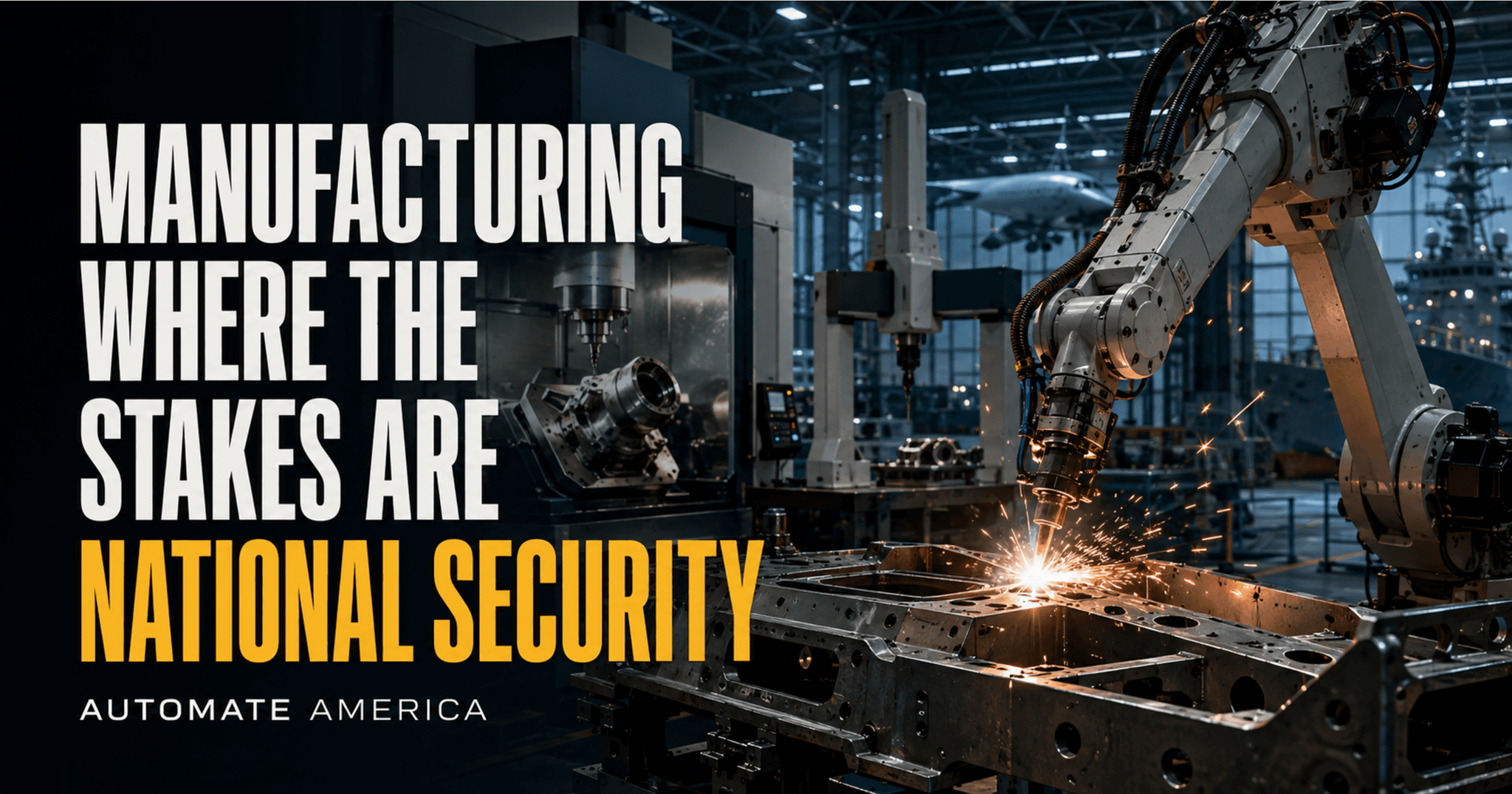
Robotic Composite Manufacturing has transformed how aircraft structures are built. Automated fiber placement (AFP) and automated tape laying (ATL) systems from manufacturers like Electroimpact, Automated Dynamics, and Fives use multi-axis robots to lay carbon fiber tape onto molds with precision that exceeds what human hands can achieve. The Boeing 787 Dreamliner fuselage is built from composite barrel sections, each laid up by AFP robots that place miles of carbon fiber tape according to precise ply schedules. Technicians who operate, program, and maintain these systems need a unique blend of robotics expertise and composite materials knowledge.
Automated Quality Inspection is expanding rapidly in aerospace. Coordinate measuring machines (CMMs), laser trackers, structured light scanners, and machine vision systems verify that parts meet dimensional specifications. Non-destructive testing (NDT) automation -- including ultrasonic inspection robots, X-ray computed tomography (CT) systems, and thermographic inspection -- detects internal defects in composite and metallic structures without damaging the part. As production rates increase, manual inspection becomes a bottleneck that automated systems are designed to eliminate.
Pay for Aerospace Automation Professionals in 2026
Entry-level aerospace machinist and manufacturing technician positions require completion of a machining or manufacturing technology program, or equivalent military training. Quality inspection technicians at the entry level gain from NDT Level I certification.
Mid-career aerospace manufacturing engineers and CNC programmers bring 4-8 years of experience, and robotic systems specialists who program and maintain AFP/ATL equipment or assembly robots carry the specialized knowledge these systems require.
Senior automation engineers and manufacturing engineering managers bring 10+ years of experience. Professionals who combine technical depth with AS9100 quality system expertise and project management skills are particularly valued. At the director level, aerospace manufacturing automation leaders work at prime contractors like Boeing, Lockheed Martin, and Northrop Grumman.
Top Employers in Aerospace Manufacturing Automation
Boeing is the largest aerospace manufacturer in the United States, with production facilities in Washington (Everett, Renton), South Carolina (North Charleston), Missouri (St. Louis), and Arizona (Mesa). Boeing hires extensively for CNC machining, composite fabrication, robotic assembly, and quality inspection roles. Lockheed Martin operates advanced manufacturing facilities in Texas (Fort Worth -- F-35 production), Georgia (Marietta -- C-130), and California, hiring automation professionals for both military aircraft and space systems production.
Northrop Grumman manufactures the B-21 Raider stealth bomber and various unmanned systems, with significant automation investment at facilities in California and Florida. RTX (Raytheon Technologies), through its Collins Aerospace and Pratt and Whitney divisions, hires for engine manufacturing automation and avionics production. GE Aerospace is expanding its manufacturing workforce to meet record engine orders, with major facilities in Ohio and North Carolina.
Spirit AeroSystems, L3Harris Technologies, Textron Aviation, and General Dynamics round out the major employers. Tier 1 and Tier 2 suppliers -- companies like Triumph Group, Heico, and TransDigm -- also hire automation professionals and often offer faster career advancement than prime contractors due to smaller organizational structures.
Essential Certifications for Aerospace Manufacturing
AS9100 Internal Auditor certification validates understanding of the aerospace quality management system standard that governs all certified aerospace manufacturers. The standard is transitioning to IA9100, with a 2-3 year migration window expected to begin in late 2026. Professionals who understand both standards are highly valued during this transition period. Quality system knowledge is not optional in aerospace -- it is woven into every manufacturing process.
NIMS (National Institute for Metalworking Skills) certifications validate CNC machining competence through practical performance assessments. NIMS credentials are recognized across the aerospace supply chain and provide a standardized measure of machining capability that employers trust. Six Sigma Green or Black Belt certification demonstrates process improvement skills that aerospace manufacturers require for continuous improvement programs and waste reduction.
ASNT NDT Level I and II certifications (American Society for Nondestructive Testing) are required for quality inspection professionals working with ultrasonic, radiographic, magnetic particle, or liquid penetrant testing methods. IPC J-STD-001 (Requirements for Soldered Electrical and Electronic Assemblies) and IPC-A-610 (Acceptability of Electronic Assemblies) certifications are essential for professionals working in avionics and electronic systems manufacturing.
Geographic Hotspots for Aerospace Manufacturing Jobs
The Puget Sound Region (Washington state) is home to Boeing's largest commercial aircraft production facilities. Everett houses the world's largest building by volume, where 747, 767, 777, and 787 aircraft are assembled. Wichita, Kansas has long been known as the "Air Capital of the World," with Spirit AeroSystems, Textron Aviation, and Bombardier Learjet operations. The Dallas-Fort Worth Metroplex anchors military aerospace manufacturing, with Lockheed Martin's F-35 production line and Bell's tiltrotor manufacturing.
Southern California (Los Angeles, Palmdale, San Diego) hosts Northrop Grumman's B-21 program, Raytheon missile systems, and numerous Tier 1 suppliers. Connecticut is the center of jet engine manufacturing, with Pratt and Whitney and Collins Aerospace facilities. Huntsville, Alabama has become a major aerospace hub with Boeing, Northrop Grumman, and Lockheed Martin facilities supporting NASA and defense programs.
Career Progression in Aerospace Manufacturing Automation
Entry-level positions include CNC Machine Operator, Manufacturing Technician, or Quality Inspector (years 0-3). Progression to CNC Programmer, Robotics Technician, or NDT Technician Level II (3-6 years) involves developing programming and diagnostic skills. Manufacturing Engineer or Automation Engineer roles (6-10 years) involve process design, equipment specification, and production system optimization. Senior Engineer or Manufacturing Manager positions (10+ years) oversee production lines, capital equipment programs, and technology roadmaps.
Getting Started in Aerospace Manufacturing Automation
Two-year programs in CNC machining technology, manufacturing engineering technology, or mechatronics provide the technical foundation. NIMS certification adds immediate credibility with aerospace employers. Community colleges near major aerospace facilities often have partnerships with local manufacturers that include internship and apprenticeship opportunities. Military veterans with aviation maintenance (A&P), ordnance, or precision manufacturing backgrounds are highly recruited by aerospace employers.
The aerospace manufacturing sector's combination of technical challenge, job security (defense contracts provide multi-year stability), and strong compensation makes it one of the most attractive career paths in industrial automation.
Ready to connect with aerospace manufacturers hiring automation professionals? Create your free profile on Automate America and get matched with prime contractors, Tier 1 suppliers, and defense companies actively seeking CNC programmers, robotics technicians, and manufacturing engineers. The platform connects you directly with employers who value precision, quality, and technical excellence.
FOLLOW AUTOMATE AMERICA


✉ Email the editor·💬 Text Automate America: 586-770-8083
Tony Wallace, Co-Founder · Automate America
Text first: 586-770-8083 or call·info@automateamerica.com